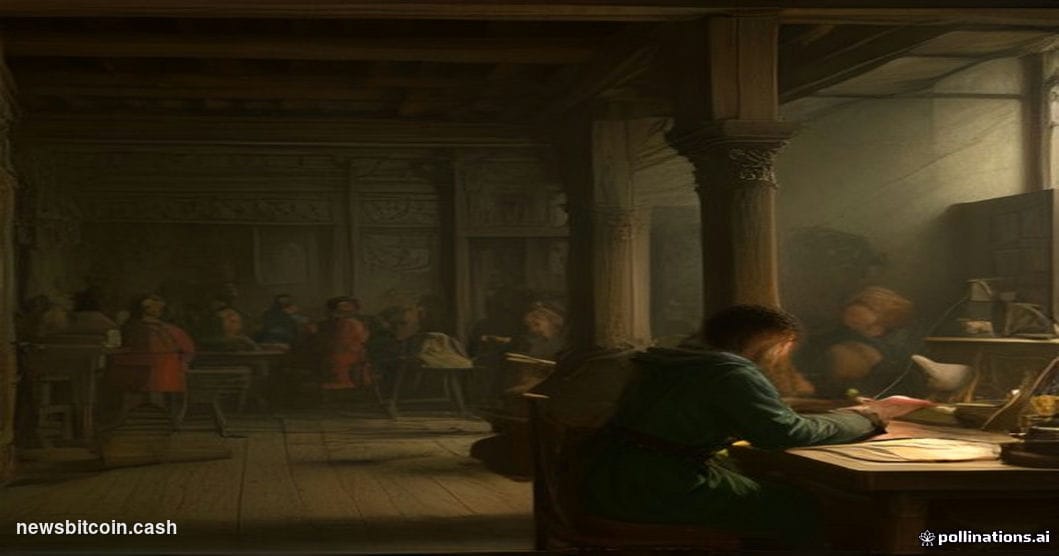
There is something deeply deliberate about reaching back five centuries to make a point about money. Lucho Poletti's art series Ten Decrees: Old Masters, New Money does exactly that — redrawing the dense, morally charged tableaux of Hieronymus Bosch and Pieter Bruegel the Elder around the fault lines of monetary history, most centrally the moment in 1971 when Richard Nixon severed the dollar's last formal tie to gold. That Poletti would choose these particular painters — artists who specialized in depicting collective human folly, grotesque consequence, and the chaotic aftermath of bad governance — tells you almost everything about the argument he is making.
The Weight of 1971
Nixon's 1971 decree — the unilateral closure of the gold window, which ended the Bretton Woods system and untethered the global monetary order from any hard commodity anchor — has become one of the foundational reference points in Bitcoin culture. The anniversary is marked annually in the community; the phrase "Nixon shock" carries totemic weight. For Poletti, it is apparently not just a date but a visual and conceptual organizing principle, a decree among decrees, one of ten moments or edicts that his series frames as pivot points in the long human story of money and power. The decision to root contemporary monetary critique in this specific historical rupture gives the work analytical grounding that separates it from generic crypto boosterism. This was not simply bad policy — it was a structural transformation of how value itself was defined and controlled, one whose consequences compound through every decade that follows.
Why Bosch? Why Bruegel?
The choice of the Old Masters here is not arbitrary nostalgia. Bosch and Bruegel were painters preoccupied with systems — with the way institutional failure cascades into individual suffering, with crowds as agents of both meaning and madness. Bosch's hellscapes are populated by figures trapped inside the mechanisms of their own moral failure. Bruegel's village scenes catalogue the full texture of economic and social life in Flemish society, where peasants, merchants, and the powerful coexist in a single frame, often oblivious to the catastrophe unfolding at the edges of the canvas. These are painters of consequence — of what happens after the decree has been issued and the crowd must live inside its effects.
For an artist working in the Bitcoin space, this makes them almost natural allies. Bitcoin Magazine's coverage of Poletti's work, written by Dennis Koch, raises the question directly: why does bitcoin art keep returning to the Old Masters? The answer embedded in Poletti's project seems to be that the Old Masters already solved the compositional problem of depicting systemic injustice at scale. Their visual language — dense with allegorical figures, layered with irony, built to be read slowly across a large surface — is suited to a subject matter that is itself dense, layered, and resistant to quick summary.
Art as Monetary Archaeology
What Poletti appears to be doing with Ten Decrees is less illustration than archaeological reconstruction. He is not simply decorating Bitcoin talking points with Renaissance imagery. He is using the formal conventions of a tradition that understood power, corruption, and collective delusion to excavate the specific history of monetary decree — the moments when rulers, governments, and central authorities made unilateral decisions that reshaped the material conditions of entire populations. The ten decrees of the title suggest a structured argument: a sequence of interventions, each one building on the last, each one moving the world further from any anchor in honest, neutral money.
This framing positions Bitcoin not as a technological novelty but as a response to a very long pattern. The Old Masters documented what decree-driven economic orders looked like at ground level — the peasant who cannot pay, the merchant who cannot trust, the official who extracts. Poletti's project implies that the digital monetary revolution is not a break from history but a continuation of a fight that Bruegel's subjects would have recognized immediately.
What This Means for Bitcoin Culture
The deeper significance of work like Ten Decrees is what it signals about the maturation of Bitcoin as a cultural phenomenon. Early crypto art tended toward the iconographic: rockets, lamborghinis, laser eyes. The turn toward Bosch and Bruegel — toward moral weight, historical depth, and compositional seriousness — suggests that a subset of artists in this space are now attempting something more ambitious: a genuine visual canon that can hold the philosophical stakes of sound money alongside centuries of art history. Poletti's willingness to sit with the difficulty of that project, to redraw masters rather than riff on memes, marks a meaningful shift in register.
Whether Ten Decrees succeeds as art in the fullest sense is a question that images alone will answer. But as a statement of intent — as evidence that the Bitcoin cultural conversation is expanding its vocabulary — it represents exactly the kind of serious engagement the space has long needed. The Old Masters painted the world as it was. Poletti is asking what they would paint now.
Written by the editorial team — independent journalism powered by Bitcoin News.