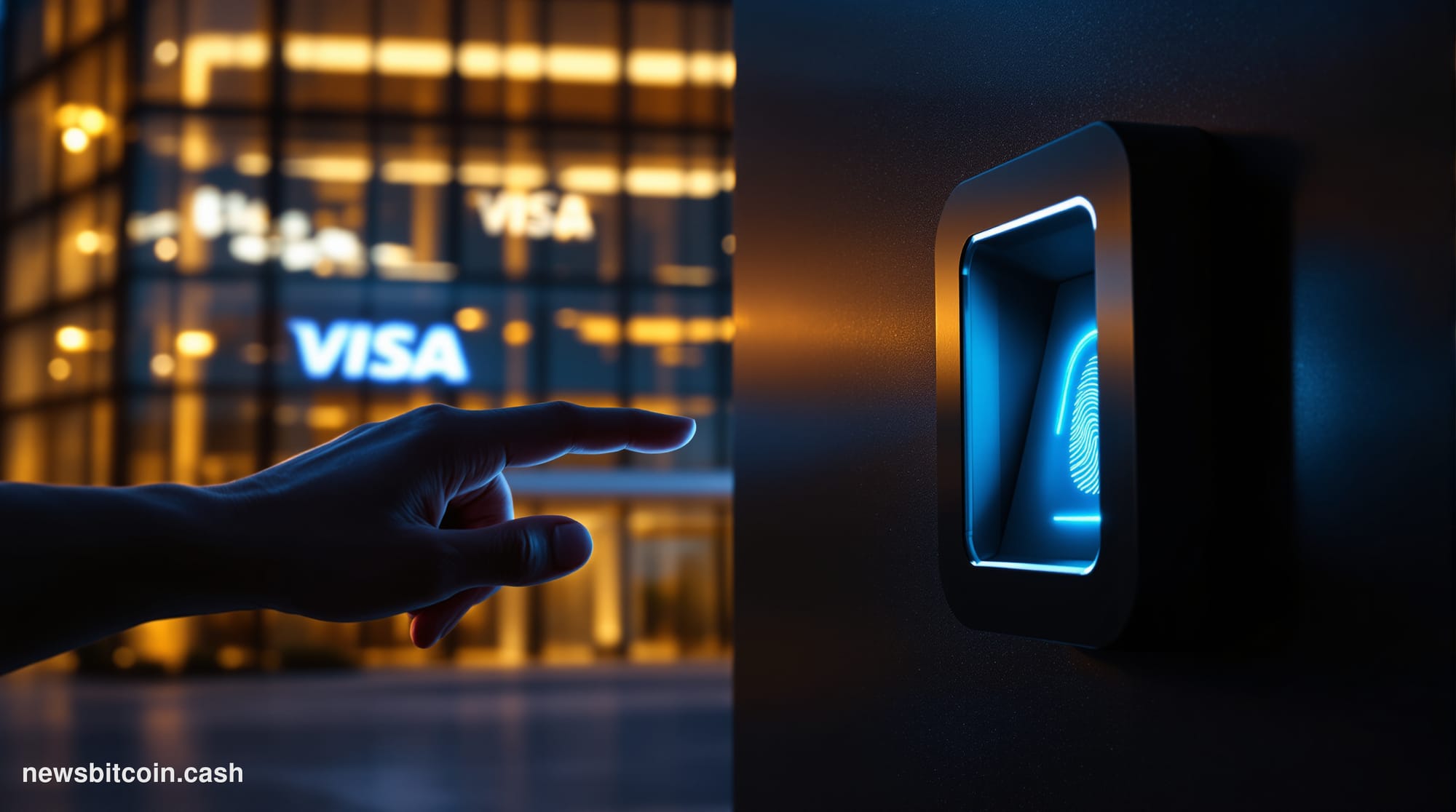
When Visa agrees to pay up to $2.4 billion in cash for a single fraud-prevention company, it is not making a defensive move. It is placing a strategic claim on what has quietly become the most contested territory in financial technology: behavioral biometrics and real-time identity verification. The announced acquisition of BioCatch is one of the largest fraud-tech deals in recent memory, and its scale tells you something important about where the payments industry believes the next decade of infrastructure investment is headed.
Behavioral Biometrics Meets Global Payments Scale
BioCatch is not a conventional cybersecurity vendor selling firewall rules and threat signatures. The company built its business around behavioral biometrics — the analysis of how users physically interact with devices, measuring patterns in mouse movements, typing cadence, scrolling behavior, and touch pressure to distinguish legitimate customers from fraudsters in real time. This category of technology sits upstream of traditional fraud detection, operating continuously and silently across a session rather than triggering only at the moment of a transaction. For a network processing the volume of transactions that Visa handles daily, embedding that capability at the infrastructure layer is a fundamentally different proposition than licensing it as a third-party add-on.
The deal, structured as an all-cash transaction of up to $2.4 billion, reflects both the premium placed on proprietary behavioral data assets and the urgency Visa clearly feels about owning rather than renting that capability. The "up to" framing suggests the final payout may be tied to performance milestones or earnout provisions, a structure increasingly common in high-value fintech acquisitions where the acquirer wants to retain the founding team and ensure integration targets are met. Either way, the floor on this deal is enormous, and the ceiling signals that Visa is prepared to pay a significant premium for what BioCatch has built.
Why Now, and Why This Much
The timing is not accidental. Fraud losses across the global payments ecosystem have accelerated in direct proportion to the digitization of commerce and the proliferation of instant-payment rails. Faster payments mean faster fraud, and the traditional rule-based systems that worked adequately in a slower environment are increasingly inadequate against sophisticated social engineering, account takeover schemes, and synthetic identity fraud. The rise of generative artificial intelligence has compounded this problem dramatically — deepfake audio used in voice authentication bypass attacks, AI-generated phishing at industrial scale, and automated credential-stuffing campaigns have all raised the cost of fraud detection for every institution that touches payment data.
Visa operates at the center of that problem. Its network connects thousands of issuing and acquiring banks, merchants, and increasingly, crypto-adjacent financial platforms and digital asset exchanges. Any degradation in its fraud detection capability does not affect Visa alone — it propagates across the entire ecosystem of institutions that rely on Visa's infrastructure. Acquiring BioCatch and integrating its behavioral biometric layer directly into Visa's transaction processing architecture would allow Visa to offer fraud protection as a native network service rather than an optional add-on, strengthening the value proposition of the network for every participant.
The Competitive Dimension
Visa's move also has to be read in competitive context. Mastercard has invested heavily in cybersecurity and identity infrastructure through acquisitions including RiskRecon and Ekata, and has positioned fraud prevention as a core component of its services business. Meanwhile, large technology companies with payment ambitions — Apple, Google, and Amazon — have each built proprietary fraud and identity stacks that reduce their dependence on card network fraud tooling. For Visa, owning a best-in-class behavioral biometrics platform is partly about improving its own security posture, and partly about ensuring that its fraud-prevention services remain compelling enough that issuers and merchants have a reason to deepen their Visa relationship rather than route around it.
For the broader fintech and digital assets industry, the $2.4 billion price tag attached to a fraud-prevention specialist is a significant data point. It validates the commercial thesis that the companies building the detection and verification infrastructure underneath financial transactions are worth as much — or more — than the platforms running on top of them. Crypto exchanges, decentralized finance protocols, and blockchain-based payment networks all face versions of the same fraud and identity challenges that BioCatch was built to solve. The methods differ, but the underlying problem — distinguishing legitimate user behavior from malicious actors in real time — is identical. Expect Visa's acquisition to accelerate investment and consolidation across the broader behavioral security space as competitors race to close the capability gap.
What This Means
A $2.4 billion all-cash acquisition by the world's largest payment network for a behavioral biometrics company is a statement of strategic intent, not just a product extension. It signals that fraud prevention has graduated from a compliance cost center to a core competitive differentiator — and that the networks willing to pay the most for that capability will shape the architecture of digital payments for years to come. For anyone building or investing in financial infrastructure, the lesson is clear: identity and behavioral security are no longer features. They are the product.
Written by the editorial team — independent journalism powered by Bitcoin News.