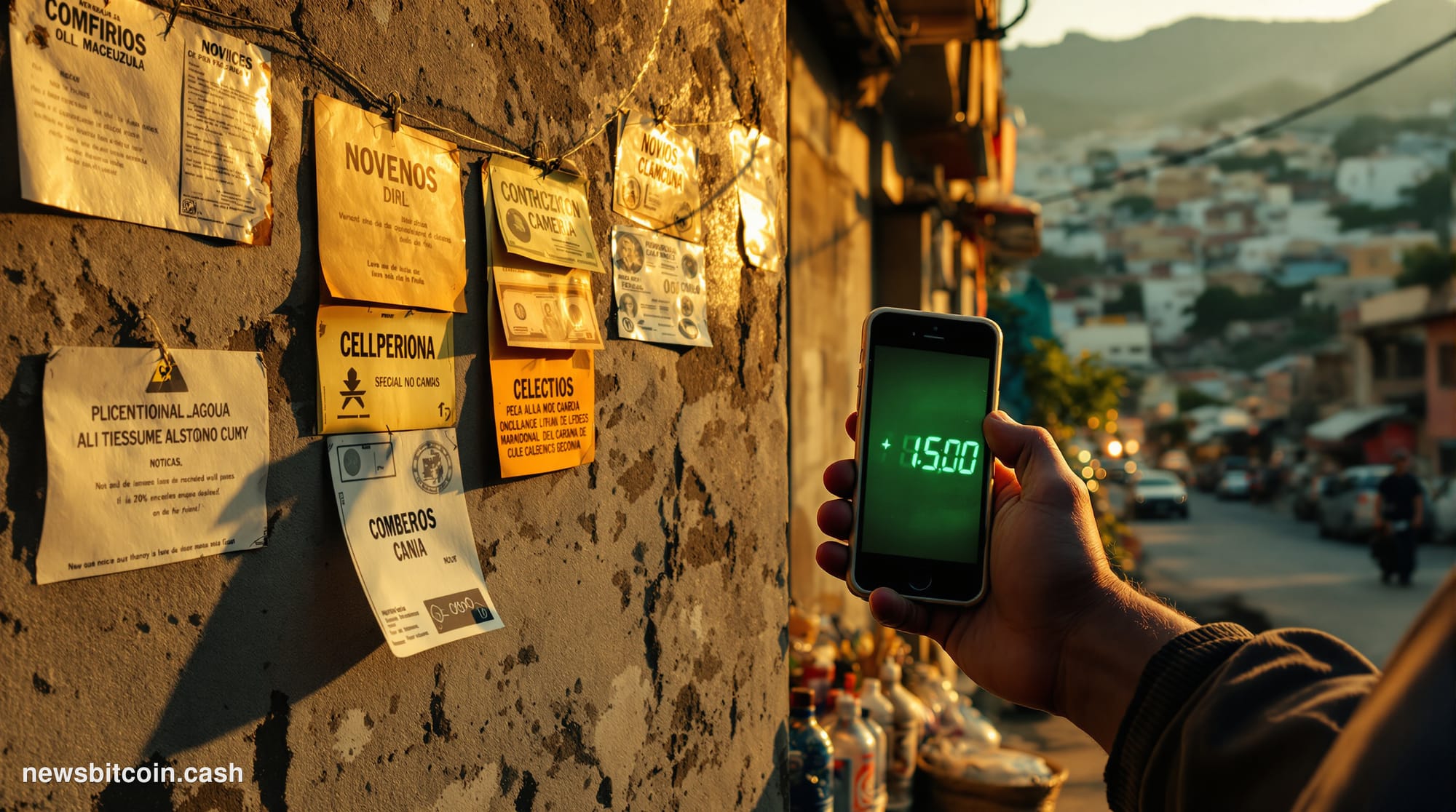
When the United States effectively locked Venezuela out of the dollar-based financial system through sanctions, the expectation in Washington was presumably that economic pressure would follow. What nobody fully anticipated was that ordinary Venezuelans — merchants, freelancers, families sending remittances — would find a workaround denominated in the very currency they were being denied. They found it in stablecoins: digital dollars that move on public blockchains, indifferent to the geopolitical calculations of correspondent banks.
Venezuela's experience is not a fringe anecdote. It is arguably the most consequential real-world stress test that dollar-pegged digital assets have ever undergone. A country banned from the dollar system has, in practice, re-dollarized through digital rails — and it has done so organically, without a central bank directive, without an International Monetary Fund program, and without the blessing of the Treasury Department that sanctioned it in the first place.
Sanctions as an Accelerant
The mechanics are straightforward even if the implications are profound. U.S. sanctions on Venezuela severed the country's access to traditional correspondent banking, making it extraordinarily difficult to hold, transfer, or receive U.S. dollars through any conventional financial institution. For a population already battered by hyperinflation that had rendered the bolívar nearly worthless, the dollar was the only reliable store of value — and sanctions made it structurally inaccessible through formal channels.
Into that vacuum stepped stablecoins. Tether's USDT in particular became a transactional layer that the sanctions architecture was never designed to address. Unlike a wire transfer routed through a New York correspondent bank, a USDT transaction on a public blockchain does not require the counterparty to be compliant with U.S. financial regulations to execute. The dollar amount settles. The compliance question becomes secondary to the economic reality.
The Proof-of-Concept Argument
Critics of stablecoins have long argued that digital dollars are a solution in search of a problem — that in developed markets with functioning banking infrastructure, the marginal utility of a blockchain-based dollar is vanishingly small. Venezuela demolishes that argument with uncomfortable directness. Here is a population of millions facing genuine, structural exclusion from dollar-denominated finance, and stablecoins have functioned as the connective tissue that filled the gap.
This is exactly what stablecoin proponents have always claimed the technology could do. The difference is that Venezuela is not a hypothetical. It is a live demonstration, run under adversarial conditions, at national scale. And by most accounts, the technology has held up. Peer-to-peer transfers move. Commerce gets priced in digital dollars. Remittances arrive without touching a correspondent bank. The infrastructure performs.
What Venezuela reveals, more than anything, is that the demand for dollar-denominated financial services is genuinely global and genuinely inelastic — and that stablecoins are capable of satisfying that demand even where the traditional system refuses to. This is not a marginal improvement on existing finance. It is a parallel system operating in the gaps that sanctions, capital controls, and banking exclusion create.
The Regulatory Tension This Creates
For regulators in Washington, Caracas presents a dilemma that is not easily resolved. The sanctions regime targeting Venezuela was designed to apply economic pressure through dollar denial. Stablecoins have partially neutralized that mechanism. That is not a comfortable fact for policymakers who view financial exclusion as a legitimate instrument of foreign policy.
The legislative response in the United States has been to push for tighter stablecoin regulation — frameworks that would compel issuers like Tether and Circle to screen transactions and enforce sanctions compliance at the protocol level. Whether that is technically feasible at scale, or whether it would simply push activity toward less compliant alternatives, remains an open question. What is not open is the policy motivation: the Venezuela case has made sanctions evasion via stablecoin a concrete, documented concern rather than a theoretical one.
But the regulatory challenge cuts both ways. Cracking down on stablecoin access does not restore the bolívar. It does not build functioning banking infrastructure in Caracas. It does not address the underlying demand that made stablecoins attractive in the first place. Heavy-handed restrictions risk imposing the greatest costs on ordinary Venezuelans already navigating extreme economic hardship — people who adopted digital dollars out of necessity, not ideology.
What This Means for the Broader Stablecoin Narrative
Venezuela's experiment with digital dollars is a signal that deserves more analytical weight than it typically receives in stablecoin policy debates. The country has functioned, however imperfectly, as a proving ground for the core thesis: that stablecoins can serve as accessible, censorship-resistant dollar infrastructure for populations that the traditional financial system excludes. The proof of concept is not theoretical anymore. It has been running in real time, under real constraints, for years.
For the digital assets industry, Venezuela is both a validation and a warning. The technology works. The demand is real. But operating at the intersection of sanctions, foreign policy, and monetary sovereignty is not a comfortable position for any issuer to occupy — and the scrutiny that comes with being a demonstrated sanctions workaround is only going to intensify as the technology scales.
Written by the editorial team — independent journalism powered by Bitcoin News.