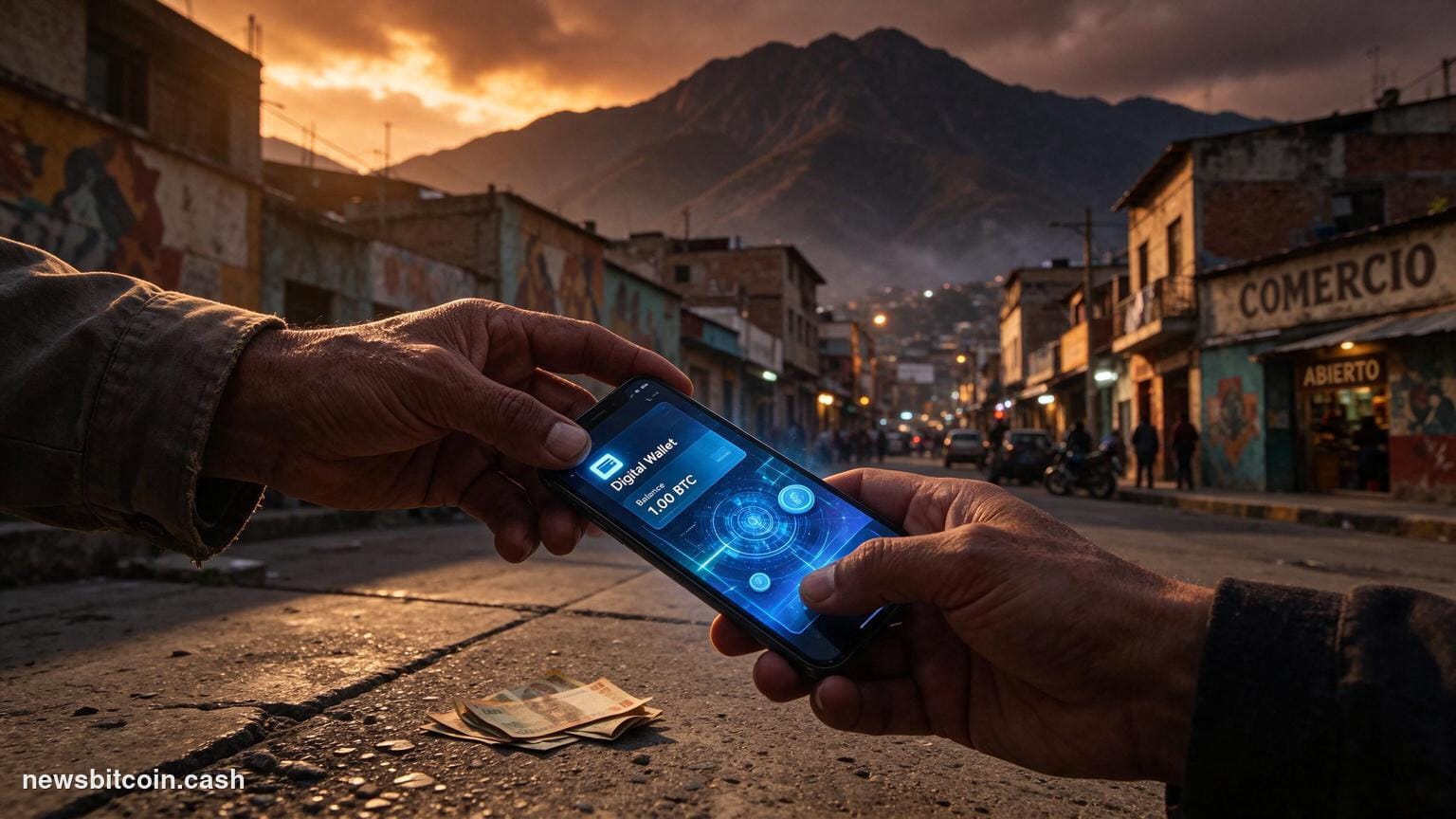
There is no cleaner stress test for a financial technology than desperation. When people have no alternative, when the official rails are locked, gated, or sanctioned out of existence, what they reach for instead tells you everything about what actually works. In Venezuela, millions of people cut off from the conventional U.S. dollar system by a sweeping architecture of American sanctions have reached for stablecoins — and in doing so, have produced the most honest proof of concept the digital dollar has ever had.
This is not a fintech pilot program. It is not a venture-backed experiment in a friendly regulatory jurisdiction. Venezuela's adoption of dollar-pegged digital assets is a live, population-scale demonstration of what stablecoins are actually for: providing access to stable, dollar-denominated value when every institutional door has been slammed shut. The country has been banned from the traditional dollar financial system, yet its citizens and businesses are transacting in digital dollars anyway. That is the story the crypto industry has been trying to tell for years, and Venezuela is living it in real time.
The Sanctions Architecture and Its Unintended Consequence
American sanctions on Venezuela were designed to constrain the Maduro government's access to hard currency, cutting off the country from correspondent banking, dollar clearing, and the broader scaffolding of the SWIFT-linked financial system. The intent was economic pressure at the sovereign level. The effect at the street level has been a population urgently seeking any mechanism to store and transfer value that doesn't collapse overnight the way the bolívar repeatedly has.
Into that vacuum came stablecoins — primarily Tether's USDT and, to a lesser extent, Circle's USDC — running on blockchains that do not require a correspondent bank in New York, do not need a licensed foreign exchange desk, and do not answer to the Office of Foreign Assets Control in the way that traditional financial intermediaries must. A Venezuelan merchant, a freelancer being paid by a foreign client, a family receiving remittances from relatives abroad — all of them have discovered that the blockchain doesn't check a sanctions list before settling a transaction.
The irony is sharp. A policy instrument designed to isolate Venezuela from dollar liquidity has instead accelerated the country's adoption of a dollar substitute that operates entirely outside the jurisdiction of U.S. financial regulators. Sanctions pushed Venezuela not away from the dollar but toward a version of it that is structurally harder to sanction.
What "Proof of Concept" Actually Means Here
The crypto industry has long argued that stablecoins democratize access to the dollar — that they allow anyone with a smartphone and an internet connection to hold and move dollar-equivalent value regardless of where they live or what their government has done. Venezuela is the case study that makes that argument concrete rather than theoretical.
For years, critics of stablecoins have pointed to their use in speculative trading as evidence that the technology serves little broader social purpose — that USDT is merely a device for cycling in and out of volatile crypto positions on Binance or other exchanges. Venezuela disrupts that narrative decisively. Here, stablecoins are functioning as savings accounts for people whose national currency has been destroyed by hyperinflation, as payment rails for cross-border commerce that conventional banks will not touch, and as a remittance channel that bypasses wire transfer fees and compliance friction.
That is not speculation about future use cases. It is happening now, at scale, in conditions of genuine economic duress. The fact that it works — that families are receiving value, that merchants are pricing goods, that contracts are being settled — is the proof of concept that no white paper could ever fully provide.
The Harder Questions This Raises
None of this is without complication. The same properties that make stablecoins useful to ordinary Venezuelans — their resistance to intermediary control, their borderless settlement, their pseudonymity — also make them useful to the sanctioned government entities those sanctions were designed to target. Regulators in Washington are acutely aware that the financial pressure they seek to apply at the sovereign level is being partially relieved at the protocol level, and that tension is not going away.
Tether, as the dominant stablecoin issuer, has demonstrated a willingness to freeze addresses flagged by law enforcement, which creates a partial compliance layer. But blockchain networks themselves remain neutral infrastructure, and the gap between what a stablecoin issuer can freeze and what actually flows across public chains is wide enough to drive significant volume through.
For policymakers crafting the next generation of stablecoin regulation — through frameworks like the United States' proposed federal stablecoin legislation or the European Union's Markets in Crypto-Assets, or MiCA, framework — Venezuela is an uncomfortable data point. It shows that stablecoins work precisely because they are hard to control. That utility and that resistance to control are not separable features. They are the same feature.
What This Means for the Industry
For the stablecoin sector, Venezuela is both validation and warning. It is validation that the core value proposition — permissionless, borderless, dollar-denominated settlement — is real and fills genuine human need. It is a warning that this same proposition puts the technology in direct tension with the geopolitical ambitions of the government whose currency it mimics. The dollar's global dominance has always rested partly on the United States' ability to weaponize access to it. Stablecoins quietly erode that weapon while simultaneously spreading dollar influence in ways no Federal Reserve policy could achieve organically.
What Venezuela demonstrates, ultimately, is that stablecoins are infrastructure — not an asset class, not a speculative vehicle, not a niche tool for crypto-native traders. They are pipes. And pipes that deliver something people desperately need tend to get used, whether or not the authorities approve. That is the most important thing the industry has learned from Caracas, and it will shape the regulatory and competitive battles of the years ahead.
Written by the editorial team — independent journalism powered by Bitcoin News.