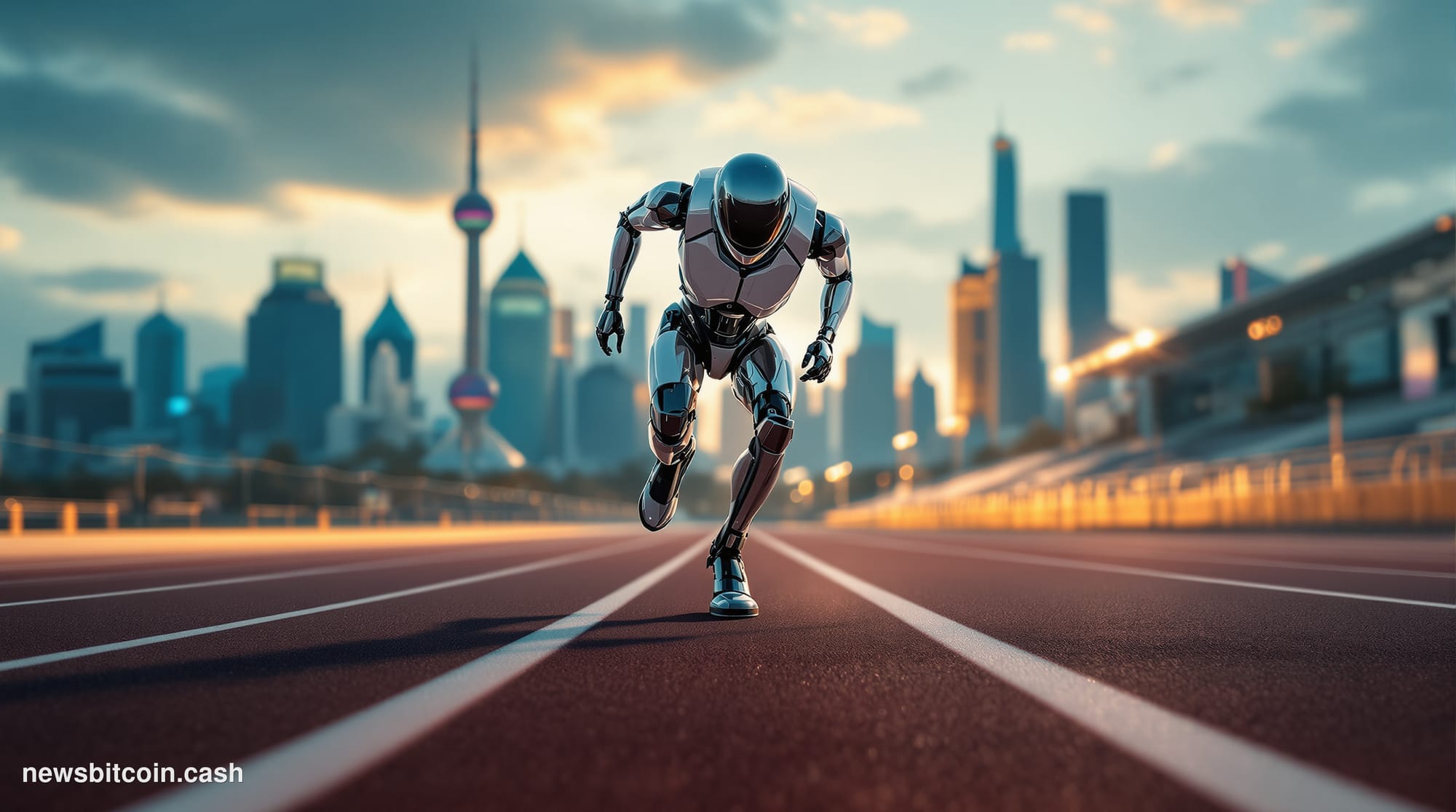
Days before its shares were set to begin trading on the Shanghai Stock Exchange at a valuation of $9 billion, Chinese robotics company Unitree did something no marketing campaign could have scripted better: it let one of its machines literally outrun the fastest human being in recorded history. The Superman robot clocked 12.66 meters per second — a speed that surpasses the peak velocity Usain Bolt ever reached during competition — and the timing was anything but accidental.
Bolt's world record sprint remains the gold standard of human locomotion, a benchmark so well-known it has become shorthand for the outer edge of biological speed. For Unitree to field a bipedal robot that exceeds that benchmark, even momentarily, signals a genuine engineering inflection point — not a publicity stunt dressed up in technical language. The 12.66 m/s figure is a hard, measurable result that positions the Superman robot among the fastest legged machines ever demonstrated publicly by any manufacturer, East or West.
The IPO Context Changes Everything
Unitree's $9 billion Shanghai IPO is not simply a fundraising event — it is a statement about where China's robotics sector believes it stands relative to global competition. Timing the Superman speed record to land in the days immediately preceding the trading debut is the kind of narrative engineering that investment bankers dream about. Whether deliberate or serendipitous, the sequence of events — record-breaking robot, then IPO — gives prospective shareholders a concrete data point to anchor expectations rather than a slide deck full of projections.
The robotics industry has long struggled with the gap between laboratory demonstrations and real-world commercial viability. Speed benchmarks matter precisely because they are unambiguous: either the machine runs faster than Bolt or it does not. Unitree's Superman clears that bar. For institutional investors evaluating the IPO, a verifiable physical performance record carries more weight than vague claims about artificial intelligence integration or manufacturing scalability — it answers the question of whether the underlying hardware engineering is genuinely competitive.
Why This Matters for the Broader Digital Asset Ecosystem
Readers focused on crypto and digital assets might reasonably ask why a Chinese robotics IPO belongs in their analytical frame. The answer lies in where capital and infrastructure are converging. Autonomous robots, artificial intelligence compute layers, and decentralized networks are increasingly sharing the same investor base, the same chip supply chains, and increasingly, the same tokenization conversations. Several blockchain infrastructure projects have already begun exploring on-chain coordination layers for robotic fleets — using smart contracts to manage task assignment, payment settlement, and data provenance for machine-generated outputs.
A Unitree trading at a $9 billion valuation on the Shanghai exchange adds institutional weight to that convergence thesis. When a robotics company of this scale goes public, it pulls venture capital, sovereign wealth attention, and corporate partnership discussions into a tighter orbit around the question of how physical automation and digital infrastructure interlock. The companies building that interlocking layer — whether through tokenized compute markets, machine-to-machine payment rails, or on-chain sensor data markets — have a stronger pitch the moment robotics firms like Unitree demonstrate that the hardware is categorically advancing.
The Competitive Signal
Boston Dynamics, Agility Robotics, Figure, and a growing roster of well-funded Western competitors have dominated the English-language conversation about humanoid robotics for the better part of a decade. Unitree's Superman record, achieved publicly and pegged to a universally understood human performance ceiling, is a deliberate insertion into that conversation. A $9 billion IPO valuation on a major exchange gives Unitree the balance sheet to accelerate hardware iteration cycles, expand manufacturing capacity, and pursue the kind of global partnership agreements that have so far been more accessible to its American counterparts.
The speed record is a single data point, not a complete picture of commercial readiness. Sustained operational reliability, energy consumption per kilometer, payload capacity, and cost-per-unit at scale all matter enormously for real-world deployment — and Unitree has not yet published comprehensive public data across all those dimensions. But a machine running at 12.66 m/s on two legs is a proof of physical capability that compresses the skepticism gap considerably. For a company heading into its IPO trading debut, that compression is worth more than almost any other headline it could generate.
What this means, practically, is that the robotics sector now has a publicly traded Chinese benchmark at $9 billion against which every subsequent funding round, acquisition, and technology partnership in the space will be measured. The Superman's sprint was brief. Its implications for how capital flows into physical AI infrastructure — and the digital rails being built around it — will play out over a considerably longer distance.
Written by the editorial team — independent journalism powered by Bitcoin News.