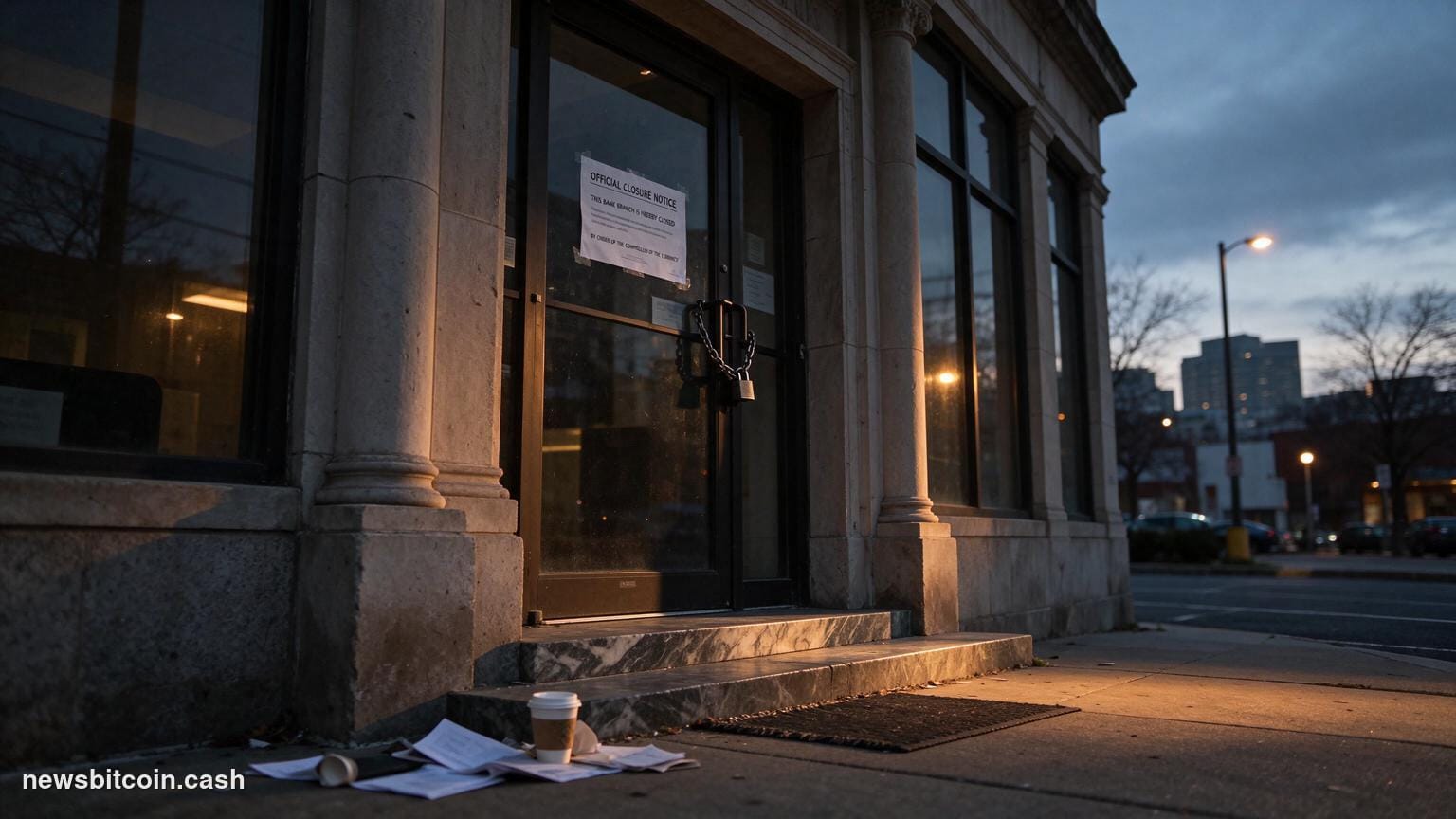
The United States banking system has absorbed another significant blow. Regulators shuttered United Fidelity Bank in what marks the largest American bank failure since 2024, with the Federal Deposit Insurance Corporation (FDIC) projecting the collapse will cost its deposit insurance fund an estimated $1.83 billion. The failure is a stark reminder that the fault lines running beneath the conventional financial system have not closed — and that the institutional vulnerabilities which crypto advocates have long argued make decentralized alternatives necessary are still very much present.
Bank failures in the United States had quieted considerably following the turbulent collapse of several regional lenders in 2023, most notably Silicon Valley Bank and Signature Bank. That episode shook confidence in mid-sized institutions and prompted a wave of regulatory scrutiny and deposit flight. The years that followed brought a measure of relative calm, making United Fidelity's closure all the more jarring — a sudden reminder that the scaffolding of traditional finance can give way without warning, even years after a supposed stabilization period.
The scale of the FDIC's projected loss here is not trivial. At $1.83 billion, it represents a material hit to the deposit insurance fund that backstops ordinary Americans' savings. The FDIC is a quasi-governmental agency funded largely by premiums paid by banks themselves, and while it does not draw directly from tax revenues under normal circumstances, a loss of this magnitude tightens the fund's buffer. When that buffer erodes, the downstream pressure on surviving institutions — through higher premiums — becomes a quiet tax on the broader banking ecosystem. Depositors rarely see this mechanism clearly, but it is real and consequential.
What drove United Fidelity to the point of regulatory shutdown remains a question the full public record has yet to answer in granular detail. Bank failures of this size typically involve some combination of deteriorating loan books, concentrated exposure to stressed asset classes, rising interest-rate pressure on bond portfolios, or accelerating deposit outflows that overwhelm liquidity buffers. The post-2022 rate environment has been particularly punishing for institutions that loaded up on long-duration assets when rates were near zero — a structural trap that caught several banks off guard and continues to lurk on balance sheets across the industry.
For the digital assets community, episodes like United Fidelity's collapse carry a dual significance. On one hand, they validate a core argument that has underpinned the cryptocurrency proposition since Bitcoin's genesis block — that centralized custodians of value are fragile, politically entangled, and capable of absorbing ordinary depositors' wealth into their own institutional failures. On the other hand, the crypto industry's own record over the same period — from the FTX implosion to a cascade of lending platform failures — means that digital asset advocates cannot claim moral high ground without acknowledging the sector's parallel vulnerabilities. Both ecosystems have demonstrated that custody risk is universal; the question is where it is better managed and disclosed.
What is different this time, compared to the 2023 regional banking crisis, is the macroeconomic backdrop and regulatory posture. Policymakers have spent the intervening years arguing that tightened oversight would prevent recurrences. United Fidelity's failure suggests those assurances deserve skepticism. If a bank of sufficient size to generate a $1.83 billion FDIC loss can reach the point of shutdown without triggering earlier intervention, it raises legitimate questions about the adequacy of supervisory tools and the timeliness of enforcement action. This is not an abstract governance concern — it is a question about whether the safety net that millions of Americans take for granted is as reliable as advertised.
The ripple effects from a failure of this scale tend to extend beyond the immediate depositor base. Counterparties, correspondent banks, and businesses that relied on United Fidelity for credit facilities or operational banking face an abrupt reckoning. The FDIC's resolution process — typically involving a sale of assets and deposit assumption by an acquiring institution — can mitigate the worst outcomes, but the transition period creates uncertainty and operational disruption for affected parties. How smoothly that process unfolds will determine how contained the damage ultimately proves.
In the broader context of an evolving financial landscape, United Fidelity's collapse arrives at a moment when the debate over how Americans should hold, store, and protect their wealth is more active than it has been in years. Coinbase and other regulated crypto custodians have spent considerable political capital arguing that digital asset infrastructure can offer transparent, auditable alternatives to opaque bank balance sheets. Stablecoin legislation working through Congress has similarly centered on the question of reserve transparency — a direct response to the kind of opacity that makes bank failures feel sudden even when their causes were months or years in the making. United Fidelity's $1.83 billion hole in the FDIC's fund will not by itself resolve those debates, but it will intensify them. For policymakers, regulators, and ordinary depositors alike, the case for understanding where your money actually sits has rarely been clearer.
Written by the editorial team — independent journalism powered by Bitcoin News.