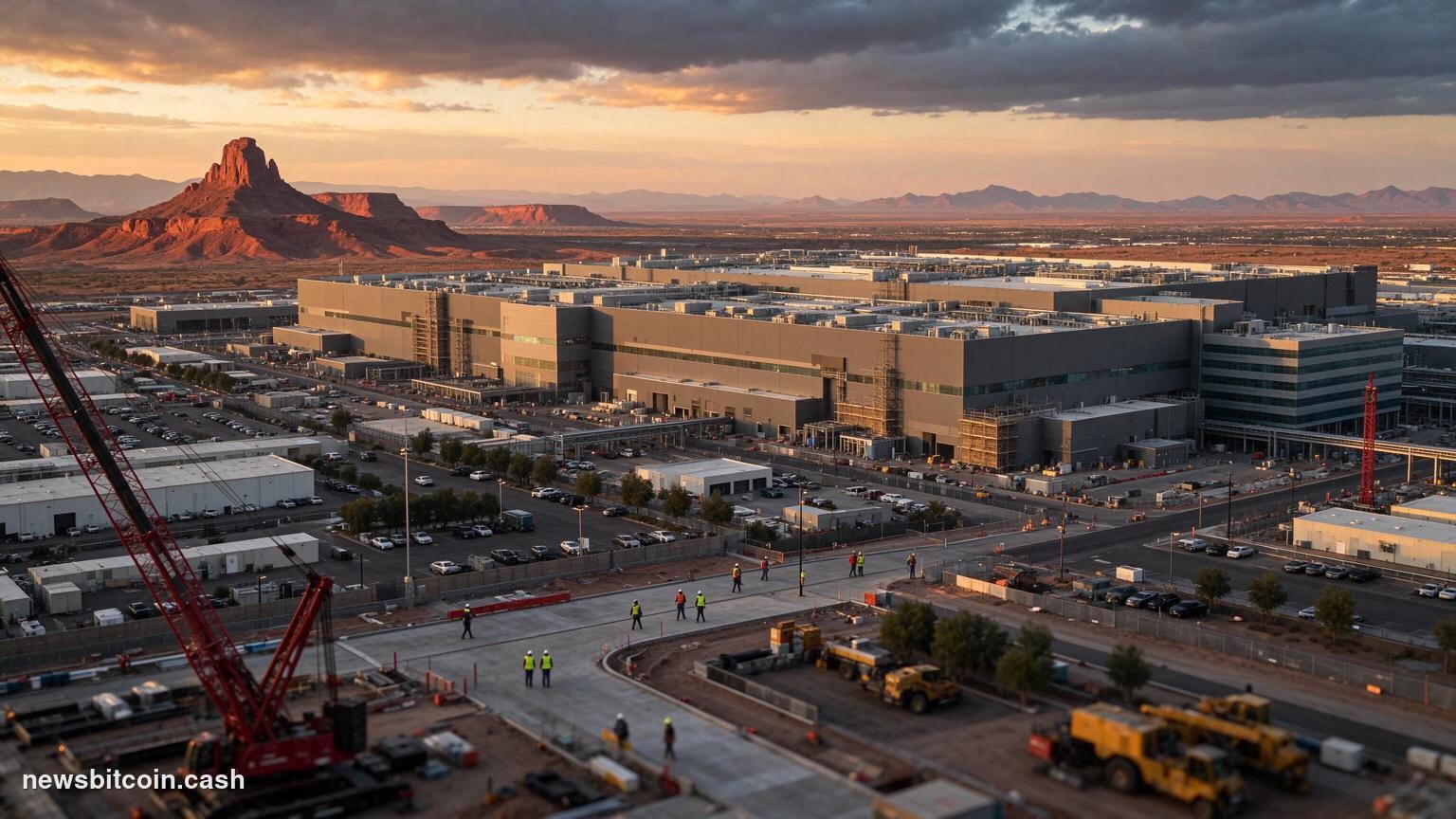
When Taiwan Semiconductor Manufacturing Company (TSMC) announced its first foray into Arizona, skeptics framed it as a symbolic gesture — a political concession dressed up as industrial policy. Five expansion phases later, the picture looks considerably different. TSMC's decision to add a dedicated south campus to its Phoenix site as part of its fifth expansion phase is no longer a gesture. It is a structural commitment to rewiring where and how the world's most critical technology gets made.
Semiconductors sit at the foundation of virtually every meaningful technology trend of this decade: artificial intelligence accelerators, blockchain mining hardware, next-generation wireless infrastructure, and the custom silicon increasingly powering everything from data centers to consumer devices. The question of who makes those chips — and under what geopolitical conditions — has quietly become one of the defining industrial policy questions of the era. TSMC's deepening Arizona footprint is a direct answer to that question, delivered not in a press release but in concrete, steel, and cleanroom-grade precision manufacturing.
From Beachhead to Campus
The addition of a south campus in Phoenix marks a qualitative shift in the nature of TSMC's American presence. Earlier phases established the operational foundation: proving that the company's famously exacting fab culture could be transplanted to the American Southwest, navigating the significant logistical and workforce challenges that came with that effort, and demonstrating to customers that wafers produced in Arizona met the same yield and quality standards as those coming out of Hsinchu or Tainan.
A fifth phase that physically expands the site's geographic footprint — creating a distinct south campus rather than simply adding capacity to existing structures — signals that TSMC is building for permanence. Campus-scale infrastructure implies long-term capital allocation, dedicated supply chain logistics, and the kind of talent pipeline investment that takes years to pay off. Companies do not build campuses at sites they expect to wind down. They build campuses at sites they expect to anchor.
The Strategic Logic Behind the Southwest
Arizona's appeal to semiconductor manufacturers extends beyond the obvious incentive structures enabled by federal legislation targeting domestic chip production. The state offers a relatively stable water management framework compared to other arid regions — critical for fabrication processes that consume enormous volumes of ultrapure water. Its proximity to major logistics corridors, combined with available land at the scale required for campus expansion, makes the Phoenix metropolitan area a genuinely attractive location rather than simply a politically convenient one.
More broadly, the expansion reflects a strategic recalibration in global chip manufacturing that has been building since supply chain disruptions during the early 2020s exposed the fragility of geographic concentration in semiconductor production. For years, the industry operated on a model of extreme specialization and geographic clustering — with leading-edge logic production concentrated to a degree that made the entire global technology economy dependent on a relatively small number of facilities in Taiwan and South Korea. That model delivered extraordinary efficiency gains, but it also created systemic vulnerabilities that became impossible to ignore once automotive manufacturers were shutting assembly lines for want of chips, and consumer electronics backlogs stretched into years rather than months.
Jobs, Independence, and the Longer Game
The domestic job creation dimension of TSMC's Arizona expansion deserves more analytical attention than it typically receives in coverage focused on geopolitics or supply chain resilience. Building a competitive semiconductor workforce in the United States requires not just hiring but the construction of an entire ecosystem: specialized vocational training, university research partnerships, supplier networks for the chemicals and equipment that fab operations require, and the accumulation of tacit knowledge that only comes from years of hands-on production experience.
Each expansion phase at the Phoenix site advances that ecosystem-building effort incrementally. The south campus addition, as the fifth such phase, represents compounding investment in that direction — each layer of infrastructure making the next phase more viable and the eventual goal of genuine U.S. technological independence more credible.
For the digital assets and blockchain infrastructure industry specifically, the implications are material. The hardware that secures proof-of-work networks, powers the AI inference workloads increasingly intertwined with on-chain applications, and enables the data center capacity underlying Web3 services all flows through semiconductor supply chains. Greater geographic diversification in leading-edge chip production reduces concentration risk for the entire technology stack that digital assets depend upon.
What This Means
TSMC's fifth Phoenix expansion phase is less a headline than a data point in a longer trend — but it is a significant one. The addition of a south campus transforms what was once a pilot program into a multi-campus industrial complex, with all the permanence, workforce development, and supply chain maturation that implies. For anyone tracking the infrastructure layer beneath digital assets, artificial intelligence, and next-generation computing, the trajectory of TSMC's Arizona investment is a leading indicator worth watching closely. The chips that will power the next cycle of technological innovation are increasingly likely to be manufactured, at least in part, on American soil — and Phoenix is becoming the clearest proof of that thesis.
Written by the editorial team — independent journalism powered by Bitcoin News.