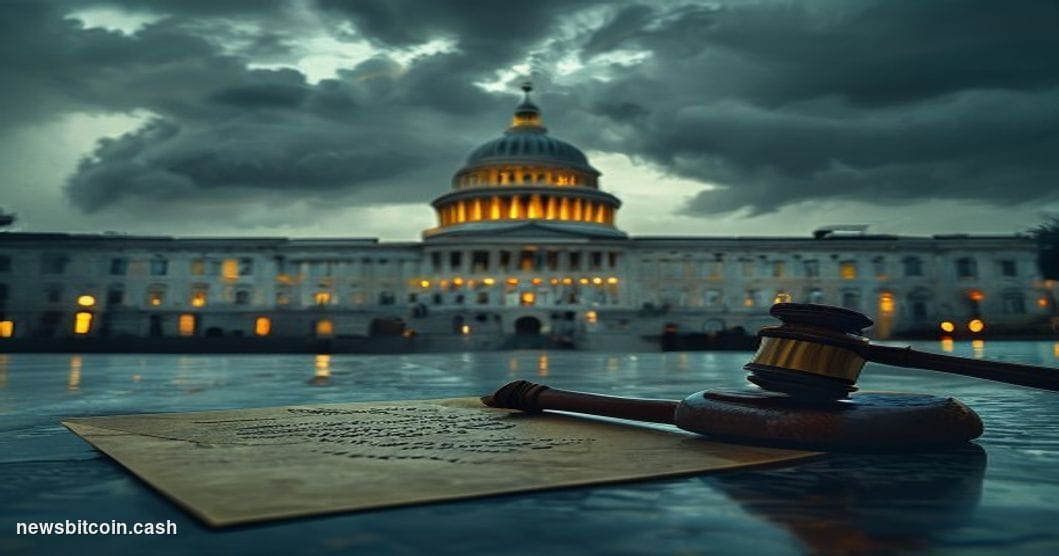
When a sitting United States president formally notifies Congress of a state of war, the reverberations extend well beyond Capitol Hill. According to a Politico report, President Donald Trump has taken precisely that step with respect to Iran — a formal congressional war notification that immediately strains an already fragile diplomatic relationship and throws cold water on market expectations that had been building around the prospect of a negotiated geopolitical settlement in 2026.
The significance of a formal war notification cannot be understated. It is not a tweet, a press briefing, or an executive order. It is a structured legal act rooted in the War Powers Resolution, a deliberate institutional signal that communicates to both domestic lawmakers and foreign governments that the executive branch has crossed a threshold. For Iran, a country whose relationship with Washington has oscillated between covert conflict and reluctant diplomacy for decades, this notification forecloses — or at minimum severely complicates — the kind of back-channel engagement that typically precedes formal agreements.
For digital asset markets, which have grown acutely sensitive to macrogeopolitical risk, this development carries tangible weight. Crypto traders and institutional desks alike had been pricing in some probability of a structured 2026 deal between Washington and Tehran — an agreement that could ease sanctions pressure, reduce regional instability, and broadly support risk-on appetite across asset classes. That calculation now faces a significant headwind. The formal war notification, as reported, directly impacts those market expectations, and the resulting uncertainty is the kind that tends to compress risk premiums and push capital toward perceived safe havens.
Bitcoin has historically served as a barometer of geopolitical anxiety, often spiking in the immediate aftermath of major conflict escalations before retracing as clarity emerges. The pattern is familiar: initial fear-driven buying, followed by a reassessment of what the conflict actually means for monetary policy, energy prices, and global liquidity. An Iran conflict scenario — even a formally declared one — introduces the additional variable of oil supply disruption, which feeds directly into inflation expectations and, by extension, central bank posture. Tighter monetary conditions are not historically friendly to speculative assets.
The diplomatic damage is arguably the more lasting concern. Efforts to broker any kind of deal — whether focused on nuclear activity, regional proxy conflicts, or sanctions relief — depend on a permissive political environment in which both sides can engage without domestic backlash. A formal war notification poisons that well. It puts congressional hawks on record, forces the administration's allies to choose sides, and gives hardliners in Tehran a powerful propaganda tool. The window for a 2026 deal, which the source material indicates was already subject to market expectations rather than confirmed progress, appears meaningfully narrower as a result.
From an infrastructure perspective, the crypto industry has particular reasons to monitor this situation closely. Iran has historically been one of the more active nation-states in Bitcoin mining, using subsidized energy to generate hash rate at scale — partly as a mechanism to convert sanctioned oil revenues into internationally transferable value. Any formal military posture from Washington toward Tehran introduces the question of how that mining activity is treated under an expanded sanctions framework, and whether exchanges or custodians facilitating transactions traceable to Iranian-origin Bitcoin face renewed regulatory scrutiny from the Office of Foreign Assets Control (OFAC). Compliance teams at major venues will be watching carefully.
There is also the broader question of what this means for the global stablecoin ecosystem and dollar-denominated crypto flows in conflict-adjacent regions. Middle Eastern markets — the Gulf states, Turkey, and the broader Levant — have seen substantial growth in stablecoin adoption as hedges against local currency risk. A widening US-Iran conflict shifts the risk calculus for those users, potentially accelerating adoption in some corridors while triggering compliance-driven access restrictions in others. Neither outcome is straightforward, and neither benefits from the uncertainty a formal war declaration injects.
What this means, ultimately, is that a geopolitical event well outside the native domain of crypto is now firmly inside its risk perimeter. The formal notification to Congress is not a rumor or a diplomatic leak — it is an institutional act with legal standing, and the markets will have to price it accordingly. The 2026 deal that traders had been anticipating as a potential tailwind for risk assets may not materialize on any near-term timeline, and the diplomatic channels required to produce it are now measurably more obstructed. In an environment where macro variables are already stretched, that is not a trivial shift.
Written by the editorial team — independent journalism powered by Bitcoin News.