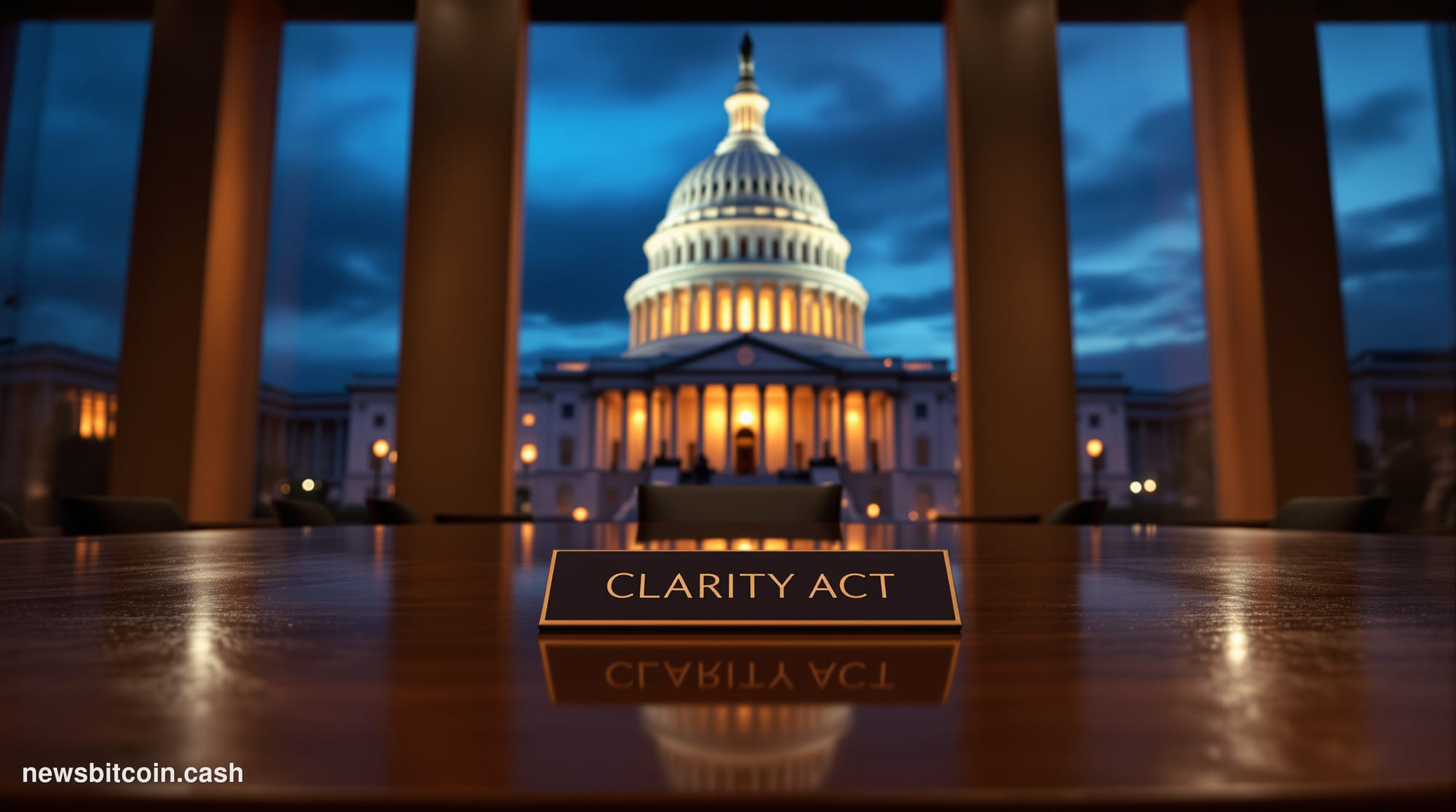
With the August congressional recess fast approaching, the fate of one of the most consequential digital asset bills in American legislative history is now resting on a direct intervention from the White House. President Donald Trump is set to meet with senators as a heated internal dispute over the CLARITY Act's ethics provisions threatens to stall — or even kill — the bill's chances of clearing the Senate before lawmakers scatter for their summer break.
The move signals both the urgency of the moment and the degree to which the crypto industry's legislative ambitions have become entangled in the broader political friction that defines Washington deal-making. A bill that was supposed to deliver long-awaited regulatory clarity to digital asset markets is now hostage to a fight over ethics guardrails — the kind of procedural and political battle that has derailed far less contentious legislation in the past.
What the CLARITY Act Is Supposed to Do
The CLARITY Act has been positioned as a landmark framework for defining how digital assets — including cryptocurrencies and tokens — should be regulated in the United States. For an industry that has spent years operating under a patchwork of enforcement actions, contradictory guidance, and jurisdictional turf wars between the Securities and Exchange Commission and the Commodity Futures Trading Commission, a comprehensive legislative framework represents something genuinely significant: predictability.
The bill has attracted considerable attention from across the crypto ecosystem precisely because it attempts to draw firm lines — establishing which assets are securities, which are commodities, and how exchanges and issuers should handle compliance obligations. Done right, it could replace years of regulation-by-enforcement with a durable statutory foundation. Done poorly, or left undone entirely, it leaves the industry in the same legal fog that has hampered institutional adoption and driven projects offshore.
Ethics Provisions: The Sticking Point
What's threatening to derail the bill isn't a disagreement about blockchain technology or token classification. It's ethics. Specifically, the ethics provisions embedded in the CLARITY Act have become a fault line among senators whose support is essential to advancing the legislation. The precise nature of the dispute — which senators, which provisions, and what compromises are being demanded — reflects the kind of Washington insider friction that rarely makes headlines but routinely determines whether major bills live or die.
Ethics provisions in financial legislation are rarely simple. They typically govern conflicts of interest, disclosure requirements, and the conduct of officials and lawmakers who might personally benefit from the regulatory regimes they help create. In the context of crypto — an asset class that has generated enormous personal wealth for a number of politically connected individuals — those provisions carry extra weight and extra sensitivity. Any senator seen as weakening ethics guardrails risks political blowback. Any senator insisting on provisions that others find onerous risks becoming the obstacle that kills the bill entirely.
This is the knife-edge the CLARITY Act now walks, and it's why Trump's direct engagement matters. Presidential involvement at this stage of legislative negotiations is a meaningful escalation. It signals that the White House views the bill's passage as a priority worth spending political capital on — and that the ethics impasse has reached a level of severity that cannot be resolved through staff-level negotiations alone.
The August Recess as a Hard Deadline
Congressional recesses are not soft deadlines. When lawmakers leave Washington for August, legislative momentum doesn't pause — it often evaporates. Bills that fail to reach a vote before the recess face an uncertain autumn, competing with budget negotiations, appropriations fights, and the gathering pressure of electoral politics as the calendar turns toward 2026 midterm positioning. The longer the CLARITY Act waits, the more variables accumulate against it.
There is also a broader context worth keeping in mind. The crypto industry has invested enormous political capital — through lobbying, through political action committees, through direct engagement with the Trump administration — in getting exactly this kind of legislative moment. Squandering it over an internal Senate disagreement on ethics provisions would be a significant setback, not just for the specific bill but for the industry's credibility as a serious legislative partner capable of shepherding complex regulation through Congress.
What This Means
Trump's decision to engage directly with senators suggests the White House understands what's at stake. Whether that intervention is sufficient to break the impasse before the August recess is an open question — but the very fact that it is happening tells you something important: the CLARITY Act is not yet dead, and the administration is not willing to let it die quietly. For the digital asset industry, the next few weeks represent one of the narrowest windows for regulatory legitimacy that has opened in years. How senators respond to Trump's direct outreach will determine whether that window stays open or slams shut until at least the fall — and with it, the industry's best near-term hope for a coherent legal foundation.
Written by the editorial team — independent journalism powered by Bitcoin News.