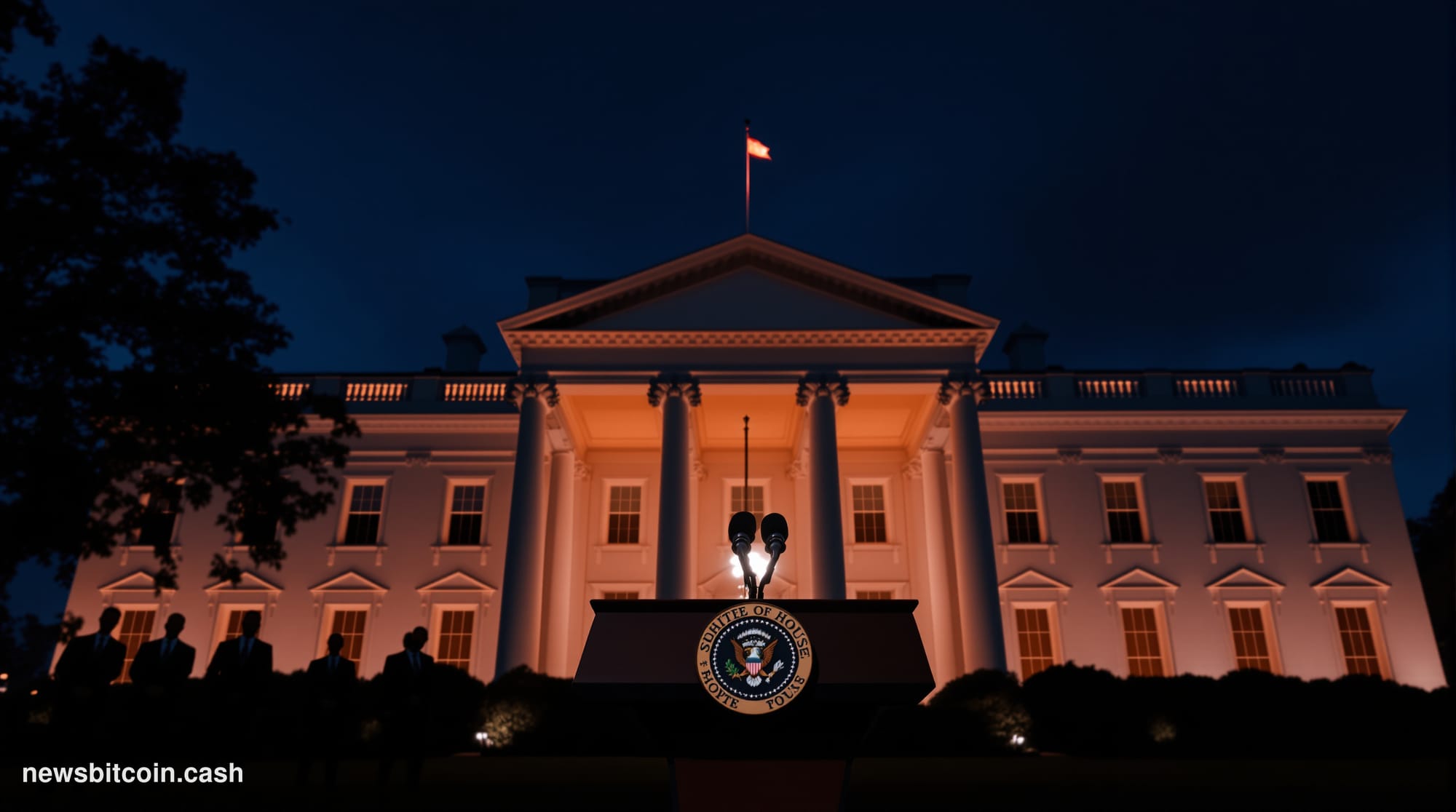
President Donald Trump stepped to the podium at the White House on Wednesday and delivered an unambiguous message to the Senate: pass the CLARITY Act now. With a cadre of crypto industry executives at his side, Trump framed the market structure legislation not merely as a domestic regulatory priority but as a direct instrument of geopolitical competition — a line in the sand drawn squarely against China.
The scene itself carried political weight beyond the words spoken. A sitting president hosting digital asset industry leaders at the White House for a public legislative push represents a categorical shift from the enforcement-first posture that defined Washington's relationship with crypto for much of the prior decade. Whatever one thinks of the policy details, the optics of August 19, 2026 will be difficult to walk back. The industry has arrived in the most literal sense possible.
What the CLARITY Act Actually Does
The CLARITY Act is a crypto market structure bill — a legislative category that is more technically consequential, and more politically complicated, than the stablecoin frameworks that have dominated recent Congressional debate. Market structure legislation attempts to answer the foundational question that has paralyzed the industry's regulatory standing for years: when is a digital asset a security, and when is it a commodity? That jurisdictional boundary determines whether the Securities and Exchange Commission or the Commodity Futures Trading Commission holds primary oversight authority — a distinction with enormous practical implications for how projects are built, listed, and traded.
Getting that distinction codified into law has proven extraordinarily difficult. Prior Congresses produced hearings, discussion drafts, and competing frameworks, but never a floor vote. The CLARITY Act represents the current attempt to resolve what has effectively been a regulatory no-man's-land, and Trump's Wednesday appearance signals that the White House is prepared to spend political capital to see it through the Senate.
The China Argument
Trump's invocation of China as the competitive foil is neither accidental nor new, but the context in which it lands in mid-2026 gives it sharper edges than the same argument would have carried two years ago. Beijing's approach to digital assets has evolved considerably, with state-backed blockchain infrastructure expanding even as domestic retail crypto activity remains tightly controlled. Washington's failure to produce a coherent regulatory framework, the argument goes, cedes the standards-setting role to rival jurisdictions — not just China, but the European Union's Markets in Crypto-Assets framework, which has been operational long enough to begin attracting institutional players who crave regulatory certainty.
The "ahead of China" framing is effective political shorthand, but it also points to something structurally real: the country or bloc that defines the rules for digital asset markets will exercise outsized influence over how global capital flows through this infrastructure for decades. Trump's White House is betting that Senate Republicans — and enough Democrats — can be moved by that argument when stablecoin legislation alone could not fully close the deal.
Industry's Calculated Presence
The crypto executives who appeared alongside Trump at the White House were not there by accident. Their presence is the product of years of increasingly sophisticated political engagement by the digital asset industry — PAC spending, lobbying infrastructure, and the cultivation of relationships across both parties that accelerated sharply after the enforcement crackdowns of 2023. Standing next to a president demanding Senate action is the return on that investment, and it sends a signal to legislators that the industry is prepared to reward allies and hold adversaries accountable at the ballot box.
That said, proximity to the White House is a double-edged instrument. The same association that lends legislative momentum can complicate bipartisan coalition building in a Senate where Democratic buy-in will almost certainly be required to reach a filibuster-proof threshold. How the industry navigates that tension in the weeks following Wednesday's appearance will be as revealing as the appearance itself.
What Happens Next
Presidential pressure from the White House podium does not automatically translate into Senate floor votes, and the CLARITY Act still faces the full complexity of the legislative process — committee dynamics, amendment fights, and the perennial competition for floor time in a chamber with a packed agenda. What Wednesday's event does accomplish is elevate the stakes and shorten the political timeline. Senators who were comfortable deferring the issue now face a more explicit accountability question.
For the digital asset industry, the moment is genuinely significant regardless of the bill's ultimate fate. The trajectory from regulatory exile to White House lawn — with a president invoking national security to demand market structure legislation on your behalf — is a trajectory that would have seemed implausible to most serious observers as recently as three years ago. The infrastructure fight for how crypto is governed in the United States is entering its most consequential legislative phase, and the outcome will shape not just domestic markets but the global architecture of digital finance.
Written by the editorial team — independent journalism powered by Bitcoin News.