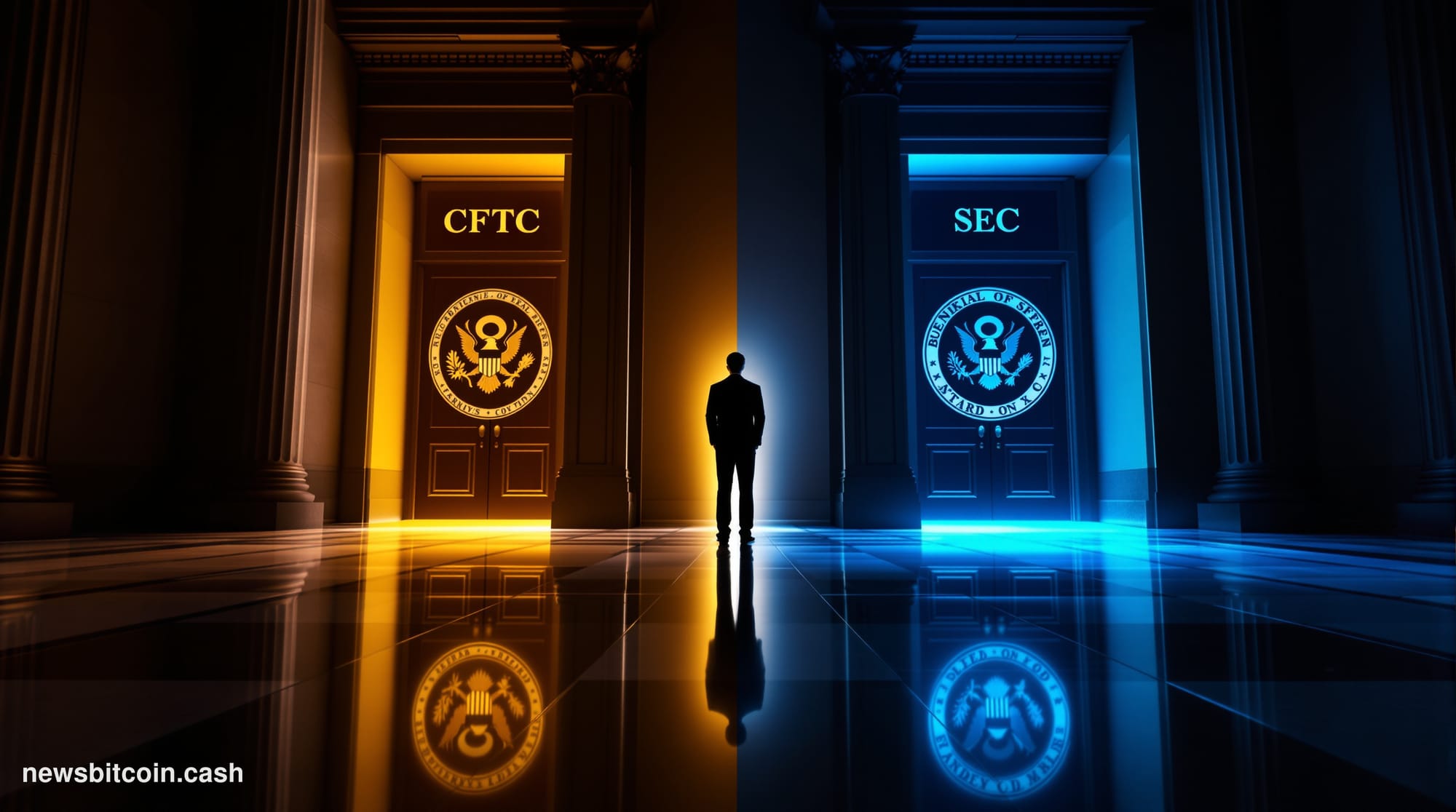
More than two years into his second term, President Donald Trump has finally crossed a threshold that his administration had long avoided: nominating Democrats to lead federal financial regulators. The White House this week unveiled a bipartisan slate of four nominees — two Republicans and two Democrats — split across the Securities and Exchange Commission and the Commodity Futures Trading Commission. For an administration that built much of its financial regulatory posture on partisan alignment, the move is a notable departure. For the crypto industry, it may be the most consequential regulatory development of the year.
These are Trump's first Democratic picks for either agency — a fact that shouldn't be glossed over. The SEC and CFTC sit at the center of every serious debate about how digital assets are classified, traded, and governed in the United States. Both commissions require bipartisan composition by law, meaning that minority-party seats cannot be filled by members of the president's own party. When those seats go empty for extended periods, as they have under this administration, the agencies lose quorum capacity and their ability to push through major rulemakings becomes constrained. Filling those vacancies now, with nominees from across the aisle, restores functional governance to institutions that the crypto industry has simultaneously criticized and desperately needed to engage with.
The Shadow of the Clarity Act
The timing of these nominations is inseparable from the legislative wreckage left behind by the Clarity Act's collapse. That bill had been the crypto industry's great legislative hope — a framework designed to draw a durable line between digital assets that fall under SEC jurisdiction as securities and those that fall under CFTC jurisdiction as commodities. Its failure to advance left both agencies in an uncomfortable position: holding significant enforcement authority over a sector without a clear congressional mandate defining the boundaries of that authority. The resulting ambiguity has stalled institutional participation, complicated exchange operations, and left project developers guessing at compliance obligations.
With no Clarity Act to anchor policy, the SEC and CFTC have been left to chart their own courses through guidance, enforcement actions, and commissioner statements. That works adequately when commissions are fully staffed and ideologically diverse enough to represent the range of interpretive positions that a functioning democratic agency should contain. It works poorly when seats sit empty and the remaining commissioners share too narrow a worldview to anticipate legal challenges from multiple directions. In that context, Trump's bipartisan nominees aren't just a political gesture — they are an operational necessity for agencies that have continued to drive crypto policy despite the legislative vacuum.
What Bipartisanship Actually Means Here
It would be a mistake to read this slate as a softening of the administration's crypto posture or as a signal that Democratic-aligned commissioners will push back against the deregulatory orientation that has characterized both agencies under Trump-appointed leadership. Democratic commissioners at the SEC and CFTC have historically ranged from cautiously pro-innovation to sharply skeptical of the industry's self-regulatory claims. The specific nominees named in this slate will determine whether this bipartisan composition produces genuine policy debate or simply satisfies the legal requirement for minority representation while leaving the ideological direction of both agencies unchanged.
What the nominations do guarantee is a more structurally legitimate rulemaking process. Enforcement actions and guidance issued by commissions at or near quorum with bipartisan sign-off carry more legal weight and are harder to challenge on procedural grounds. For a crypto industry that has seen multiple high-profile enforcement actions vacated or softened on administrative procedure grounds in recent years, this structural legitimacy cuts both ways: it strengthens the agencies' hand in future enforcement, but it also creates a more stable environment for good-faith compliance efforts.
The Road Ahead
Senate confirmation of the full slate remains the next critical step. Bipartisan nominations don't automatically translate into bipartisan confirmation — particularly in an environment where financial regulation has become a proxy battlefield for broader political disputes. If the nominees advance, however, both commissions will enter their next phase with renewed institutional capacity at a moment when the absence of the Clarity Act makes agency-level decision-making more important, not less.
The crypto industry spent years lobbying for legislative clarity as the preferred solution to its regulatory uncertainty. That solution failed. What remains is the harder, slower work of shaping policy through the agencies themselves — through rulemaking participation, litigation strategy, and yes, the composition of the commissions that write and enforce the rules. Trump's first Democratic picks for the SEC and CFTC won't resolve the fundamental questions the Clarity Act was meant to answer. But they do reopen the institutional channels through which those answers will eventually have to come.
Written by the editorial team — independent journalism powered by Bitcoin News.