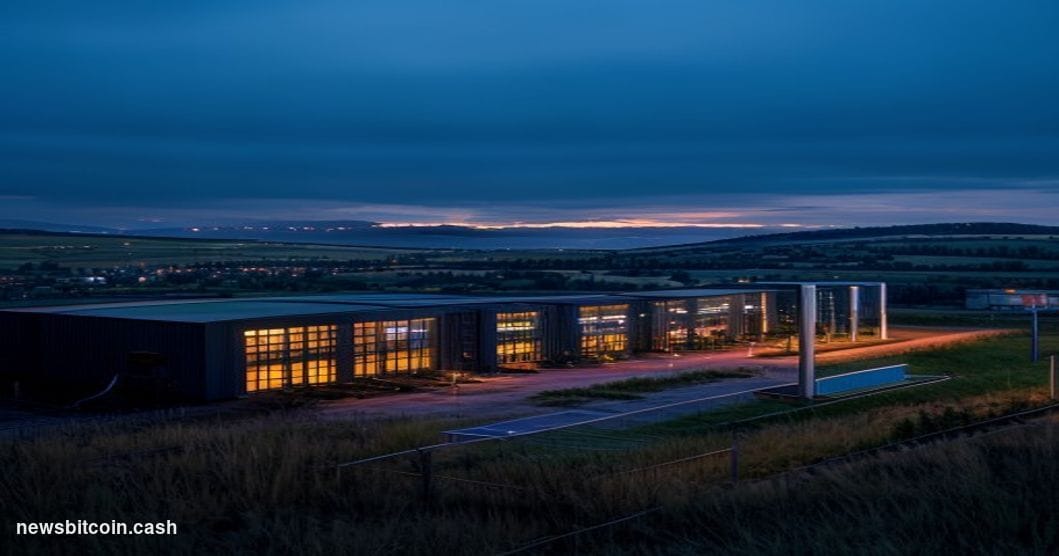
A Bitcoin miner just signed one of the most consequential infrastructure deals in the history of the industry — and it has nothing to do with Bitcoin. TeraWulf, long known as a low-cost proof-of-work mining operator, has locked in a $19 billion, 20-year lease agreement with artificial intelligence company Anthropic, handing over a 401-megawatt data center in Kentucky to power Anthropic's compute-hungry AI workloads. The sheer size of the contract — nearly two decades of committed revenue — reframes TeraWulf not as a miner that dabbles in AI, but as a full-scale infrastructure landlord that happens to have started life in crypto.
The numbers demand attention. At $19 billion spread over 20 years, the deal represents roughly $950 million in average annual contract value, dwarfing what any similarly sized Bitcoin miner could realistically generate from block rewards and transaction fees in the current environment. For context, the entire Bitcoin mining sector has been under sustained margin compression since the April 2024 halving slashed block rewards from 6.25 BTC to 3.125 BTC per block. TeraWulf's Kentucky lease sidesteps that pressure entirely, replacing volatile, energy-intensive crypto economics with long-duration, predictable infrastructure revenue.
What makes this pivot structurally interesting is the asset class TeraWulf is selling: power capacity. The 401-megawatt facility in Kentucky is not just a building — it is a secured, grid-connected energy envelope in a state with competitive electricity costs and favorable regulatory conditions. Anthropic, whose large language model workloads require enormous and sustained compute density, needs exactly that. The AI company's demand for reliable, high-capacity power infrastructure is so acute that locking in a two-decade lease makes rational economic sense. For TeraWulf, it transforms a depreciating mining asset into a long-term income-generating property.
The strategic logic runs deeper than a single deal. Bitcoin miners as a cohort sit on a peculiar competitive advantage: they have spent years identifying, permitting, and connecting to power infrastructure in locations that utilities and data center developers often overlooked. That site-selection expertise, originally deployed to minimize electricity costs per terahash, translates directly into the ability to deliver large-scale power capacity to hyperscalers and AI model developers. TeraWulf is not the first miner to recognize this — Core Scientific inked a major high-performance computing hosting deal with CoreWeave — but the scale and duration of the Anthropic arrangement puts TeraWulf's pivot in a category of its own.
There are legitimate questions about what this transformation means for TeraWulf's identity and its existing Bitcoin mining operations. A 20-year lease with a single tenant of Anthropic's scale creates concentration risk that is qualitatively different from the distributed, market-priced nature of mining revenue. If Anthropic were to face financial stress, regulatory headwinds, or a dramatic shift in AI infrastructure strategy at any point over two decades, the implications for TeraWulf would be significant. Diversification — the kind that comes from running multiple revenue streams across different asset classes — becomes more important, not less, once a company commits this heavily to a single counterparty relationship.
Yet the counterargument is equally compelling. Anthropic is one of the best-capitalized AI companies on the planet, backed by billions in investment from Amazon and others, and operating in a sector where demand for compute has shown no credible signs of plateauing. Signing a 20-year lease with that caliber of tenant is not a desperate exit from mining — it is a sophisticated read of where durable infrastructure value is migrating. Bitcoin mining revenue, by contrast, is subject to four-year halving cycles, global hashrate competition, and energy market volatility in ways that a long-term colocation lease simply is not.
For the broader mining sector, TeraWulf's $19 billion Kentucky deal will function as a proof-of-concept that accelerates copycat strategies. Miners with grid-connected facilities, particularly those in energy-rich states with available land and permitting goodwill, will increasingly market themselves not as crypto operators but as power infrastructure providers. The Bitcoin mining business model built on squeezed margins and hardware depreciation cycles will increasingly compete for capital against the AI infrastructure landlord model built on contracted, bankable cash flows. TeraWulf just demonstrated which one institutional capital is likely to prefer.
The transformation from Bitcoin miner to AI landlord does not happen overnight, and TeraWulf's mining heritage will likely remain part of its operational identity for years. But the $19 billion Anthropic lease draws a clear line: when a company secures 20 years of revenue from the world's most capital-intensive technology sector, the mining operation becomes the footnote, not the headline.
Written by the editorial team — independent journalism powered by Bitcoin News.