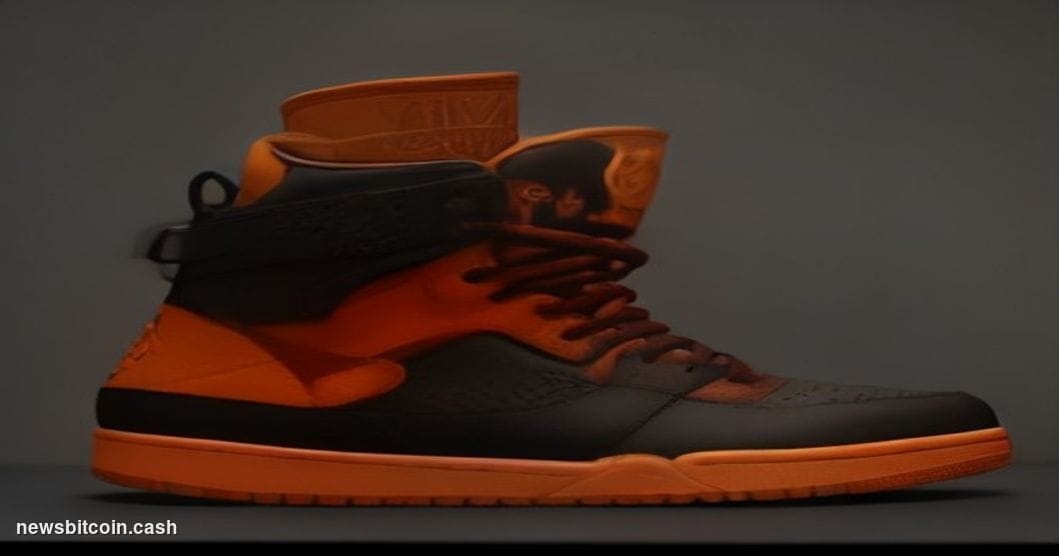
There is something almost poetic about the collision of sneaker culture and Bitcoin maximalism, but Strategy — the firm formerly known as MicroStrategy and the world's most recognizable corporate Bitcoin holder — has managed to find the irony hiding inside that poetry. The company has dropped a limited Bitcoin-themed Jordan sneaker retailing at $250, a product dripping in crypto cultural signaling. The catch: you cannot pay for it with Bitcoin, or any other cryptocurrency.
The shoe itself is a collaboration with Nike's Jordan Brand, and on the surface it looks like a savvy piece of brand extension from Strategy's executive chairman Michael Saylor, who has built his entire corporate identity on the accumulation and evangelism of Bitcoin. A Bitcoin-branded sneaker carrying the Jordan name carries genuine cultural weight — Jordan shoes occupy a rare space where streetwear, sport, and collector culture converge. Attaching Bitcoin iconography to that universe is not a frivolous move. It signals, at minimum, that Bitcoin has enough mainstream brand cachet to sit alongside one of the most recognizable shoe labels in history.
But the payment restriction punctures the narrative cleanly. If any company on earth had standing to normalize Bitcoin as a medium of exchange for consumer goods, it was Strategy. The firm holds more Bitcoin on its balance sheet than virtually any other publicly traded entity. Its entire market identity has been reconstructed around the Bitcoin thesis. Choosing to price the sneaker in dollars and accept only fiat currency at checkout is either a concession to practical commerce realities or a revealing contradiction at the heart of the Bitcoin-as-currency argument — perhaps both.
The practical explanation is not hard to find. Retail payment infrastructure for cryptocurrency remains fragmented, compliance obligations around crypto transactions add friction, and Nike's own distribution and e-commerce systems are not built for on-chain settlement. When a product sells through conventional retail pipelines, the payment rails tend to follow convention. This is the same structural reality that keeps even the most Bitcoin-forward companies transacting in dollars day to day.
What gives the story additional texture is the state of Nike as a corporate partner. Nike's stock has shed almost half its value over the past year — a brutal drawdown by any measure for one of the world's most storied consumer brands. The company has been navigating a difficult stretch defined by weakening consumer demand, margin pressure, and strategic missteps in its direct-to-consumer pivot. In that context, a high-profile collaboration with Strategy and its Bitcoin branding reads partly as a volume play — a way to generate buzz and move product in a category, limited-edition Bitcoin sneakers, that will attract speculative buyers and collectors who might otherwise be indifferent to a Jordan drop.
For Strategy, the calculus is different but equally transparent. The company has spent years making Bitcoin a corporate identity, not just a treasury strategy. Branded merchandise that carries Bitcoin symbolism into physical consumer culture extends that identity beyond financial markets and institutional audiences. A $250 sneaker is not a treasury move. It is a cultural one — an attempt to plant the Bitcoin flag in a space where millions of people who have never bought a satoshi spend real money and real attention.
The crypto community's reaction to the payment restriction will be worth watching. Bitcoin advocates have long argued that the currency's future depends on its utility as actual money — spendable, accepted, practical. Every high-profile launch that prices goods in Bitcoin but collects in dollars nudges that argument a little further into abstraction. At the same time, hardcore holders, the so-called Bitcoin maximalists who cluster around Saylor's orbit, often argue that spending Bitcoin is irrational when its value is expected to appreciate. Under that logic, a product that celebrates Bitcoin but accepts only dollars is not a contradiction at all — it is orthodoxy.
What this moment actually reveals is that the line between Bitcoin as cultural symbol and Bitcoin as functioning currency remains very much unresolved at the commercial level. Strategy can sell Bitcoin Jordans. Nike can stamp a ticker-adjacent aesthetic onto premium footwear. But when the checkout screen loads, the dollar is still the only option available. For a company whose entire brand proposition rests on the future of money, that is a detail worth sitting with — even if the sneakers sell out regardless.
Written by the editorial team — independent journalism powered by Bitcoin News.