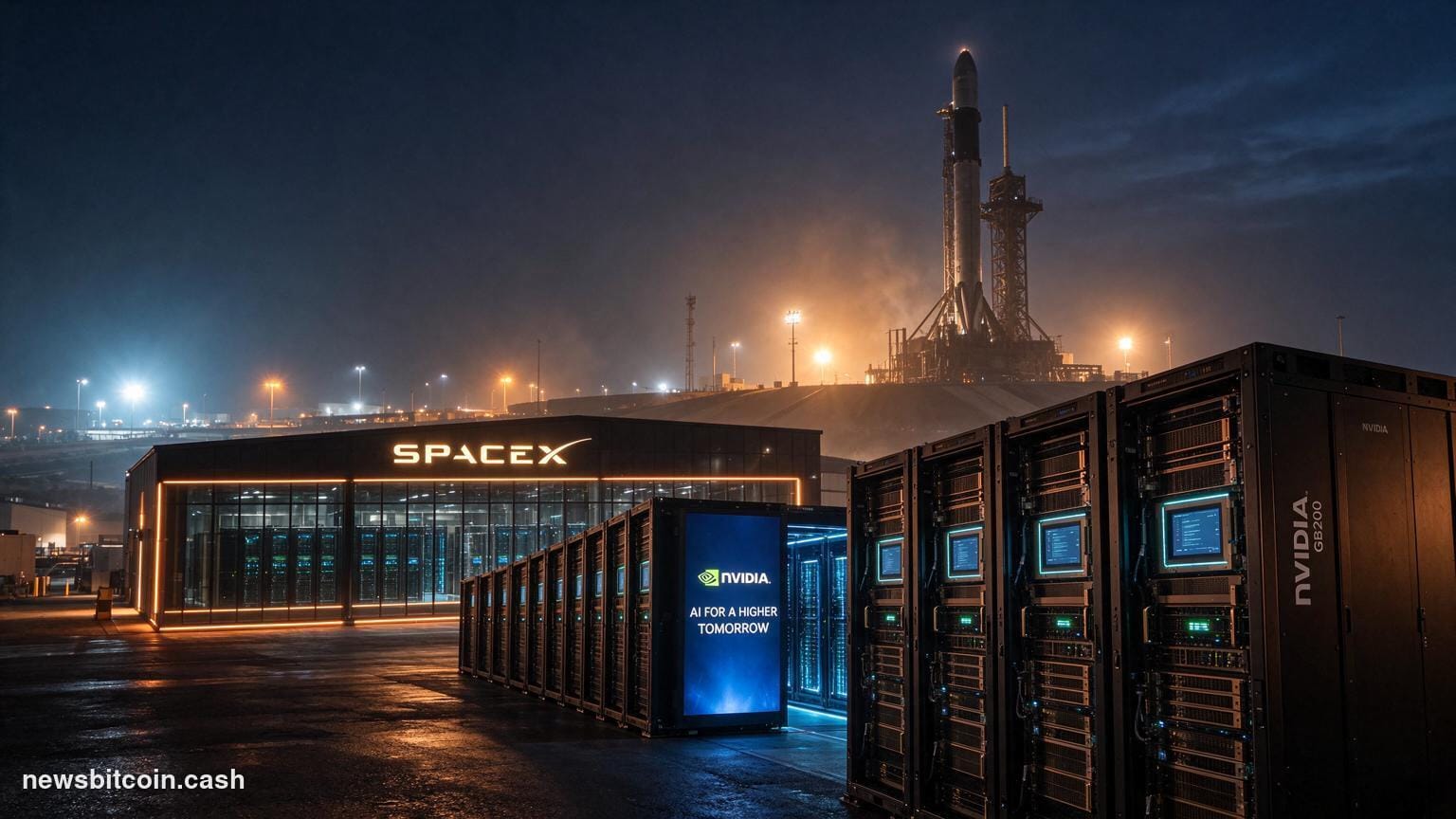
When the history of artificial intelligence infrastructure is written, the moment SpaceX ascended to the position of Nvidia's single largest customer may read as one of its most telling inflection points. It is a data point that collapses several assumptions at once — about who the dominant consumers of advanced AI hardware are, about the boundary between aerospace and computing, and about how exclusive supply relationships could quietly redraw the competitive map of the AI industry for years to come.
The scale of SpaceX's AI ambitions has long been visible in outline. Elon Musk's rocket and satellite company has been building out computational infrastructure at a pace that rivals dedicated AI labs, driven by the demands of autonomous flight systems, Starlink network optimization, and the broader artificial intelligence workloads that increasingly underpin modern aerospace operations. What the company's new status as Nvidia's top customer confirms is that those ambitions have now translated into procurement volumes large enough to outpace some of the most established names in the technology sector — a remarkable achievement for a company whose primary business remains putting objects into orbit.
Hardware as Strategic Leverage
The significance of this development extends well beyond the balance sheets of two prominent companies. When a single customer reaches the top of a supplier's revenue hierarchy, the relationship tends to evolve from transactional to symbiotic. Priority access to allocation cycles during periods of chip scarcity, early access to next-generation architectures, and co-development arrangements on specialized silicon all become realistic outcomes of that elevated status. In an environment where Nvidia's graphics processing units remain among the most constrained resources in global technology, being first in line is not a minor advantage — it is a structural one.
This dynamic carries implications that extend into the broader AI market. If SpaceX's purchasing volume has enabled it to secure preferential terms with Nvidia, other large-scale AI consumers — cloud hyperscalers, defense contractors, and emerging foundation model labs — will be watching closely. The prospect of increasingly exclusive hardware partnerships, in which the largest buyers lock in supply relationships that effectively crowd out smaller competitors, represents a meaningful shift in how AI capability is distributed. Access to compute is already the central constraint on AI development; access to the best compute, on preferential terms, is a qualitatively different advantage.
Precedent and Market Dynamics
What makes the SpaceX-Nvidia relationship particularly worth scrutinizing is its potential to function as a template. The aerospace sector has historically operated on long-term exclusive supplier relationships — it is a procurement culture built around reliability, certification, and deep integration between buyer and vendor. If that model migrates into AI hardware procurement, the consequences for market openness could be substantial. Smaller AI developers and research institutions, already squeezed by GPU shortages and elevated prices, could find themselves locked out not just by cost but by contractual architecture.
For the digital assets and blockchain industry, which has its own substantial appetite for GPU compute — spanning everything from zero-knowledge proof generation to on-chain AI inference — the downstream effects of this kind of market consolidation deserve serious attention. If the most capable hardware increasingly flows toward a small number of elite anchor customers under exclusive or semi-exclusive arrangements, the cost and availability calculus for decentralized infrastructure projects shifts accordingly. The crypto sector's reliance on commodity GPU markets for certain workloads makes it structurally vulnerable to supply concentration at the top of the market.
The Broader Signal
It would be a mistake to read SpaceX's emergence as Nvidia's top customer purely as a corporate milestone for two well-capitalized companies. The more important reading is structural: AI spending has deepened to the point where aerospace companies are now competing for hardware supremacy with the cloud giants that were previously assumed to dominate that space. The composition of Nvidia's top customer list is itself a leading indicator of where AI investment is concentrating — and the fact that a launch vehicle and satellite internet company sits at its apex in late 2026 says something fundamental about how widely and unexpectedly AI infrastructure demand has spread.
The precedent that SpaceX's position may set — for exclusive partnerships, for preferential allocation, for the vertical integration of AI hardware into non-traditional industries — is the story that the market should be tracking carefully. How Nvidia manages its customer relationships from this point forward, and whether other large buyers move to formalize similar arrangements, will shape the competitive landscape of AI development more decisively than almost any software breakthrough in the near term. Compute scarcity, concentrated in the hands of anchor customers, has a way of becoming permanent infrastructure advantage.
Written by the editorial team — independent journalism powered by Bitcoin News.