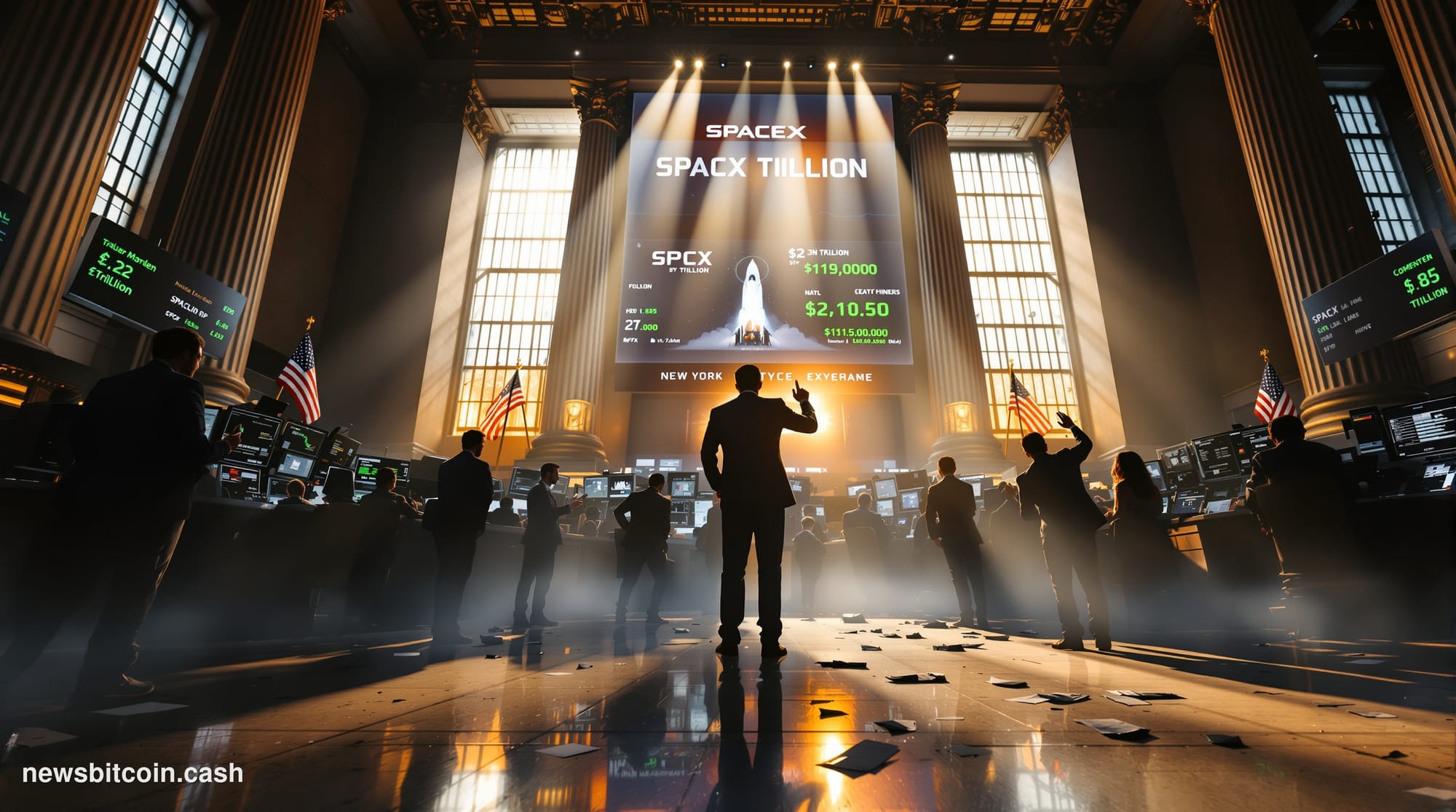
Wall Street witnessed history Friday as SpaceX completed the largest initial public offering ever recorded, with shares surging past the $2 trillion valuation threshold under the ticker SPCX. The aerospace giant's market debut not only shattered previous IPO records but also propelled Elon Musk into unprecedented territory as the world's first trillionaire, fundamentally reshaping how mega-cap companies approach public markets.
The implications extend far beyond traditional equity markets into the digital assets ecosystem, where Musk's expanded financial influence could accelerate institutional crypto adoption. His track record of market-moving cryptocurrency commentary, combined with newfound liquidity from SpaceX's public status, positions him to drive significant capital flows between traditional finance and digital assets. The aerospace company's massive valuation also signals growing investor confidence in space-economy infrastructure, a sector increasingly intertwined with satellite-based blockchain networks and decentralized communication systems.
Friday's trading session demonstrated unprecedented retail and institutional demand, with shares climbing sharply from their opening price throughout the day. The offering's scale dwarfed previous record-holders, including Saudi Aramco's $29.4 billion debut in 2019 and Alibaba's $25 billion listing in 2014. Investment banks coordinating the deal reportedly struggled to maintain orderly markets as demand exceeded available shares by significant multiples, forcing multiple trading halts during peak volatility periods.
The timing of SpaceX's public debut coincides with renewed institutional interest in alternative assets, including cryptocurrencies and space-economy investments. Major pension funds and sovereign wealth funds have increasingly allocated capital toward next-generation infrastructure plays, viewing companies like SpaceX as foundational to future economic frameworks. This institutional appetite mirrors similar trends in cryptocurrency markets, where traditional finance giants have embraced Bitcoin exchange-traded funds and blockchain-based settlement systems.
Musk's achievement as the first trillionaire carries particular significance for cryptocurrency markets, given his documented ability to influence digital asset prices through social media commentary and corporate treasury decisions. Tesla's previous Bitcoin acquisitions and SpaceX's rumored cryptocurrency holdings suggest his expanded wealth could translate into larger-scale digital asset investments. The aerospace company's satellite constellation also provides critical infrastructure for blockchain networks requiring global connectivity and decentralized validation systems.
The IPO's structure challenged conventional wisdom about mega-cap public offerings, utilizing innovative mechanisms to accommodate unprecedented scale and demand. Investment banks employed modified Dutch auction systems alongside traditional bookbuilding processes, allowing broader retail participation while maintaining institutional allocation preferences. This hybrid approach could influence future large-scale offerings, particularly as cryptocurrency companies prepare their own public market debuts amid evolving regulatory frameworks.
Market analysts note that SpaceX's valuation reflects growing recognition of space economy fundamentals, including satellite internet, cargo delivery, and interplanetary exploration capabilities. These business lines increasingly intersect with cryptocurrency infrastructure, as blockchain networks require reliable global communication systems and space-based mining operations demand sophisticated logistics capabilities. The company's successful public debut validates investor thesis around space-economy growth trajectories and their intersection with digital asset ecosystems.
The record-breaking offering also highlights shifting dynamics in public market accessibility, as retail investors gained unprecedented participation in historically institutional-dominated mega-cap debuts. Social media platforms and commission-free trading applications enabled broader market participation, echoing similar democratization trends in cryptocurrency markets where retail investors increasingly compete with institutional players for market-moving positions.
Looking forward, SpaceX's public status provides a new benchmark for space economy valuations while potentially accelerating cryptocurrency adoption through Musk's expanded influence and liquidity. The company's satellite infrastructure could prove essential for next-generation blockchain networks requiring global coverage and decentralized validation systems. As traditional finance continues converging with digital assets, Friday's historic IPO represents a pivotal moment where space economy investments and cryptocurrency markets begin sharing common institutional frameworks and investor bases.
Written by the editorial team — independent journalism powered by Bitcoin News.