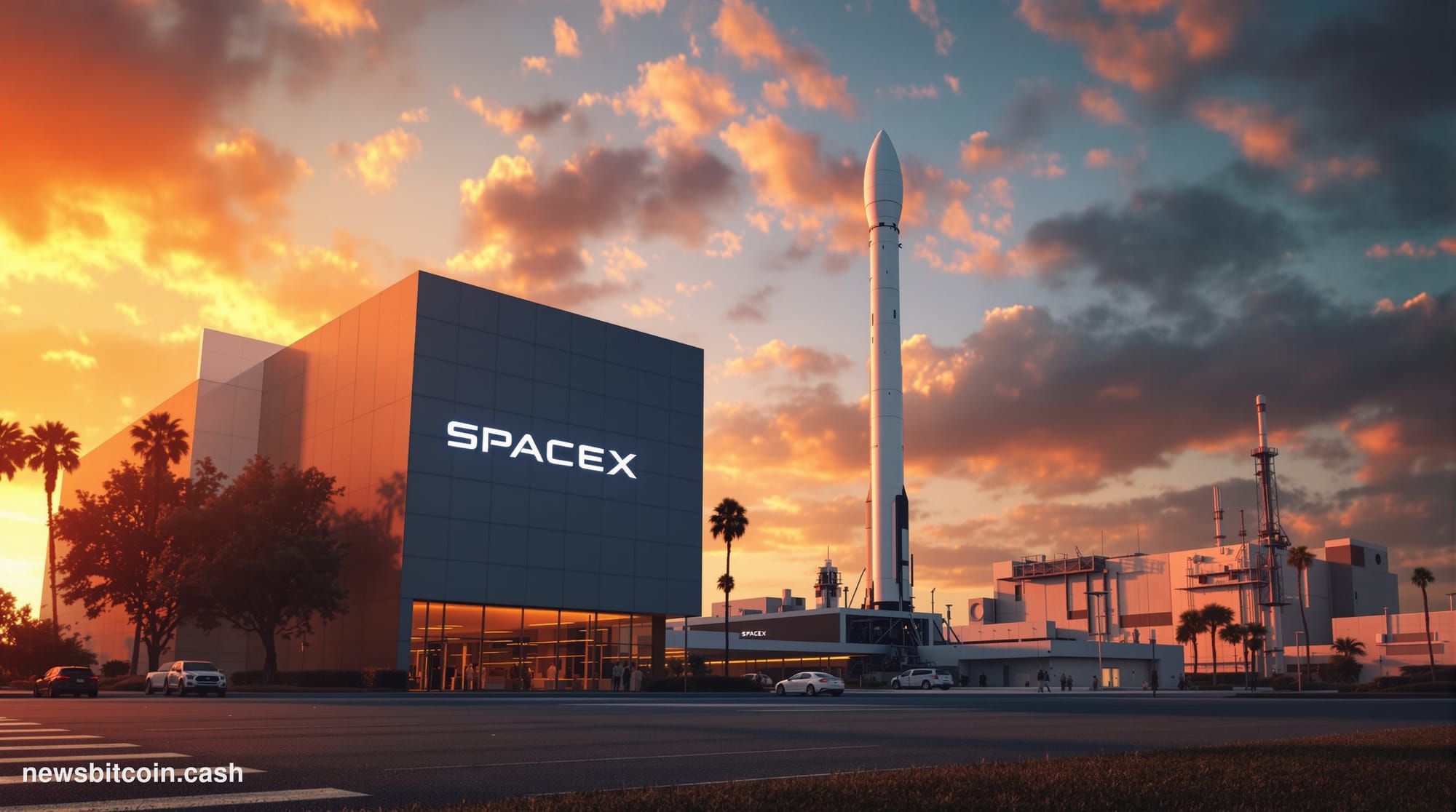
The financial world witnessed an unprecedented moment Friday as SpaceX completed the largest initial public offering in history, rocketing past a $2 trillion market valuation and fundamentally reshaping how investors value space economy companies. The aerospace manufacturer's debut under the ticker SPCX sent shockwaves through Wall Street, with shares climbing sharply from their opening price and establishing new benchmarks for mega-cap public offerings.
The historic listing simultaneously catapulted Elon Musk into rarefied air as the world's first trillionaire, cementing his position not merely as an influential entrepreneur but as a figure whose wealth transcends previous economic paradigms. The achievement underscores how space technology has evolved from a niche government-dominated sector into a cornerstone of modern capital markets, with institutional investors now treating orbital infrastructure as seriously as terrestrial assets.
SpaceX's $2 trillion valuation dwarfs traditional aerospace benchmarks and places the company among the most valuable public entities globally. The market response reflects investor confidence in the company's diversified revenue streams, spanning satellite internet through Starlink, commercial launch services, and ambitious plans for interplanetary transportation. Unlike previous space companies that relied heavily on government contracts, SpaceX has demonstrated sustainable commercial demand across multiple verticals, creating a business model that resonates with growth-oriented investors.
The IPO's structure itself rewrote conventional wisdom about bringing high-growth companies public. Rather than following the typical roadshow and incremental pricing approach, SpaceX leveraged its established brand recognition and proven financial performance to command premium valuations from the opening bell. This approach signals a potential shift in how other unicorn companies might approach public markets, particularly those with strong consumer recognition and diversified revenue bases.
The successful debut carries implications far beyond SpaceX itself, validating the broader space economy investment thesis that has attracted increasing institutional attention. Major pension funds, sovereign wealth funds, and traditional asset managers have poured capital into space-related ventures, viewing orbital infrastructure as the next frontier for technological disruption. SpaceX's market reception provides concrete validation for these investment strategies and likely accelerates capital allocation toward similar ventures.
Wall Street's embrace of SpaceX also reflects evolving investor sentiment around companies that operate at the intersection of multiple high-growth sectors. The company's positioning spans telecommunications through Starlink, logistics through launch services, and emerging technologies through its Mars colonization initiatives. This diversification offers investors exposure to several technological megatrends within a single equity position, a structure that increasingly appeals to portfolio managers seeking concentrated exposure to transformative industries.
The record-breaking IPO arrives at a moment when traditional growth companies face scrutiny over profitability timelines and sustainable unit economics. SpaceX's demonstrated revenue generation across multiple business lines positions it differently from many technology companies that rely primarily on user growth metrics. The company's established contracts, recurring satellite internet subscriptions, and expanding launch manifest provide visibility into future cash flows that public market investors demand.
Looking ahead, SpaceX's public market success likely accelerates competition within the space industry while simultaneously raising capital requirements for meaningful participation. The $2 trillion valuation establishes new benchmarks for space technology companies and creates pressure on competitors to demonstrate similar scale and diversification. For the broader technology sector, the IPO validates that companies building fundamental infrastructure rather than consumer applications can command premium valuations when they achieve sufficient scale and market penetration.
Written by the editorial team — independent journalism powered by Bitcoin News.