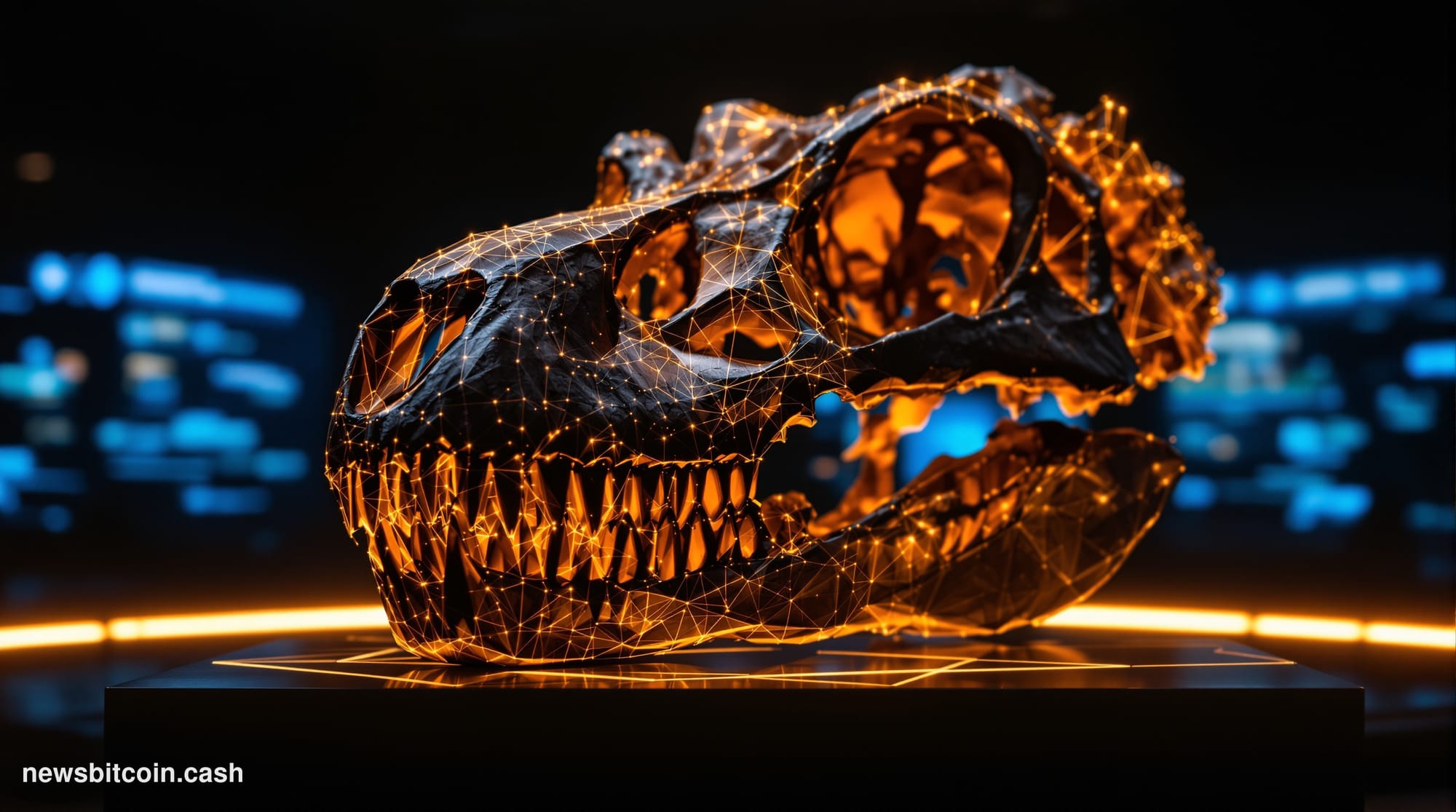
When Solana's co-founder stepped in to amplify a $660,000 fundraise built around a tokenized dinosaur skull, it wasn't just an eyebrow-raising social media moment. It was a signal — however unconventional — about where the real-world asset tokenization movement is heading, and how far blockchain infrastructure proponents are willing to stretch the definition of what belongs on a distributed ledger.
The asset in question, a tokenized dinosaur skull known as "Deaton," completed a raise of $660,000, with Solana's co-founder throwing his public weight behind the offering during its final hours. The timing of that endorsement matters: amplifying a deal in its closing window is a deliberate act, one designed to drive urgency and visibility at the moment they're needed most. Whether the co-founder was a participant, an advisor, or simply an enthusiastic observer, the signal sent to the broader market was clear — tokenized physical assets, even ancient ones, are being taken seriously at the highest levels of the blockchain industry.
Tokenizing the Prehistoric: Why It's Not as Strange as It Sounds
Real-world asset (RWA) tokenization has spent the better part of three years evolving from a theoretical exercise into a genuine market category. Tokenized U.S. Treasury bonds, real estate fractional ownership, fine art, and commodity-backed instruments have all found traction on public and permissioned blockchains. A dinosaur skull fits within that lineage more logically than it might appear at first glance. Rare fossils are established alternative assets — verifiably scarce, culturally significant, and historically difficult to access for anyone outside the museum or high-net-worth collector class.
Tokenization changes that access equation. By representing ownership of the Deaton skull as digital tokens on a blockchain, the offering theoretically opens fractional participation to a far wider pool of buyers than a traditional private auction ever could. The $660,000 raised is not a trivial figure — it places this single fossil offering in the same bracket as serious early-stage venture rounds and meaningful real estate tokenization deals. That number demands to be taken at face value.
Solana's Infrastructure Ambitions Are the Real Story
The choice of Solana as the apparent platform for this transaction is worth scrutinizing beyond the headline novelty. Solana has aggressively positioned itself as the chain of choice for high-throughput, low-cost tokenization use cases. Its leadership has consistently courted institutional and alternative asset issuers who need transaction finality that Ethereum's base layer cannot always deliver economically at scale. A co-founder publicly backing a $660,000 tokenized fossil sale — especially in its final hours when market attention is most concentrated — fits a broader pattern of demonstrating that Solana's infrastructure can handle the eclectic, diverse wave of assets coming on-chain.
This is not charity or idle enthusiasm. Co-founders of major Layer-1 protocols are acutely aware that every high-profile tokenization event that runs successfully on their network is a proof-of-concept for future, larger deals. If a dinosaur skull can be tokenized, custodied, and traded with sufficient legal and technical integrity to raise $660,000, the implicit argument is that the infrastructure is ready for art collections, rare car fleets, and eventually institutional-grade commodity pools worth multiples of that figure.
The Legitimacy Question Remains Open
Enthusiasm from a high-profile blockchain founder does not resolve the structural challenges that RWA tokenization still faces at scale. Physical custody, legal enforceability of token-linked ownership rights, secondary market liquidity, and insurance frameworks for one-of-a-kind assets like rare fossils remain genuinely complex problems. A $660,000 raise in a niche asset class is a proof of concept, not a solved market. Buyers participating in something like the Deaton skull offering are operating with a degree of trust in the issuing platform's custody arrangements and legal documentation that is not yet standardized across the industry.
Regulators, too, are watching. As tokenized physical assets attract larger raises and more public attention — especially when amplified by co-founders of billion-dollar networks — the question of whether these instruments constitute securities becomes harder to sidestep. The $660,000 Deaton skull sale may be novel enough to fly under the radar today, but the broader RWA tokenization category will inevitably face sharper regulatory scrutiny as deal sizes and participation grow.
What This Means for the Market
The Deaton skull raise is a cultural and infrastructural data point arriving at a moment when RWA tokenization is one of the most actively funded verticals in the digital asset space. A co-founder-level endorsement from within the Solana ecosystem during the final hours of a $660,000 raise carries disproportionate weight: it normalizes the concept, drives urgency, and signals that serious builders view exotic physical asset tokenization as a legitimate frontier rather than a gimmick. The real test will come when deals of this nature scale into the tens of millions — and whether the legal, custodial, and regulatory plumbing can keep up with the ambition.
Written by the editorial team — independent journalism powered by Bitcoin News.