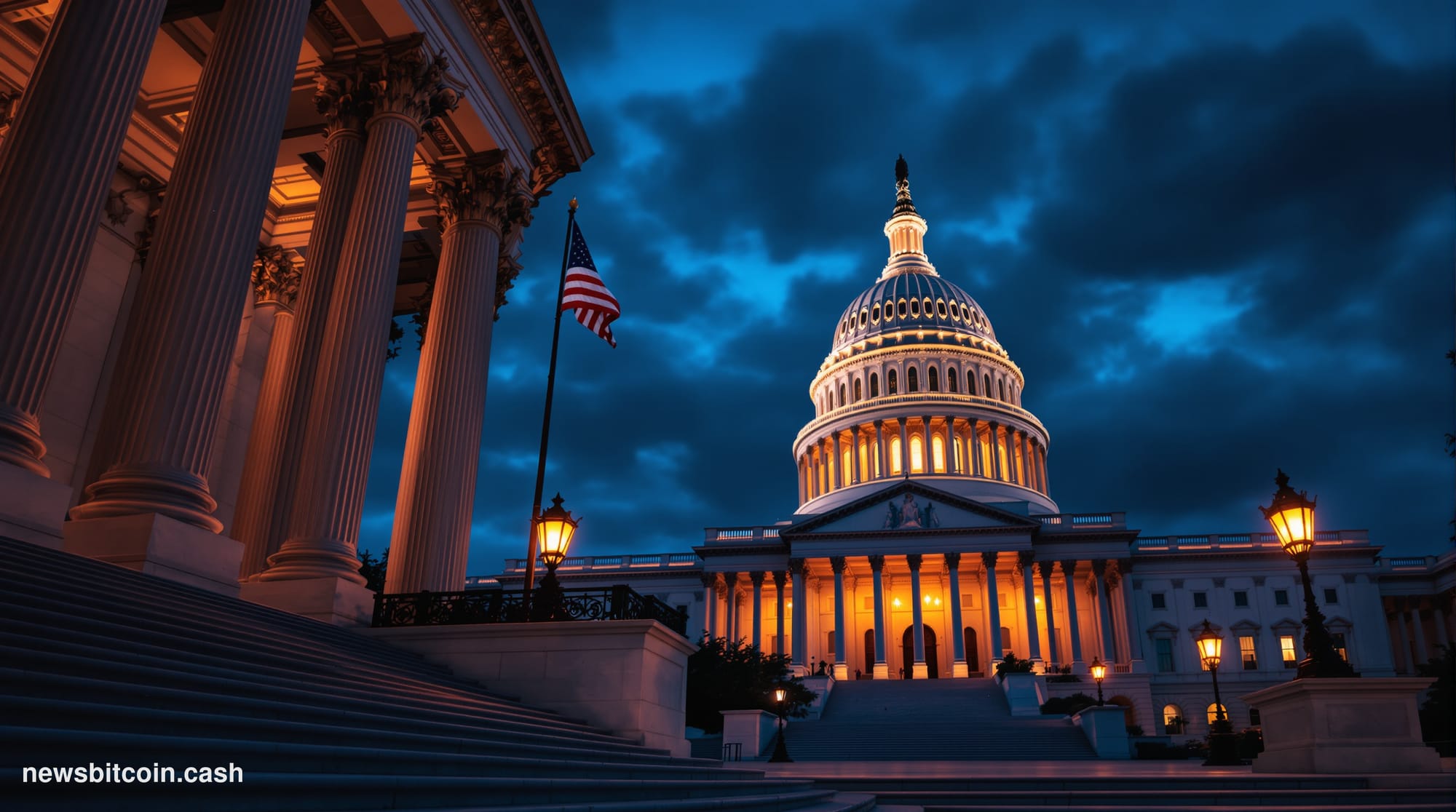
The United States Senate has locked in a vote for September 15 on the CLARITY Act, a piece of digital asset legislation whose passage — or failure — stands to become one of the most consequential regulatory moments in the short history of American crypto policy. After years of jurisdictional disputes, enforcement-by-lawsuit governance, and prolonged congressional inertia, a firm floor vote date signals that Washington may finally be ready to answer the question that has shadowed the industry since its inception: who regulates digital assets, and under what rules?
What the CLARITY Act Represents
The CLARITY Act — whose name alone signals its stated ambition — is designed to establish a coherent federal framework for digital assets, drawing clearer lines around how cryptocurrencies, tokens, and related instruments are classified and supervised. For an industry that has operated under a patchwork of Securities and Exchange Commission enforcement actions, Commodity Futures Trading Commission guidance, and state-level money transmission rules, the prospect of a single, legislatively defined regime is significant. The bill targets precisely the regulatory ambiguity that has driven billions of dollars in crypto-related business activity offshore, pushed major exchanges to structure around non-U.S. entities, and left retail investors without clear protections or recourse.
Why the Vote Date Matters
A scheduled Senate floor vote is meaningfully different from a committee hearing or a draft bill circulating among staffers. It means Senate leadership has determined there is sufficient support — or at least sufficient political will — to force a recorded position from every sitting senator. That is a high-stakes proposition in an environment where digital assets have become a genuinely bipartisan issue, with crypto-friendly legislators on both sides of the aisle and skeptics equally distributed. The September 15 date gives markets a fixed moment to price in outcomes, and investor confidence, as the source reporting makes clear, is directly implicated in what the Senate decides.
Market Dynamics Hanging in the Balance
The relationship between regulatory clarity and crypto market behavior is well-documented at this point. Every credible signal of forthcoming U.S. legislative order has historically correlated with increased institutional inflows, tighter bid-ask spreads on major pairs, and a general compression of the risk premium that sophisticated money attaches to domestic crypto exposure. Conversely, legislative failures — bills that die in committee, votes that collapse along partisan lines, or compromised language that satisfies no constituency — tend to reset that sentiment clock entirely. The CLARITY Act vote is therefore not merely a political event. It is a market event, and one with a known date on the calendar.
Institutional players who have been waiting for a defined legal perimeter before committing further capital now have a concrete inflection point to underwrite against. Whether the bill passes cleanly, passes with amendments that dilute its scope, or fails outright, each outcome carries distinct implications for asset valuations, exchange licensing strategies, and the long-running debate over whether the United States can remain a credible center of gravity for digital asset innovation or whether it has permanently ceded that ground to more permissive jurisdictions.
The Regulatory Stakes Are Structural, Not Cyclical
It would be a mistake to read the CLARITY Act vote purely through the lens of short-term price action. The deeper issue is structural. The absence of a coherent U.S. digital asset framework has created compounding distortions: legal uncertainty that inflates compliance costs, jurisdictional arbitrage that concentrates systemic risk in less-regulated markets, and an investor protection gap that policymakers across the political spectrum have acknowledged needs closing. A successful vote would not resolve all of these problems overnight, but it would establish a legislative foundation on which more detailed rulemaking could proceed.
Failure, on the other hand, would likely extend the current paradigm — one in which regulators rely on existing securities and commodities law to assert jurisdiction on a case-by-case basis, and in which the industry's legal exposure remains a function of enforcement priorities rather than settled statute. That outcome would not be neutral. It would actively disadvantage U.S.-domiciled participants relative to their international counterparts operating under frameworks like the European Union's Markets in Crypto-Assets regulation.
What This Means
September 15 is now the date that the digital asset industry, institutional investors, and global regulators watching Washington's moves will have circled. The CLARITY Act vote represents a rare confluence of legislative momentum and market consequence — a moment when a single recorded roll call will either accelerate the maturation of U.S. crypto infrastructure or confirm that American lawmakers remain unable to legislate coherently in a domain that has already reshaped global finance. The outcome will reverberate well beyond Capitol Hill, touching everything from exchange business models to the long-term trajectory of decentralized finance adoption in the world's largest economy.
Written by the editorial team — independent journalism powered by Bitcoin News.