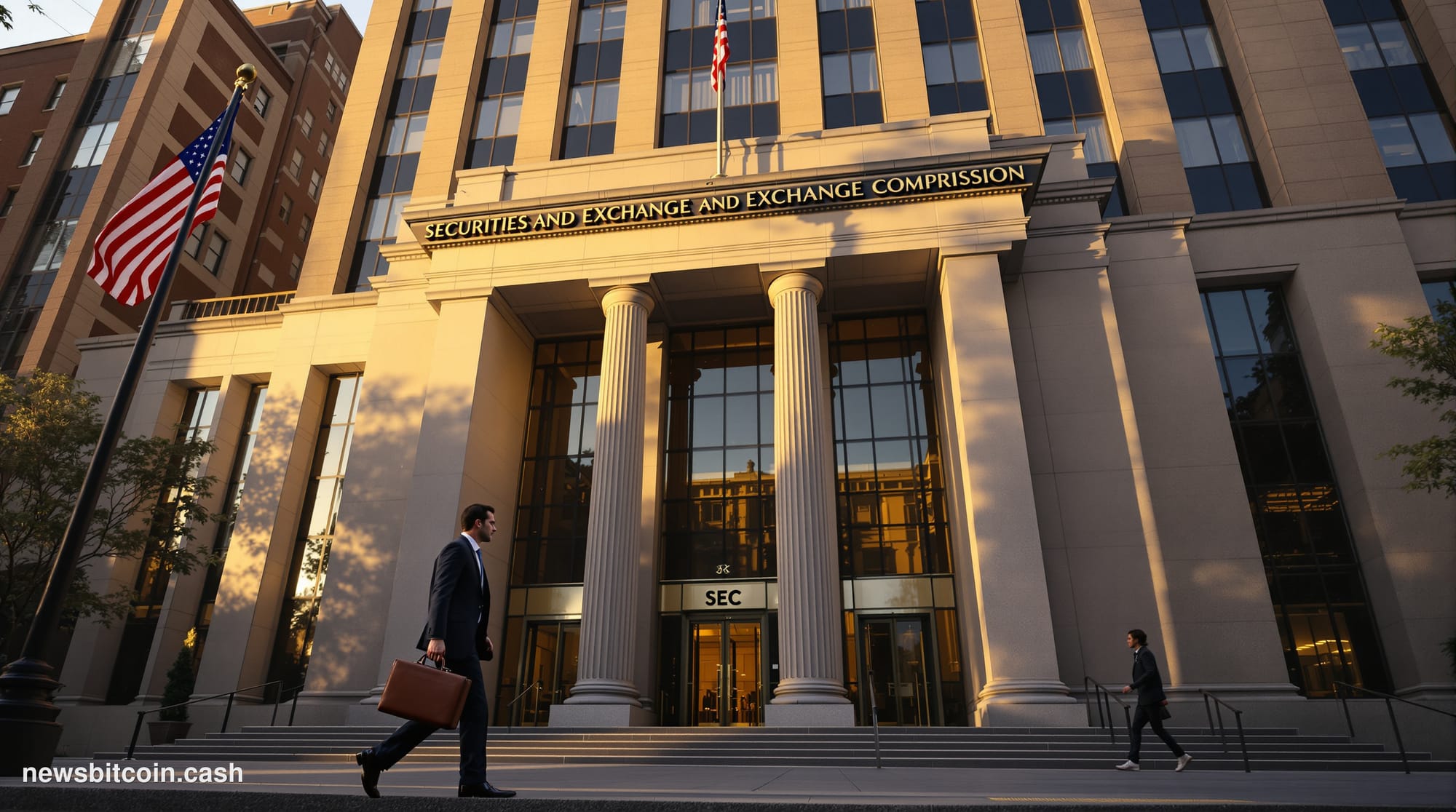
The U.S. Securities and Exchange Commission's staff has issued a no-action letter granting Canton Coin relief for token minting — a decision that positions the asset firmly outside the regulatory perimeter of securities law and into the emerging legal territory of digital commodities. It is a classification with consequences that reach far beyond a single project, arriving at a moment when the entire digital asset industry has been demanding clearer lines from Washington.
At the core of the SEC staff's reasoning are two interlocking arguments: first, that Canton Coin possesses genuine network utility, and second, that no controlling central party governs the network. These two criteria have long been treated by legal scholars and industry participants as the essential hallmarks of a commodity-like digital asset — the same conceptual framework that underpinned the SEC's earlier determinations that Bitcoin and, eventually, Ether did not qualify as securities. Canton Coin, in the staff's view, clears both bars.
No-action relief, for those unfamiliar with the procedural mechanics, does not constitute rulemaking. It is not legislation, and it does not carry the binding force of a court judgment. What it does represent is the considered opinion of SEC staff that, given the specific facts presented, they would not recommend enforcement action against Canton Coin for minting tokens without registering under federal securities law. For a project operating in a regulatory environment that has seen aggressive enforcement across the board, that assurance is not a minor footnote — it is a material green light.
The digital commodity framing matters enormously as a precedent-setting signal. For years, the SEC's posture under its previous leadership was to treat the vast majority of tokens as unregistered securities by default, forcing projects into a legal limbo where the only real defense was expensive litigation or flight offshore. The Howey Test — derived from a 1946 Supreme Court case involving Florida orange groves — became the blunt instrument applied to every blockchain-issued token regardless of its design or function. The Canton Coin determination suggests staff are now willing to engage with the specific architecture of a network before reflexively reaching for securities law.
The two criteria cited by the division deserve scrutiny. Network utility, in practice, means that Canton Coin serves a functional purpose within its ecosystem — it is not merely a speculative instrument sold to fund a development team, but a token with an operational role in how the network functions. The absence of a controlling central party speaks to decentralization: no single entity, by the staff's assessment, holds sufficient sway over Canton Coin's protocol to make purchasers dependent on that party's managerial efforts for their returns. Both are findings of fact, not law, which means they are inherently project-specific and highly sensitive to the underlying technical and governance reality of the network in question.
That specificity is both the strength and the limitation of this relief. Teams building genuinely decentralized infrastructure with meaningful on-chain utility can point to the Canton Coin letter as a navigational marker. But projects that have dressed up centralized token sales with decentralization rhetoric should take little comfort — the staff's analysis appears to be substantive rather than superficial. The no-action process requires detailed factual submissions, and the SEC's willingness to find commodity status here likely reflects that Canton Network's architecture made a credible case on both dimensions.
From an infrastructure standpoint, Canton Network has been positioning itself as a privacy-enabled, institutional-grade blockchain designed for financial markets — a permissioned-but-interoperable environment aimed squarely at regulated entities like banks and asset managers. That context likely informed the staff's analysis. A network built to serve institutional financial infrastructure, with tokenomics tied to network participation rather than passive investment returns, presents a meaningfully different profile than a typical initial coin offering structured around speculative upside.
What This Means
For the broader digital asset market, the Canton Coin no-action letter is a data point in a still-incomplete regulatory picture, but it is a significant one. It demonstrates that the SEC's division is capable of engaging with the technical substance of a blockchain network and arriving at a commodity classification — without waiting for Congress to deliver comprehensive crypto market structure legislation. Teams that have invested in genuine decentralization and coherent token utility now have a clearer procedural pathway to seek similar relief. The standard, however, remains demanding: the absence of a controlling central party and demonstrable network utility are not boxes to be checked on a whitepaper — they are factual determinations that must be defensible under regulatory scrutiny. Canton Coin has cleared that bar. The question now is how many other projects can honestly say the same.
Written by the editorial team — independent journalism powered by Bitcoin News.