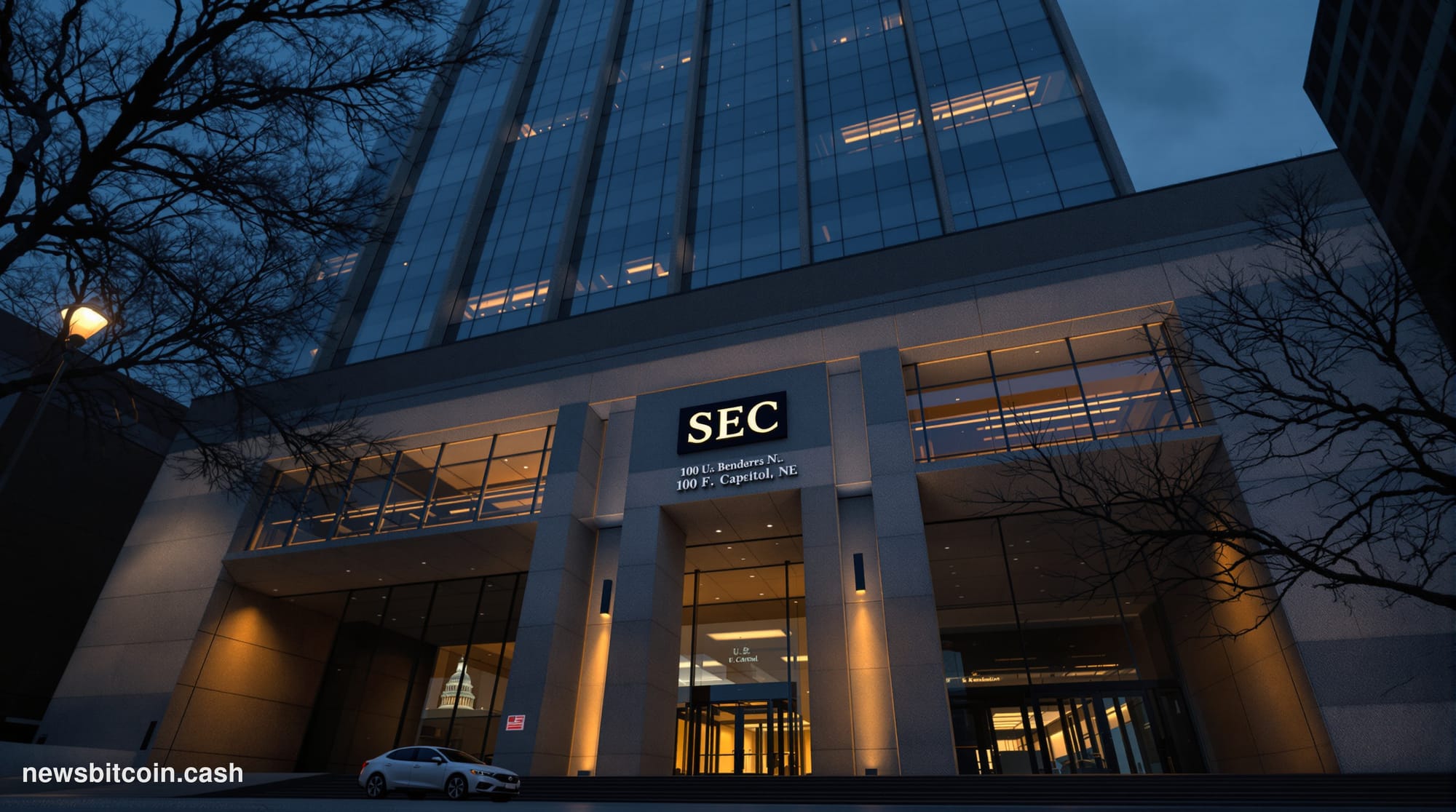
Two pillars of U.S. crypto regulatory progress collapsed within days of each other this week. The Securities and Exchange Commission has cancelled a scheduled crypto rulemaking meeting with no replacement date on the books, arriving on the heels of the Senate's failure to advance the Crypto Clarity Act. Together, the twin setbacks leave an industry that has been desperately seeking legal footing staring into a prolonged and deepening institutional silence.
The SEC offered a brief and opaque explanation for pulling the meeting — an "unforeseen scheduling issue" — a bureaucratic phrase that tells the market almost nothing while signaling something significant: the Commission's internal clock on crypto rulemaking has no confirmed reset. For an agency that has spent years navigating accusations of regulation-by-enforcement rather than clear rule-writing, the absence of a rescheduled date is not a minor procedural footnote. It is a policy statement in itself.
The timing compounds the problem considerably. The Senate's decision to punt the Crypto Clarity Act — legislation designed to draw firm jurisdictional lines between the SEC and the Commodity Futures Trading Commission over digital assets — had already sent a deflating signal to market participants who believed 2026 would finally be the year Washington delivered coherent crypto law. When the SEC then cancelled its own rulemaking session within days, any remaining optimism about near-term regulatory clarity took a measurable hit.
It is worth pausing on what the Crypto Clarity Act was meant to accomplish. For years, one of the central fault lines in U.S. digital asset policy has been jurisdictional ambiguity: whether a given token is a security regulated by the SEC or a commodity sitting under the CFTC's purview. That ambiguity has driven enforcement actions, chilled institutional investment, pushed development offshore, and spawned years of litigation. The Clarity Act represented one of the more serious legislative attempts to resolve that question with statutory authority rather than case-by-case agency discretion. The Senate's failure to move it forward means that foundational question remains legally unresolved.
Into that vacuum, the SEC's cancelled meeting lands with particular weight. Rulemaking meetings — formal, public, on-record processes — are one of the few mechanisms through which agencies can create durable, defensible legal standards. They are slower than enforcement actions but they produce frameworks that companies can actually build compliance programs around. When such a meeting is cancelled with no rescheduling, the industry loses a concrete near-term checkpoint on the regulatory calendar. Projects, exchanges, and institutional participants are left recalibrating their compliance timelines against a blank slate.
Critics of the SEC's approach to crypto will argue this pattern is familiar: the Commission moves decisively when bringing enforcement actions but hesitates when it comes to proactive rule-writing that would constrain its own discretion. Whether or not that characterization is entirely fair, the optics of cancelling a crypto rulemaking session days after Congress failed to pass the defining crypto legislation of the session are difficult to spin constructively. The phrase "unforeseen scheduling issue" does little to address the industry's concern that the regulatory apparatus simply lacks the urgency that the market's maturity now demands.
There is also a broader institutional dynamic at play. Regulatory bodies operate in political environments, and when congressional momentum on a major policy question stalls, agencies often find it easier to slow their own processes rather than get ahead of a legislature that has not yet spoken. The SEC cancelling its meeting in the wake of the Senate's inaction may reflect that quiet institutional logic — a bureaucratic deference to legislative primacy that, whatever its internal justification, translates on the ground to more months of uncertainty for an industry that has been navigating grey zones for well over a decade.
What this means practically is straightforward and uncomfortable: no near-term statutory definition of what constitutes a crypto security or commodity, and now no confirmed date for the SEC to advance its own rulemaking framework to fill that gap. Projects operating in the U.S. market face the same fundamental compliance risk they have faced for years — the threat that any token, product, or exchange function could be retroactively deemed a securities violation. For institutional players evaluating market entry or expansion, that is not an abstraction. It is a direct input into risk models and legal budgets. The dual collapse of legislative and regulatory momentum in the same week is the clearest signal yet that the U.S. crypto policy environment, for all its recent energy, remains structurally unresolved — and that the cost of that ambiguity continues to accrue, quietly, to every participant in the market.
Written by the editorial team — independent journalism powered by Bitcoin News.