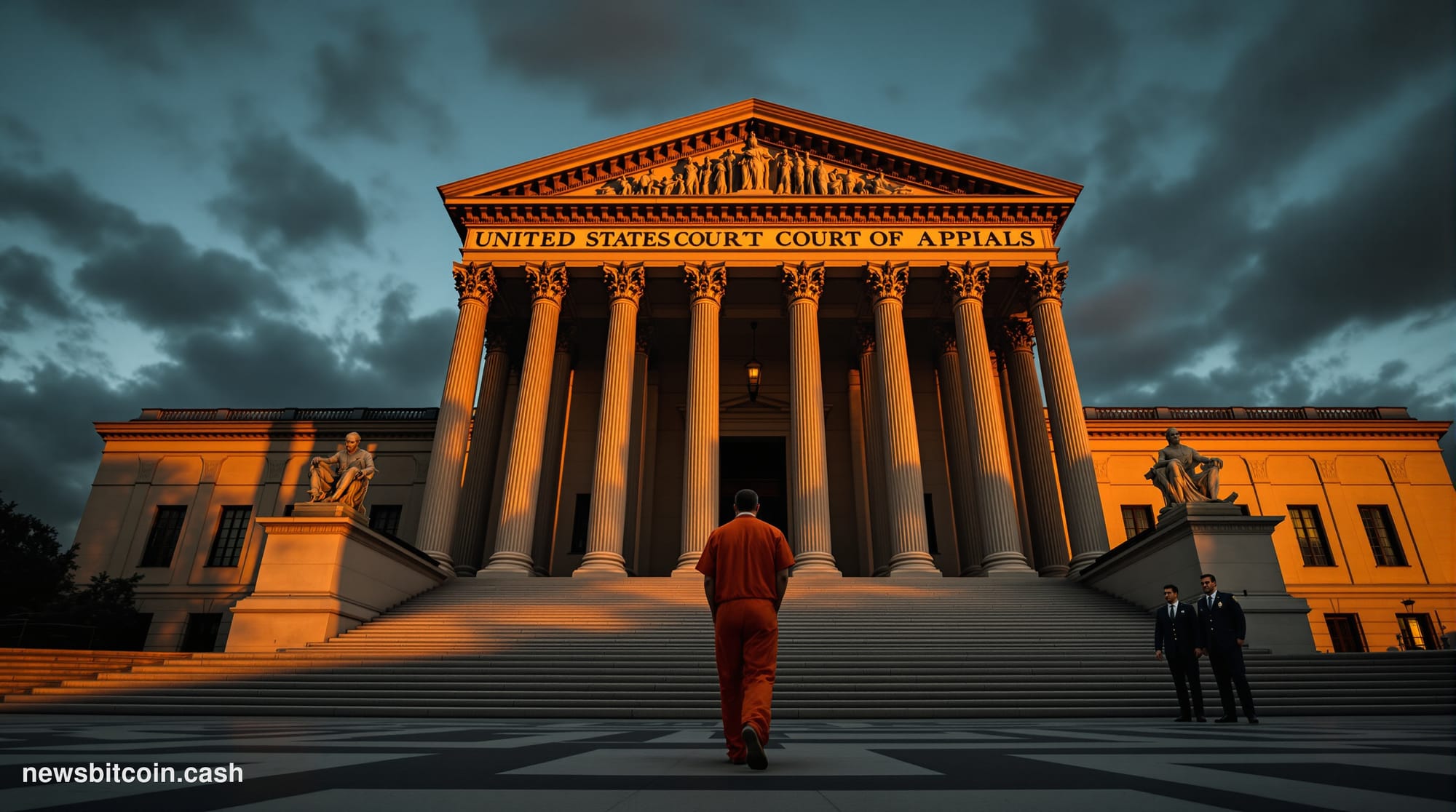
The crypto industry's most notorious collapse has reached its legal conclusion. Sam Bankman-Fried, the disgraced founder of FTX, saw his final attempt at freedom crushed today as a federal appeals court rejected his bid to overturn both his fraud conviction and 25-year prison sentence. The ruling represents a definitive end to one of the largest financial fraud cases in American history, involving $8 billion in missing customer funds and cementing new accountability standards for crypto executives.
The appeals court's decision validates the original trial's findings that Bankman-Fried orchestrated a massive fraud scheme through his crypto empire. His legal team had argued for a new trial, claiming procedural unfairness in the proceedings that led to his conviction. These arguments failed to persuade the appellate judges, who upheld both the guilty verdict and the substantial prison term that will keep the former crypto billionaire behind bars until well into his forties.
This judicial finality arrives at a critical juncture for digital asset markets. The FTX collapse in November 2022 sent shockwaves through the crypto ecosystem, wiping out billions in market value and triggering a crisis of confidence that persists today. Customer funds that investors believed were safely held in segregated accounts had been secretly diverted to Alameda Research, Bankman-Fried's trading firm, where they were lost in high-risk bets. The $8 billion hole in FTX's balance sheet represented one of the most brazen misappropriations of customer assets in financial history.
The appeals court's rejection of Bankman-Fried's claims sends an unmistakable signal about judicial attitudes toward crypto fraud. Unlike the early days of digital assets, when regulatory ambiguity provided some cover for questionable practices, courts are now applying traditional financial fraud standards with full force. The 25-year sentence reflects judicial recognition that crypto crimes deserve punishment commensurate with their massive scale and impact on innocent investors.
For the broader cryptocurrency industry, today's ruling establishes important precedent about executive accountability. The decision demonstrates that crypto's technological innovation provides no immunity from fundamental principles of fiduciary duty and customer protection. Exchange operators and crypto fund managers can no longer assume that regulatory gaps or technological complexity will shield them from prosecution for traditional fraud schemes dressed in digital clothing.
The FTX case also highlights the evolution of crypto prosecutorial capabilities. Federal authorities successfully navigated complex blockchain transactions, cryptocurrency mechanics, and international corporate structures to build an ironclad case against Bankman-Fried. This prosecutorial sophistication suggests that other crypto executives engaging in questionable practices should expect increasingly effective law enforcement attention.
Market participants are already adapting to this new reality. Major exchanges like Coinbase and Binance have implemented enhanced transparency measures and customer fund protection protocols. Institutional investors are demanding proof-of-reserves audits and segregated custody arrangements before committing capital. The regulatory environment is crystallizing around clear principles of customer protection and operational transparency.
The finality of Bankman-Fried's conviction also provides closure for FTX's victims, who lost billions in the exchange's collapse. While bankruptcy proceedings continue to recover assets for creditors, the criminal case's conclusion removes any lingering uncertainty about accountability for the fraud. This clarity should help restore some investor confidence in properly regulated crypto platforms and legitimate digital asset businesses.
Looking forward, the FTX case will likely serve as a watershed moment for crypto regulation and industry practices. The harsh consequences faced by Bankman-Fried demonstrate that crypto innovation must operate within established legal frameworks protecting investors and customers. As the industry matures, this precedent should help separate legitimate blockchain businesses from fraudulent schemes exploiting crypto's reputation for disruption.
Written by the editorial team — independent journalism powered by Bitcoin News.