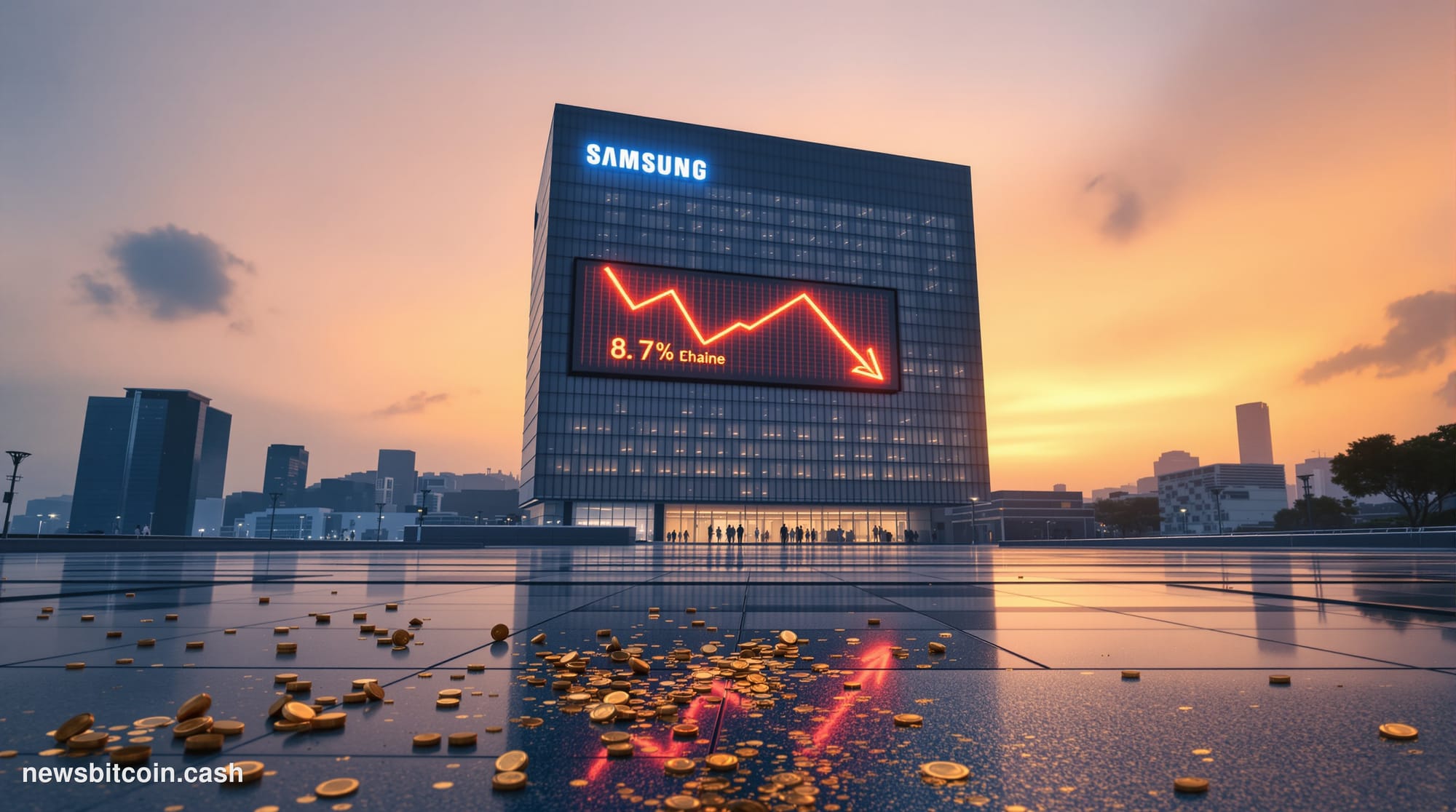
When a company announces a record $79 billion shareholder return plan, markets are supposed to cheer. Instead, Samsung Electronics watched its stock collapse 8.7% on Monday, trading near 257,000 won — a drop of 24,500 won from Friday's closing price — and surrendering every gain the board announcement had previously generated. It is a rare and telling signal: size alone no longer buys confidence on the trading floor.
A Record That Became a Referendum
The $79 billion figure is not a small gesture. By any conventional measure, committing that sum to shareholder returns should register as a landmark moment of corporate generosity, a signal to long-term holders that management is aligned with their interests. But capital markets are not moved by headline numbers in isolation. What investors ultimately price is the credibility of the plan, the financial health underpinning it, and the broader strategic context in which the commitment is made. In Samsung's case, Monday's trading session suggests the market found at least one of those three pillars unconvincing.
The fact that the stock not only failed to hold its post-announcement gains but actively erased them entirely is particularly damning. It implies that the board's announcement had generated a temporary, sentiment-driven rally — the kind that evaporates the moment institutional desks sit down to model the actual numbers. When the math does not support the enthusiasm, the correction tends to be swift and unforgiving.
What the Selloff Is Really Telling Us
A decline of 8.7% in a single session for a company of Samsung's scale represents serious money leaving the table. For context, Samsung Electronics is one of the largest technology conglomerates on the planet, with its components division supplying chips to competitors, automakers, and consumer electronics manufacturers worldwide. A move of this magnitude is not retail noise. It reflects institutional repositioning — fund managers and sovereign vehicles reassessing their exposure in light of what the plan actually delivers versus what they had expected.
The market's logic appears straightforward, if harsh: a record payout plan funded from a balance sheet that investors already consider stressed — or insufficiently competitive against rivals in advanced semiconductor manufacturing — reads less as generosity and more as a substitution for a growth strategy. When a technology company cannot credibly articulate a path to dominant market share in the next technology cycle, returning cash to shareholders can look like an admission of limited internal investment opportunities. Whether or not that is a fair characterization of Samsung's position, it is the narrative the Monday session crystallized.
The Semiconductor Backdrop
Samsung's travails do not exist in a vacuum. The global semiconductor industry is navigating one of its most consequential realignments in decades, driven by artificial intelligence compute demands, geopolitical supply chain pressures, and the aggressive capital expenditure commitments of rivals including TSMC and SK Hynix. In that environment, investors scrutinize every allocation decision with unusual intensity. A $79 billion commitment directed toward shareholders rather than toward next-generation fabrication capacity or advanced memory architecture will inevitably draw questions about long-term competitiveness.
For the crypto and digital assets sector specifically, Samsung's position matters more than casual observers might assume. The company's semiconductor output underpins the hardware layer of a significant portion of blockchain infrastructure — from the mining rigs that secure proof-of-work networks to the application processors powering mobile wallets and hardware security modules used in institutional custody solutions. Any signal of strategic uncertainty at Samsung carries downstream implications for the hardware ecosystem that the digital asset industry depends on.
What This Means
Monday's selloff is a case study in the limits of financial engineering as a substitute for strategic conviction. Samsung assembled a record-breaking $79 billion return plan, watched its share price rally on the announcement, and then saw the entirety of that rally — and more — obliterated once investors had time to absorb the details. The stock's fall to approximately 257,000 won, down 24,500 won in a single session, encodes a straightforward verdict: the market expected something different, something more forward-looking, and it voted accordingly with capital.
For digital asset investors tracking the hardware and infrastructure layer, the episode is a reminder that even the largest incumbents face credibility tests in a market cycle defined by rapid technological transition. The question Samsung now faces is whether it responds with a sharper strategic narrative or allows the selloff to define the next chapter of investor relations. History suggests the window for that answer is shorter than most boards would prefer.
Written by the editorial team — independent journalism powered by Bitcoin News.