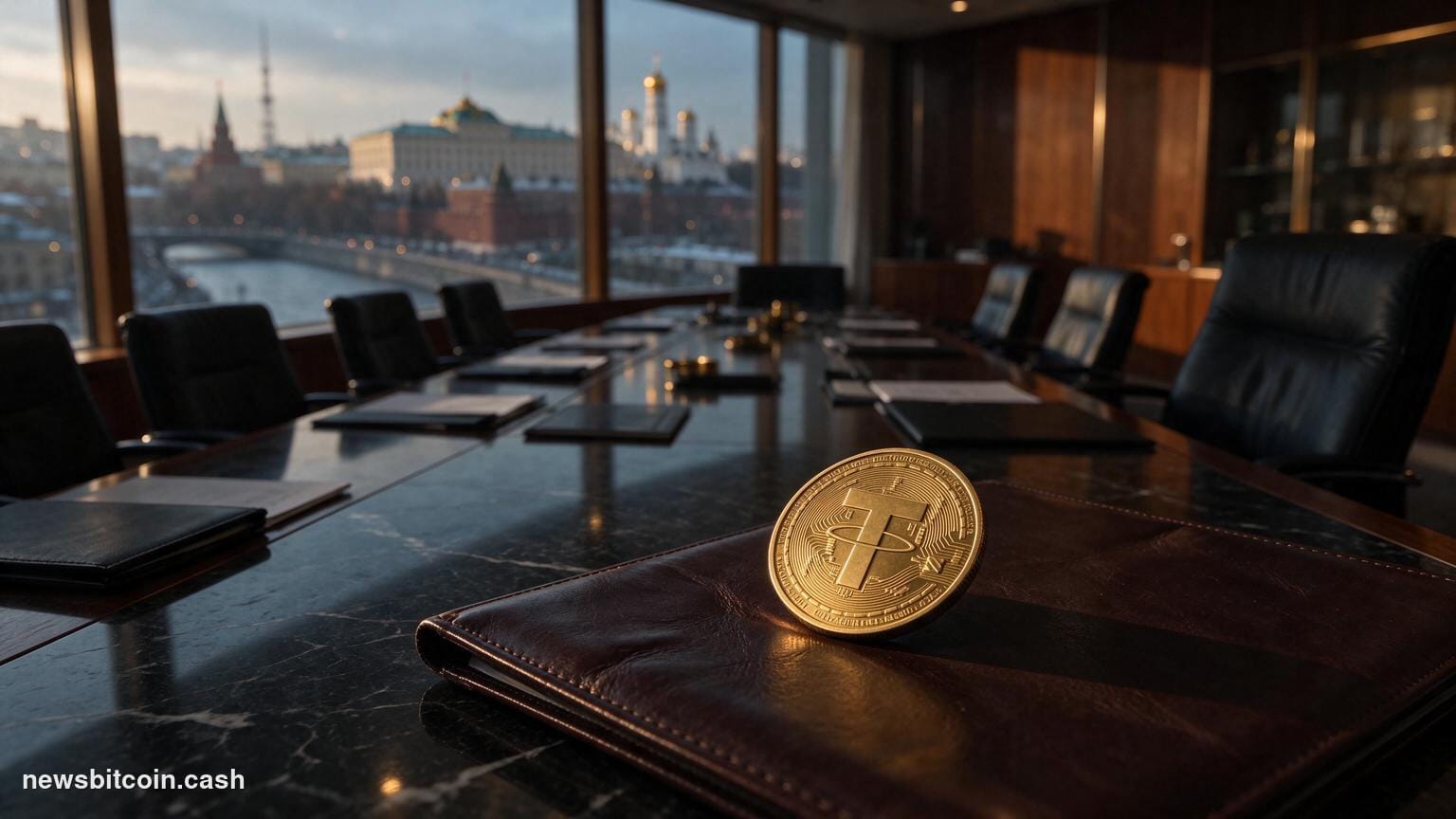
A Financial Times investigation has drawn back the curtain — even if only slightly — on one of the most opaque corners of the global financial system: the ownership structure of Tether, the privately held company behind USDT, the world's dominant stablecoin. According to the FT's reporting, Russian investor Vitaly Bezrodnykh holds a multibillion-dollar stake in the company, an investment he made around 2017, when stablecoins were barely a footnote in cryptocurrency discourse and regulatory frameworks for digital assets were virtually nonexistent.
The revelation is significant not merely because of the size of the stake — multibillion-dollar ownership positions in privately held financial infrastructure companies do not surface without consequence — but because of the broader questions it reopens about who, exactly, controls the rails that move hundreds of billions of dollars in digital value every single day. USDT has grown to become the dominant stablecoin in the world, deeply embedded in trading pairs, decentralized finance protocols, and cross-border payment corridors from Southeast Asia to Latin America. That infrastructure is now inseparably linked to this disclosure.
Tether has long operated as one of the most consequential and least transparent private companies in modern finance. It does not publish a full audit. Its ownership has never been comprehensively disclosed. Its principals — most prominently Chief Executive Officer Paolo Ardoino and the broader iFinex group — have resisted detailed scrutiny even as the company has grown into a systemically important issuer. When a company of this scale reveals a previously unreported ownership connection of this magnitude, it is not a footnote. It is a structural fact that markets, regulators, and institutional counterparties must now absorb.
The timing of Bezrodnykh's investment, circa 2017, is worth contextualizing. That year, USDT was still a relatively niche instrument, primarily used to park value on cryptocurrency exchanges without converting back to fiat. The notion that a stablecoin would eventually command a market capitalization in the tens of billions of dollars — and become the primary liquidity layer for global crypto markets — was speculative at best. Whoever invested in Tether at that stage was making a bet on infrastructure, not on a token price. That bet has paid off at a scale few early investors in any asset class can claim.
From a regulatory standpoint, this disclosure arrives at a particularly charged moment. The United States, the European Union, and multiple other jurisdictions are actively constructing or refining stablecoin oversight frameworks. In the U.S., stablecoin legislation has moved through Congressional debate with questions of issuer transparency, reserve composition, and beneficial ownership at its core. The Markets in Crypto-Assets regulation — known as MiCA — in Europe similarly demands rigorous disclosure from stablecoin issuers operating in the bloc. A multibillion-dollar Russian ownership stake in the world's largest stablecoin issuer, surfacing now, will almost certainly accelerate calls for Tether to open its books more fully to regulatory examination.
The geopolitical dimension cannot be dismissed either. Since Russia's invasion of Ukraine in 2022, Western governments have constructed an extensive architecture of financial sanctions targeting Russian capital. Regulators and law enforcement agencies have scrutinized the degree to which cryptocurrency — and stablecoins specifically — have been used to route around those restrictions. Tether itself has responded to some of those concerns, working with law enforcement to freeze addresses linked to sanctioned entities on specific occasions. But the existence of a large Russian ownership stake that apparently predates the current sanctions regime adds a layer of complexity that compliance officers and policymakers will need to parse carefully.
It is also worth noting what the FT report does not appear to establish: that Bezrodnykh's ownership itself represents a sanctions violation, or that there is evidence of improper conduct. The investment dates to 2017, a period well before the current geopolitical environment hardened into its present form. The legal and regulatory analysis of what that stake means today, under current sanctions frameworks, is a question for lawyers and regulators — not one settled by the report alone. But disclosure of previously unknown ownership at this scale is precisely the kind of data point that makes that analysis necessary.
What This Means for Stablecoin Infrastructure
For anyone building on or transacting through USDT — which at this point includes nearly every significant participant in crypto markets globally — this report underscores a persistent and unresolved risk: the ownership of critical financial infrastructure remains poorly lit. Stablecoins are no longer niche instruments. They function as settlement layers, as savings vehicles in hyperinflationary economies, and increasingly as the connective tissue between traditional finance and decentralized protocols. Infrastructure of that consequence requires ownership transparency commensurate with its systemic importance. The FT's report does not resolve that gap — it widens the case for closing it.
Written by the editorial team — independent journalism powered by Bitcoin News.