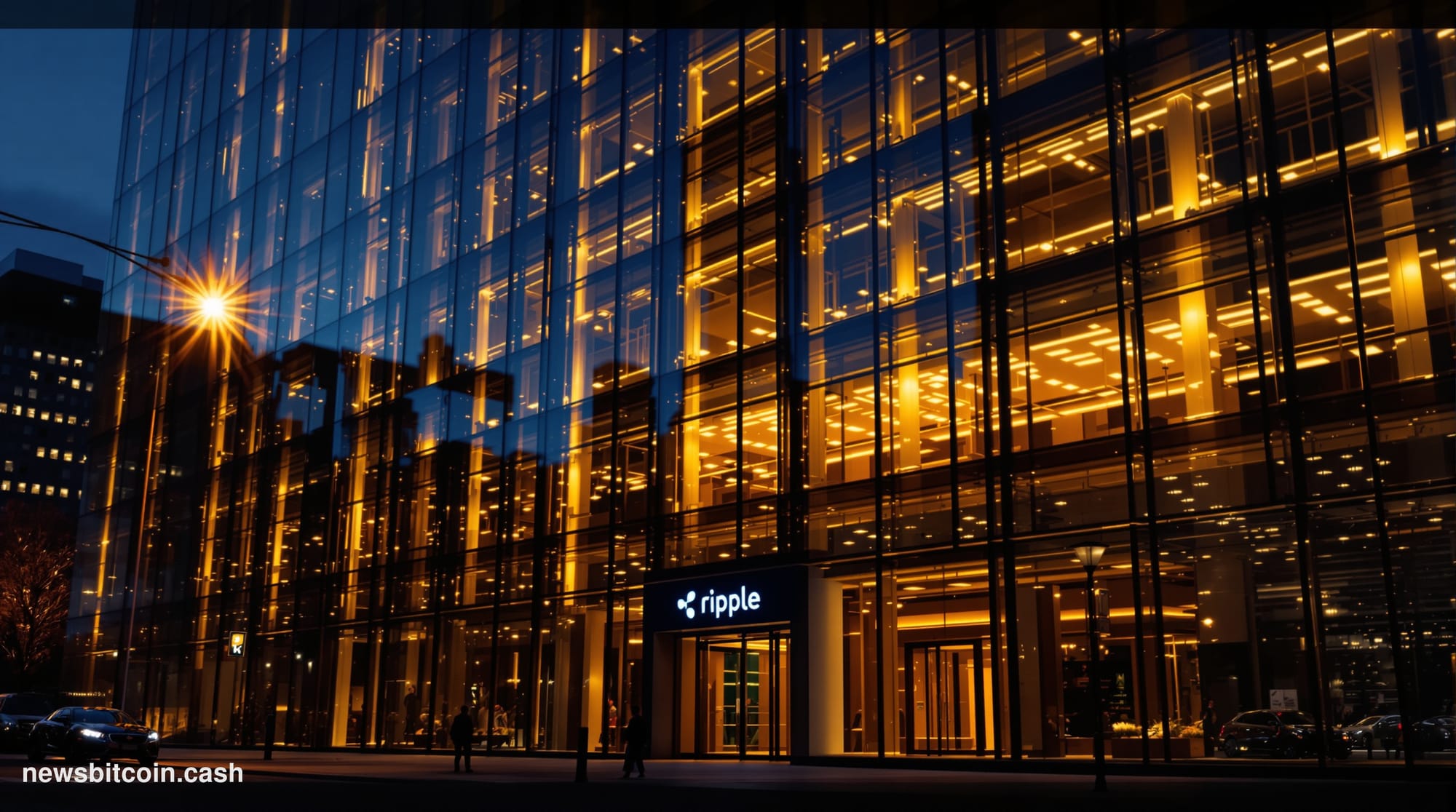
Ripple has closed a $275 million private placement earmarked specifically for expanding its footprint across the United States, a move that arrives alongside an investment-grade credit rating and signals the company's intent to become a dominant force in domestic digital asset brokerage. The dual development — fresh institutional capital combined with a credentialed balance sheet — puts Ripple in a category few crypto-native firms have ever occupied, and raises a pointed question for the industry: is this the moment a blockchain payments company genuinely breaks into the mainstream financial services tier?
What the $275M Actually Buys
Private placements of this scale are not routine in the digital asset sector, and the structure matters as much as the size. Unlike a public equity raise or a token sale, a private placement targets accredited and institutional investors directly, carrying implicit signals about governance discipline and financial transparency. For Ripple, closing $275 million through this mechanism suggests the company was able to present audited financials, forward revenue projections, and a credible operational roadmap convincing enough to attract sophisticated capital — without resorting to the retail hype cycles that have defined so many crypto fundraises over the past decade.
The designated use of funds — US expansion — is equally telling. Ripple has spent years navigating a bruising legal battle with the United States Securities and Exchange Commission (SEC) over the classification of its XRP token, a conflict that forced the company to build much of its commercial momentum offshore, particularly across Asian and Middle Eastern payment corridors. A $275 million domestic deployment signals genuine confidence that the US regulatory environment has shifted sufficiently to make aggressive domestic investment rational. Whether that confidence is rewarded will depend on how quickly the brokerage and payments infrastructure can be stood up and monetized.
The Investment-Grade Rating Changes the Game
Perhaps more consequential than the funding amount is the investment-grade rating Ripple has secured. In traditional finance, an investment-grade designation from a recognized ratings agency is the credential that unlocks access to pension funds, insurance pools, corporate treasury programs, and a host of institutional counterparties that are structurally prohibited from engaging with sub-investment-grade or unrated entities. For a crypto-native firm, holding that designation is transformative.
It means Ripple can now appear on the approved counterparty lists of financial institutions that would otherwise be legally or policy-barred from doing business with it. It means treasury departments at Fortune 500 companies can engage Ripple's services without triggering internal compliance flags. And it means Ripple's debt instruments — should the company choose to issue them — would be eligible for inclusion in investment-grade bond indices, a distribution channel with trillions of dollars of passive capital flowing through it. In short, the rating is not a vanity metric. It is a structural unlocking of an entirely different tier of commercial relationships.
Reshaping the US Digital Asset Brokerage Landscape
The US digital asset brokerage space is already contested terrain. Coinbase holds a public company profile and a growing institutional custody business. Traditional financial giants have been steadily acquiring crypto infrastructure or building their own digital asset desks. Into this environment, Ripple is arriving with a $275 million war chest, an investment-grade balance sheet, and a payments heritage built on cross-border transaction infrastructure that most pure-play brokerages cannot match.
That payments-plus-brokerage combination is a genuine differentiator. Where most digital asset brokerages compete on trading fees, liquidity, and user interface, Ripple can theoretically offer institutional clients an integrated pipeline — from fiat on-ramp through cross-border settlement to digital asset custody and brokerage — under a single counterparty with investment-grade standing. For corporate treasury clients and mid-tier financial institutions looking to consolidate vendor relationships, that bundled proposition is genuinely attractive in ways that a standalone brokerage account is not.
Risks That Capital Alone Cannot Resolve
None of this means the road ahead is smooth. Investment-grade ratings require continuous maintenance, and any deterioration in Ripple's balance sheet or governance could see that designation revised downward, with significant commercial consequences. US expansion at scale requires regulatory licensing across multiple jurisdictions within the country — money transmitter licenses, broker-dealer registration, and potentially banking-adjacent charters — each of which carries its own timeline and compliance burden. And the competitive response from incumbents will be swift; Coinbase and others are unlikely to cede institutional ground without a fight.
There is also the broader market context. Ripple's ability to deploy $275 million productively depends on institutional appetite for digital asset services remaining strong — an assumption that has historically proven fragile. The company is making a large, long-duration bet on the regulatory and market environment sustaining the conditions that make this expansion logical. That bet is more credible today than it would have been two years ago, but it is still a bet.
What This Means for the Industry
Ripple's private placement and investment-grade rating represent a maturation moment — not just for the company, but for the sector. When a blockchain-native firm can raise $275 million through institutional channels, secure a credit rating that opens the doors of pension funds and corporate treasuries, and pivot that capital toward US domestic infrastructure buildout, the industry is operating in a fundamentally different register than the speculative cycles of previous years. The competitive edge this combination provides is real, and its effect on the US digital asset brokerage landscape will be worth watching closely as deployment begins.
Written by the editorial team — independent journalism powered by Bitcoin News.