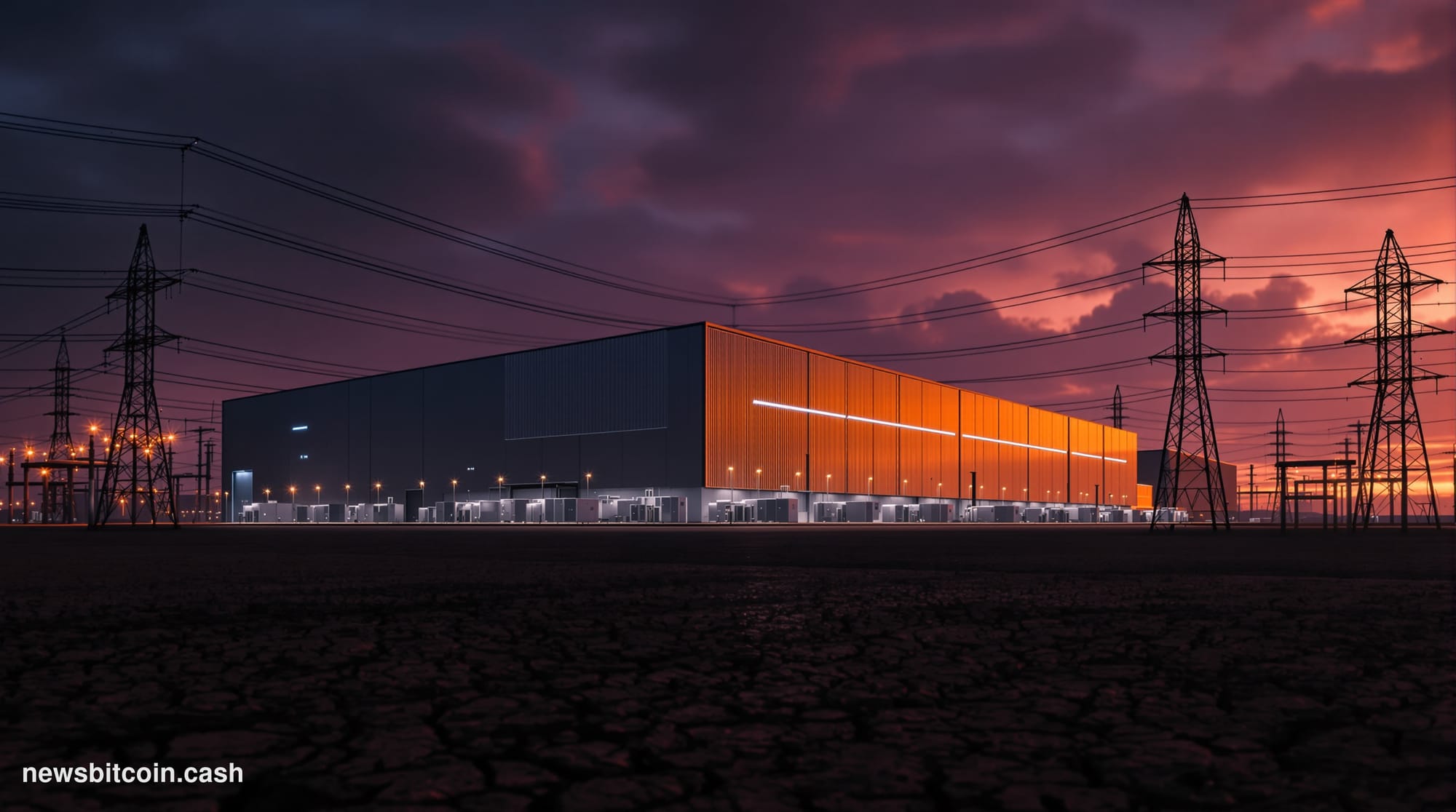
When a Bitcoin miner signs a $9.1 billion lease to turn its mining campus into an artificial intelligence data center, the industry should pay attention. Riot Platforms has done exactly that, inking a 20-year agreement to lease its Texas Bitcoin mining facility as an AI data center — a deal that averages $457 million per year and stretches across two decades. The announcement is not merely a corporate pivot; it is a candid acknowledgment that the economics of proof-of-work mining have fundamentally shifted, and that the most valuable asset Riot owns may no longer be the coins it digs out of the blockchain.
The numbers underlying this decision are stark. Last quarter, Riot's fully costed Bitcoin mining operation ran at 126.5% of the value of the coins it actually produced. That figure deserves to linger: for every dollar of Bitcoin Riot mined, it spent more than a dollar and a quarter doing so. Mining was, by any honest accounting, a loss-generating activity. The $9.1 billion lease deal did not emerge from boardroom ambition alone — it emerged from a spreadsheet that made uncomfortable reading.
The Infrastructure Arbitrage
What Riot holds in Texas is not just mining hardware and warehouses. It is something far more strategically valuable in 2026: massive electrical infrastructure, pre-permitted land, established grid connections, and industrial-scale cooling systems. These are precisely the assets that artificial intelligence compute providers are desperate to acquire, and they take years — sometimes a decade — to build from scratch through conventional real estate development. Riot's willingness to lease rather than sell suggests the company wants to retain long-term ownership of the physical plant while monetizing it immediately and reliably through a tenant relationship.
At $457 million per year in projected average revenue, the lease transforms Riot's financial profile in ways that Bitcoin mining simply cannot match at current economics. Mining revenue is volatile, tied to Bitcoin's price, network difficulty, and the halving cycle. Lease revenue is contractual. For a publicly listed company managing investor expectations across a 20-year horizon, the difference between those two income streams is not just financial — it is existential. One requires praying for bull markets; the other requires a functioning building and a creditworthy tenant.
A Mirror for the Broader Mining Industry
Riot's move does not exist in a vacuum. Across the Bitcoin mining sector, large-scale operators that built out gigawatts of capacity during the bull markets of 2021 and 2023 are confronting the same structural reality: the post-halving environment compresses margins brutally, and energy costs that were tolerable at $60,000 per Bitcoin become punishing at anything approaching production cost parity. When fully costed mining runs above 100% of coin production value — as Riot's did last quarter — the business case for continuing to mine at scale becomes a question of faith in future price appreciation rather than present operational logic.
The AI compute boom has provided an unexpected escape valve. Hyperscalers and AI infrastructure companies are locked in a race to secure compute capacity, and the electrical and thermal infrastructure that miners built — often in rural areas with access to cheap power — maps almost perfectly onto what AI data centers require. The arbitrage is geographic, electrical, and temporal: miners built fast, and AI companies need capacity now. The Texas facility Riot is leasing out represents a convergence of those two realities.
What the Lease Structure Says About Riot's Confidence
A 20-year lease is an unusual instrument in an industry measured in four-year halving cycles. Riot's willingness to commit its Texas infrastructure to a tenant for two decades implies one of two things: either the company has concluded that large-scale Bitcoin mining at that site is unlikely to be economically superior to the lease income for a very long time, or it has structured the deal with sufficient flexibility to evolve its operations at other facilities. Either interpretation points toward a company that is consciously repositioning itself from pure-play Bitcoin miner to diversified digital infrastructure operator — a category that arguably commands a different, and potentially more generous, valuation multiple from public markets.
The $9.1 billion total figure is also significant in terms of counterparty signaling. Committing to nearly a decade's worth of revenue in a single contract requires a tenant of substantial size and financial credibility. The scale of the commitment, structured over 20 years, reflects how seriously the AI infrastructure buildout is being treated by both sides of the transaction — this is not a short-term experiment but a generational bet on compute demand.
What This Means for Bitcoin Mining's Identity
Riot's Texas lease deal crystallizes a question the industry has been avoiding: at what point does a Bitcoin miner stop being a Bitcoin miner? If the most rational use of your electrical infrastructure, your land, and your industrial facilities is to lease them to an AI company for $457 million a year, then the pickaxe metaphor starts to break down. The miners who survive the next decade may be the ones who recognized earliest that they were always infrastructure companies first — and that Bitcoin just happened to be the highest-value workload for that infrastructure during a particular window of time. That window, at least for Riot's flagship Texas campus, appears to be closing in favor of a different kind of compute entirely.
Written by the editorial team — independent journalism powered by Bitcoin News.