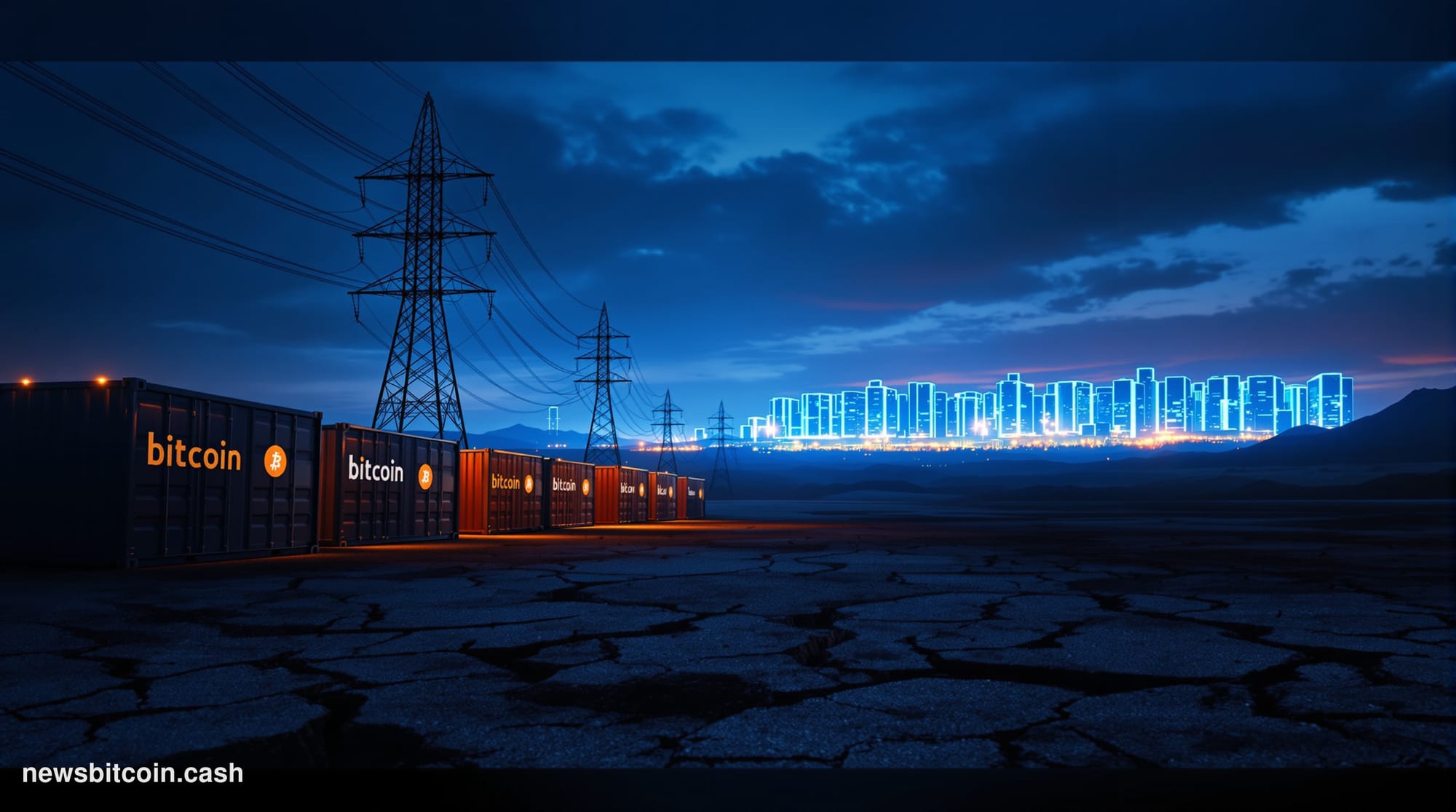
For the better part of a decade, Bitcoin miners occupied a unique and quietly powerful position in the global energy market: flexible, location-agnostic buyers of last-resort electricity who could set up shop wherever power was cheap and infrastructure was available. That position is under sustained pressure. Artificial intelligence hyperscalers — the Microsofts, Amazons, and Googles of the world — are arriving at the same substations with longer lease commitments, deeper balance sheets, and a willingness to pay rates that make Bitcoin mining economics look shaky by comparison. Headlines have predictably framed this as an eviction notice, a slow-motion surrender of grid access by an industry that built its competitive moat around cheap power.
That framing, while attention-grabbing, misses something important. According to analysis by Nick Ward published in Bitcoin Magazine, the displacement of Bitcoin miners from prime grid-connected sites is not simply a loss — it is, arguably, the catalyst for a structural evolution that could leave the industry more resilient, more strategically positioned, and more deeply embedded in the energy infrastructure of the future than it has ever been.
The Pressure Is Real — And So Is the Opportunity
The competition for power is not a rumor or a future risk. AI data centers require enormous, continuous, low-latency power with the kind of uptime guarantees that utilities prioritize above almost any other customer class. When a hyperscaler signs a 10- or 20-year power purchase agreement for hundreds of megawatts at a premium rate, it fundamentally reshapes the economics of every other load-competing facility in that grid region. Bitcoin miners, who have historically thrived by operating at the margin — curtailing during demand spikes, absorbing excess renewable output, negotiating interruptible service rates — find those favorable terms disappearing as utilities discover they have more lucrative, more stable anchor tenants available.
The honest assessment is that Bitcoin miners cannot match a hyperscaler dollar-for-dollar in a straight competition for prime, fully permitted, grid-connected capacity. That race is effectively over in many markets, and pretending otherwise would be a strategic error. The question worth asking is not how miners win the power competition against AI — it is what becomes possible when they stop trying to fight that battle on its current terms.
The Forced Migration Toward Stranded and Wasted Energy
The silver lining embedded in the eviction thesis is that it accelerates Bitcoin mining's migration toward one of the most underutilized and economically significant resource pools in modern energy infrastructure: stranded, flared, curtailed, and otherwise wasted power. Natural gas flaring at oil extraction sites, excess hydroelectric output during high-flow seasons, wind and solar generation that is curtailed because it exceeds local grid absorption capacity — these sources collectively represent billions of dollars in wasted energy annually across the globe. They are also power sources that AI hyperscalers, with their demands for grid reliability, long-term contracts, and massive interconnection queues, cannot easily pursue.
This is where Bitcoin mining's structural flexibility becomes a genuine competitive moat rather than a consolation prize. A mining operation that can be containerized, transported, and deployed at a flare site in the Permian Basin or a wind farm in rural Montana operates in a market segment that AI data centers are institutionally incapable of entering. The economics of stranded energy monetization are compelling precisely because the energy is otherwise worth little or nothing. Miners who pivot aggressively toward these sources do not just survive the grid displacement — they access electricity at cost structures that grid-connected competitors, including other miners who fight for premium substations, simply cannot match.
Infrastructure Win Hidden in the Headlines
Ward's broader argument, as framed in Bitcoin Magazine, is that what the mainstream narrative characterizes as a defeat for the mining industry is actually a forcing function toward a more sophisticated and defensible infrastructure posture. When AI hyperscalers consume the easily accessible grid capacity, they inadvertently push Bitcoin miners toward energy sources that are genuinely additive to global energy efficiency — converting waste into productive economic output, reducing methane emissions from flaring, and providing a financial offtake mechanism that makes marginal renewable projects economically viable.
This is not a small or theoretical impact. As the energy transition accelerates, the volume of curtailed renewable power is expected to grow substantially in markets like the United States, Europe, and Australia, where grid buildout consistently lags behind generation capacity additions. Bitcoin miners positioned to absorb that curtailed output serve a real grid balancing function — one that regulators and utilities are beginning to recognize and, in some jurisdictions, actively incentivize.
What This Means for the Industry
The miners who will thrive over the next five years are unlikely to be the ones who win the bidding war against Microsoft or Amazon for substation access in a tier-one grid market. They will be the operators who build the logistics, legal, and technical capabilities to deploy at scale in the messy, fragmented, and underserved corners of the global energy map. That is a harder business to run — it requires supply chain sophistication, regulatory navigation across dozens of jurisdictions, and tolerance for operational complexity that a standard data center lease does not demand.
But it is also a business with structural cost advantages, differentiated positioning, and a symbiotic relationship with the energy transition that gives it a compelling long-term narrative. The AI boom did not kill Bitcoin mining. It redirected it — toward exactly the kind of infrastructure role that the industry has always been best suited to play, if often reluctant to fully embrace.
Written by the editorial team — independent journalism powered by Bitcoin News.