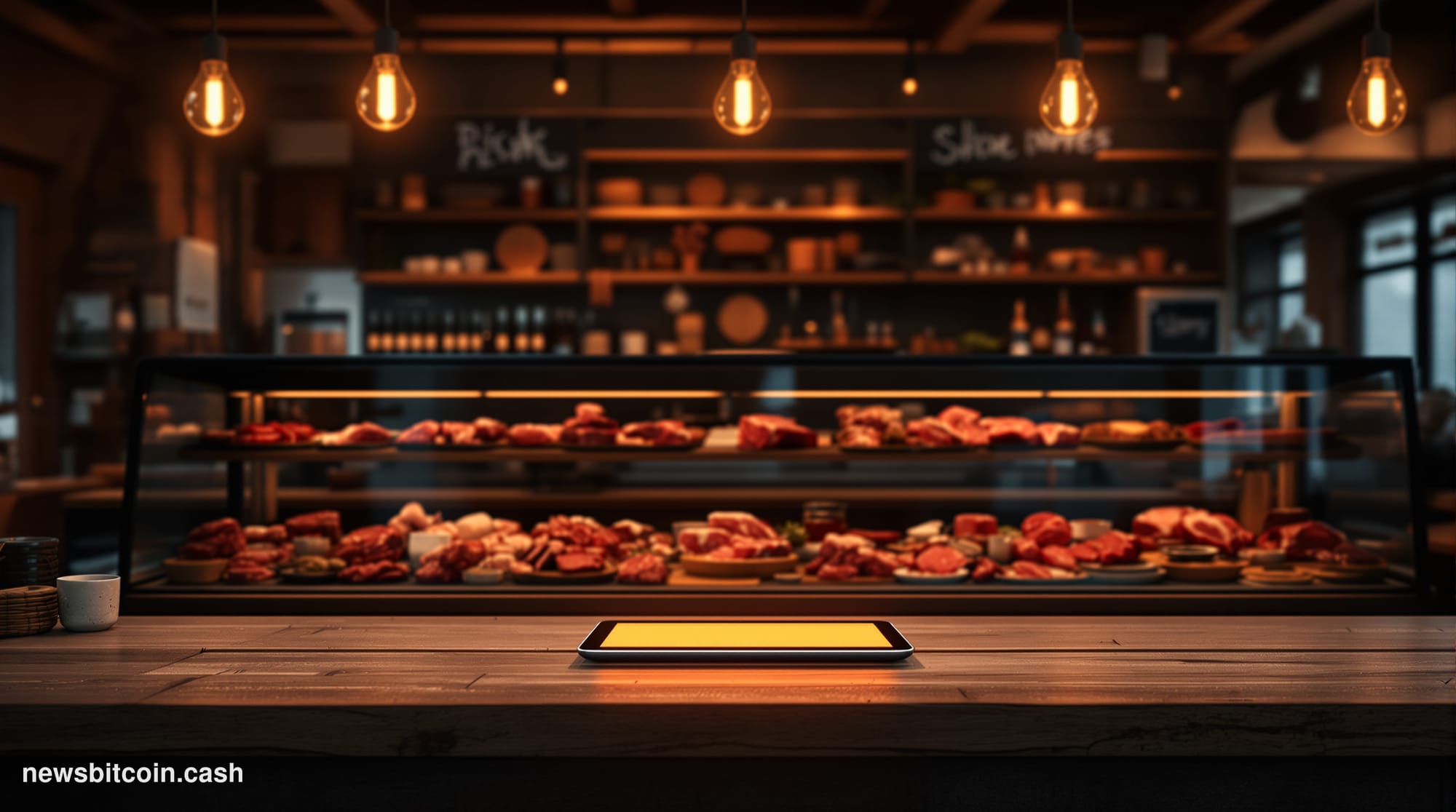
A Central Indiana butcher shop is quietly doing something most small businesses still treat as a thought experiment: accepting Bitcoin as payment for premium artisanal meats — and then keeping every satoshi it receives. Old Major Market, which ships to 48 states across the country, has adopted a full Bitcoin treasury policy, holding 100% of incoming Bitcoin payments on its balance sheet rather than converting them to dollars at the point of sale.
It is the kind of move that usually gets attributed to tech companies with audacious CFOs or publicly traded firms with shareholders to impress. Seeing it executed by a Midwestern butcher dealing in dry-aged cuts and hand-crafted charcuterie reframes the conversation about who Bitcoin adoption actually belongs to — and what it looks like on the ground in 2026.
The Treasury Play in a Butcher's Apron
The decision to hold 100% of Bitcoin receipts rather than liquidate them immediately is not a trivial accounting choice. It reflects a deliberate bet that Bitcoin will appreciate relative to the dollar over time, and it carries real risk management implications for a small business operating on food-industry margins. Most retailers who "accept Bitcoin" do so through payment processors that instantly convert the cryptocurrency to fiat, eliminating any exposure to price volatility. Old Major Market is making no such hedge. The shop is treating its Bitcoin income the way a conviction investor treats a long position — with patience and a long time horizon.
This approach puts Old Major Market in the same philosophical camp as publicly traded companies that have added Bitcoin to their corporate treasuries, but with a key distinction: Old Major Market is not raising capital markets money to fund the position. It is earning Bitcoin through commerce, one order of heritage-breed pork and grass-fed beef at a time. That is a fundamentally different model — revenue-driven Bitcoin accumulation rather than balance-sheet financing — and arguably a more organic expression of what a Bitcoin standard looks like for a small business.
48 States, One Monetary Standard
The geographic footprint matters here. Shipping artisanal meats to 48 states is not a trivial logistics operation. It requires cold-chain infrastructure, compliance with state-by-state food shipping regulations, and a customer base willing to pay a premium for quality over convenience. That Old Major Market has built this kind of reach from Central Indiana while simultaneously layering in a Bitcoin payment rail suggests the shop is not experimenting casually — it has operational depth and, apparently, an ownership team with a clear point of view on money.
The nationwide shipping model also means that Bitcoin payments are not just a local novelty for walk-in customers who happen to run a hardware wallet. Any of the shop's customers across nearly the entire continental United States can theoretically complete a transaction in Bitcoin, with the seller retaining the asset on its books. For a sector — specialty food e-commerce — that has been almost entirely untouched by crypto payment adoption, this is a meaningful data point.
Why This Story Is Larger Than One Shop
Small business Bitcoin adoption has long been the movement's most elusive frontier. The narrative around Bitcoin in commerce tends to oscillate between two poles: nation-state adoption (El Salvador's legal tender experiment) and institutional treasury management (corporate balance sheet diversification). The middle ground — the neighborhood business, the regional producer, the specialty retailer — has been poorly served by both the infrastructure and the cultural momentum of the Bitcoin ecosystem.
Old Major Market represents something the industry badly needs more of: a privately held, operationally grounded business that has made a principled decision to integrate Bitcoin into its financial architecture without fanfare or venture capital backing. There is no token, no NFT drop, no blockchain-native loyalty scheme. There is simply a butcher that sells excellent meat, ships it across the country, and banks its Bitcoin.
The question the industry should be asking is not whether Old Major Market will inspire a wave of imitation among artisanal food producers — though it might. The more consequential question is what the economics look like two or three years from now if Bitcoin continues its long-term appreciation trajectory. A small business that has been accumulating Bitcoin through ordinary revenue since 2026 will have a very different balance sheet than one that converted every payment to dollars. That asymmetry is the entire thesis, expressed not in a white paper but in pounds of aged beef and cured sausage shipped across 48 states.
For an ecosystem that talks endlessly about hyperbitcoinization, Old Major Market is a reminder that the transition — if it comes — will be built one merchant at a time, in places far from Silicon Valley or lower Manhattan, by operators who simply decided that their revenue was worth keeping in harder money.
Written by the editorial team — independent journalism powered by Bitcoin News.