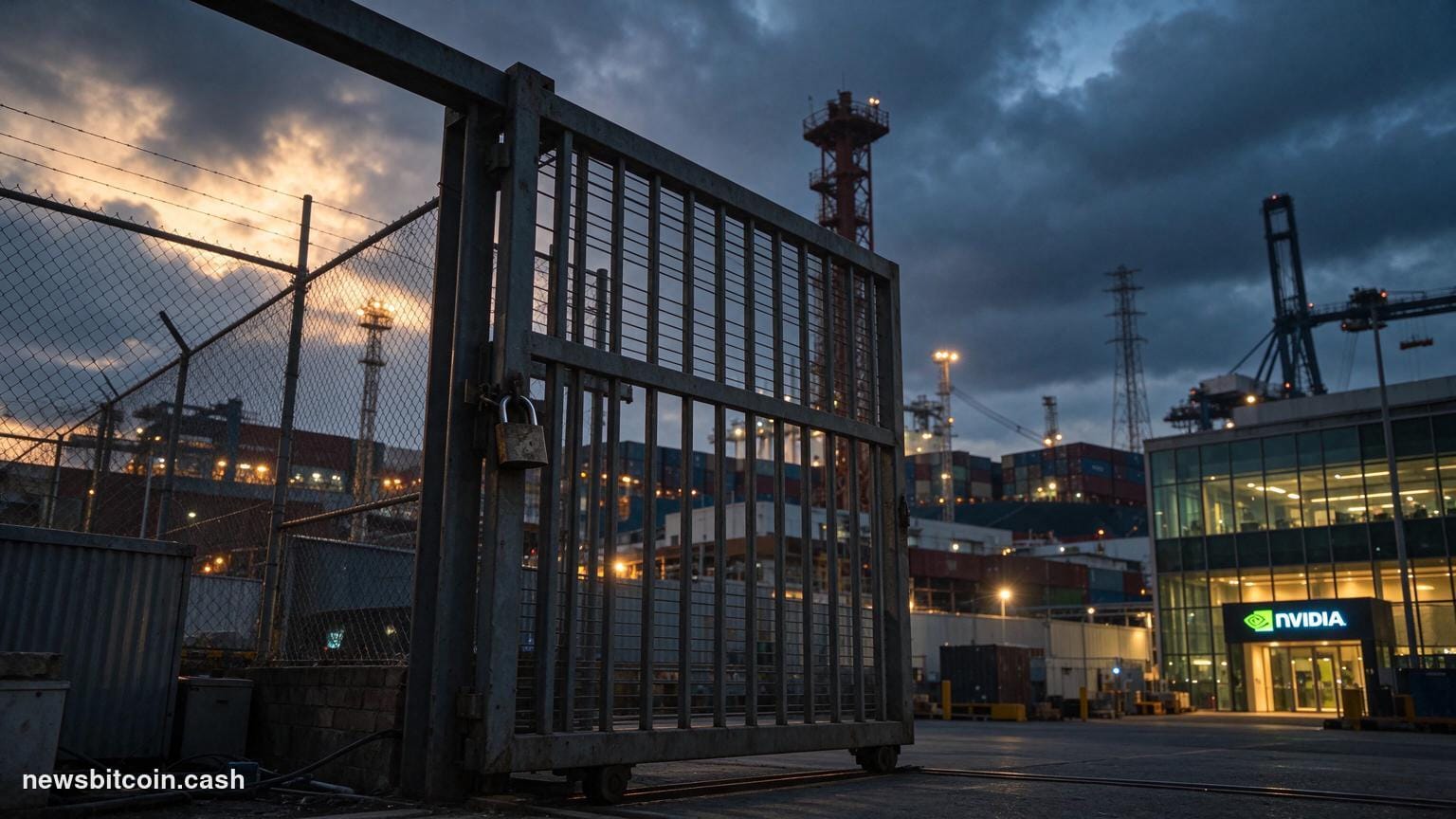
The global artificial intelligence hardware race has hit another geopolitical wall. Nvidia, the dominant force in graphics processing units (GPUs) and AI accelerator chips, has halted orders across Southeast Asia in response to tightening United States export controls, according to a report by Semafor. The move threatens to fracture supply chains across a strategically vital region and raises serious questions about the company's near-term revenue trajectory — and about how the broader technology and digital assets ecosystem will absorb the shock.
Southeast Asia has quietly become one of the most consequential regions in the global AI and data infrastructure buildout. Countries including Singapore, Malaysia, Vietnam, and Indonesia have aggressively courted hyperscale data center investment, and GPU supply has been the lifeblood of that expansion. Nvidia's decision to freeze orders in the region is not a minor administrative adjustment — it is a material disruption to a supply pipeline that feeds not just enterprise computing, but crypto mining operations, AI inference workloads, and blockchain infrastructure providers that have staked serious capital on continued hardware availability.
Export Controls Tighten Their Grip
The United States government has spent the better part of the last several years constructing an increasingly elaborate framework of chip export restrictions aimed primarily at limiting China's access to advanced semiconductor technology. What began as targeted controls on specific high-end chips has gradually expanded in scope, with allies and neighboring jurisdictions now caught in the regulatory crossfire. Southeast Asia, long viewed as a potential transhipment corridor for restricted chips finding their way to sanctioned end-users, has become a focus of enforcement attention.
Nvidia's response — halting orders rather than risking regulatory violation — reflects the company's acute awareness of its exposure. The chipmaker has already navigated several rounds of product redesigns intended to keep certain GPU models technically compliant with export thresholds, releasing downgraded versions of flagship chips for restricted markets. The Southeast Asia freeze suggests that even those workarounds may no longer be sufficient to satisfy compliance requirements in a region now under sharper regulatory scrutiny. For a company whose stock performance has been almost entirely tied to its AI hardware dominance, the reputational and financial stakes of a misstep are enormous.
Supply Chain Fallout and Revenue Risk
The immediate operational consequence of halted orders is supply chain disruption. Data center operators, cloud providers, and AI startups across Southeast Asia that were counting on GPU deliveries to meet expansion timelines will now face delays of indeterminate length. Some will pivot to alternative suppliers — a list that remains short and largely unable to match Nvidia's performance benchmarks at scale. Others will simply defer infrastructure buildout, slowing the region's AI adoption curve.
The revenue implications for Nvidia are harder to quantify but impossible to ignore. Southeast Asia represents a growing slice of global data center demand, and any sustained halt in order fulfillment translates directly into deferred — or potentially lost — top-line contribution. Market participants will be watching closely for signals about whether this freeze is a short-term compliance pause or the beginning of a more structural retrenchment from the region. Either scenario is likely to influence market perceptions of Nvidia's growth story, and by extension, its stock price. For a company trading at valuations that price in near-flawless execution, any friction in the revenue engine matters.
The Crypto and Digital Asset Dimension
For the digital assets industry specifically, Nvidia's export control entanglements carry layered consequences. GPU availability is not simply a data center concern — it is foundational infrastructure for proof-of-work mining operations that have migrated heavily into Southeast Asian jurisdictions following China's 2021 crackdown, as well as for the AI-adjacent crypto projects that have made GPU compute a core part of their token economics. Decentralized compute networks, AI inference protocols, and next-generation mining rigs all sit downstream of Nvidia's supply decisions.
Projects building decentralized GPU marketplaces — an increasingly crowded segment of the crypto infrastructure space — will find their core value proposition stress-tested by this disruption. If legitimate GPU supply is constrained by export controls, the premium attached to available compute resources rises, potentially benefiting some decentralized compute token economies in the short term even as it complicates the hardware procurement strategies of their node operators.
What This Means
Nvidia's Southeast Asia order halt is a sharp illustration of how US export control policy is no longer a background consideration for technology companies — it is a front-line operational constraint with direct consequences for revenue, supply chain integrity, and market confidence. For the digital assets and AI infrastructure sectors that have built their growth assumptions on continued GPU abundance, the freeze is a reminder that geopolitical risk is not abstract. The chips that power modern AI and much of crypto's emerging compute economy are now explicitly subject to the same great-power tensions reshaping global trade. How Nvidia navigates the next phase of this regulatory pressure will have consequences well beyond its own balance sheet.
Written by the editorial team — independent journalism powered by Bitcoin News.