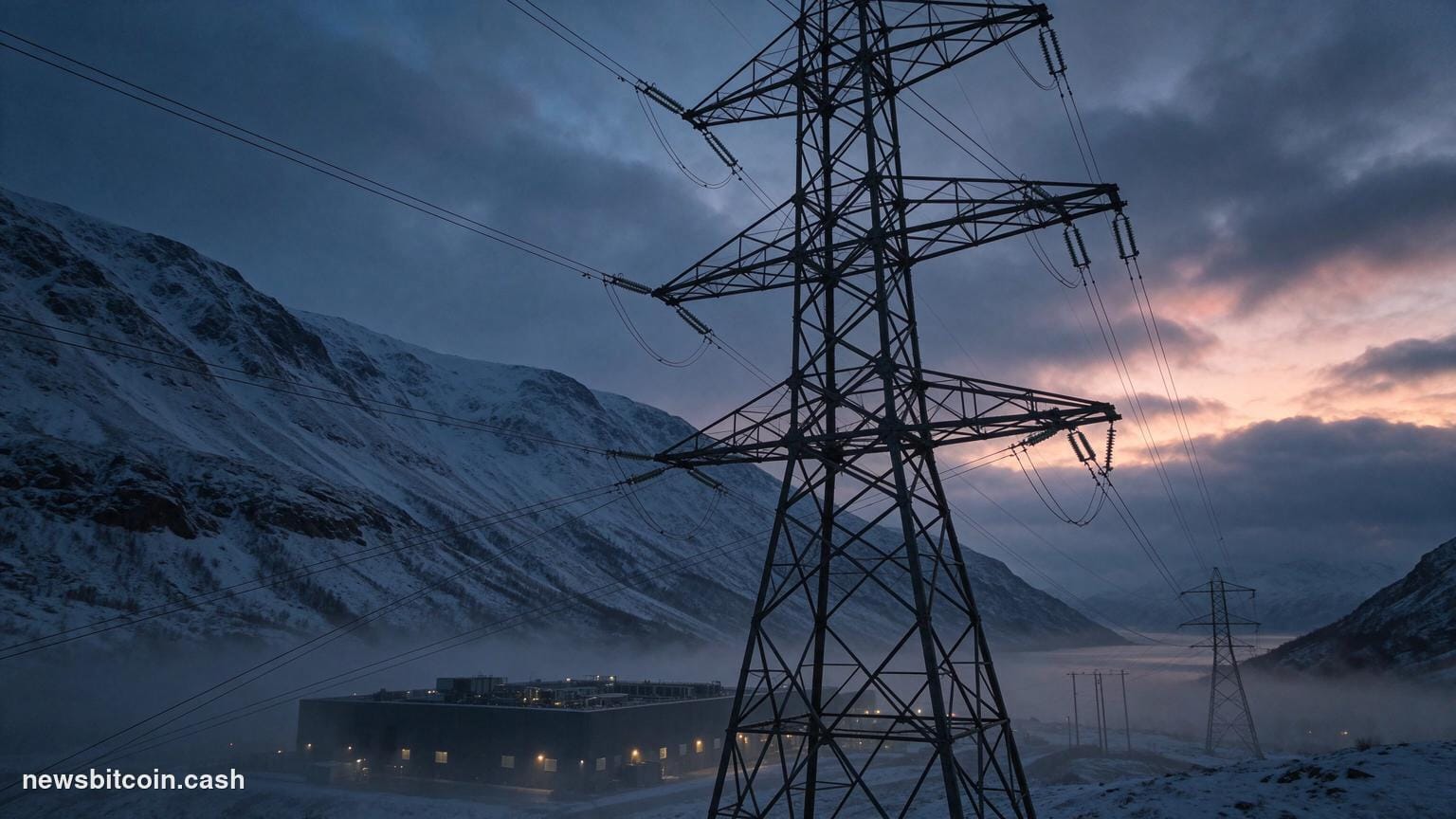
Norway's grid operator Statnett has drawn a hard line in the snow: no new data center grid reservations will be approved until at least August 2027. The decision, one of the more consequential infrastructure rulings to hit the digital-asset and cloud-computing sectors in Europe this year, signals that the era of treating electricity as an unlimited resource for high-throughput computing is running into its physical limits — even in a country long celebrated for its abundant hydropower.
The freeze applies to new reservations on Norway's national transmission grid, meaning that data center operators — including those running Bitcoin mining facilities and artificial intelligence compute clusters — cannot secure new capacity commitments from Statnett for the foreseeable future. Existing reservations are not immediately affected, but the pipeline for expansion has effectively been shut off for the better part of two years.
Why Norway, and Why Now
To understand the weight of this decision, context matters. Norway is not an energy-scarce nation by conventional measures. Its grid is powered overwhelmingly by hydroelectric generation, giving it one of the cleanest electricity mixes on the planet and historically some of the lowest industrial power prices in Europe. That combination made it a natural magnet for data center investment throughout the 2010s and into the 2020s, as operators sought cheap, green electricity to meet both cost and sustainability targets.
But scale has a way of straining even well-resourced systems. As data center loads multiplied — driven by cloud migration, artificial intelligence training workloads, and cryptocurrency mining — the cumulative draw on regional grid infrastructure began colliding with capacity constraints that hydropower generation alone cannot instantly resolve. Grid infrastructure, unlike software, cannot be updated overnight. Transmission lines, substations, and balancing systems require years of planning and capital deployment to expand meaningfully.
Statnett's move is explicitly framed around strategic energy allocation — prioritizing societal benefit over raw commercial demand. That is a significant philosophical statement from a grid operator. It places residential consumers, traditional industrial users, and public services above the queue of data center applicants who might otherwise have been able to secure capacity through sheer commercial scale and willingness to pay.
Implications for the Mining and AI Compute Sectors
For the cryptocurrency mining industry, the Norwegian grid pause is a pointed reminder that geographic arbitrage on energy has limits. Miners have historically migrated toward jurisdictions offering low-cost, renewable power — Iceland, Paraguay, parts of Scandinavia — betting that those regions had sufficient headroom to absorb industrial-scale electrical loads. Norway's pause suggests that headroom is now being rationed at the national infrastructure level, not simply priced by the market.
The August 2027 deadline is not a guarantee of resumption either — Statnett's language of "at least" August 2027 leaves the door open for further extensions if grid capacity assessments remain unfavorable. Operators who had been planning Norwegian expansions are now facing a minimum two-year window of uncertainty, which at current market velocity represents multiple cycles of hardware depreciation and strategic repositioning.
The artificial intelligence sector faces parallel exposure. As hyperscalers race to build out inference and training infrastructure across Europe, national grid operators are increasingly becoming a binding constraint. Norway's move may encourage similar reviews in neighboring Nordic countries, particularly as regional grids become more interconnected and demand projections for AI compute continue to escalate well beyond earlier forecasts.
A Policy Template in the Making
What makes the Statnett decision worth watching beyond its immediate operational impact is its potential as a policy model. Grid operators across Europe are grappling with the same fundamental tension: electricity systems designed for legacy industrial and residential loads are absorbing exponential demand from new digital industries with almost no notice period. The traditional market mechanism — let prices rise until demand moderates — is politically difficult for residential consumers and strategically complex for governments trying to retain both industrial investment and public confidence.
A reservation pause reframes the question entirely. Rather than asking what price clears the market, it asks what uses of electricity best serve national interests over a planning horizon of several years. That is a more interventionist posture, but it is not without precedent in energy systems that have always involved significant state coordination. Norway's decision effectively puts the conversation about compute infrastructure and energy sovereignty on the same policy agenda — a convergence that the industry would do well to take seriously.
For project developers, the practical takeaway is stark: energy access is no longer a commodity to be assumed, even in historically power-rich jurisdictions. Due diligence on grid capacity, reservation status, and national energy policy has become as critical as hardware costs or regulatory licensing when evaluating where to build next-generation compute infrastructure.
Written by the editorial team — independent journalism powered by Bitcoin News.