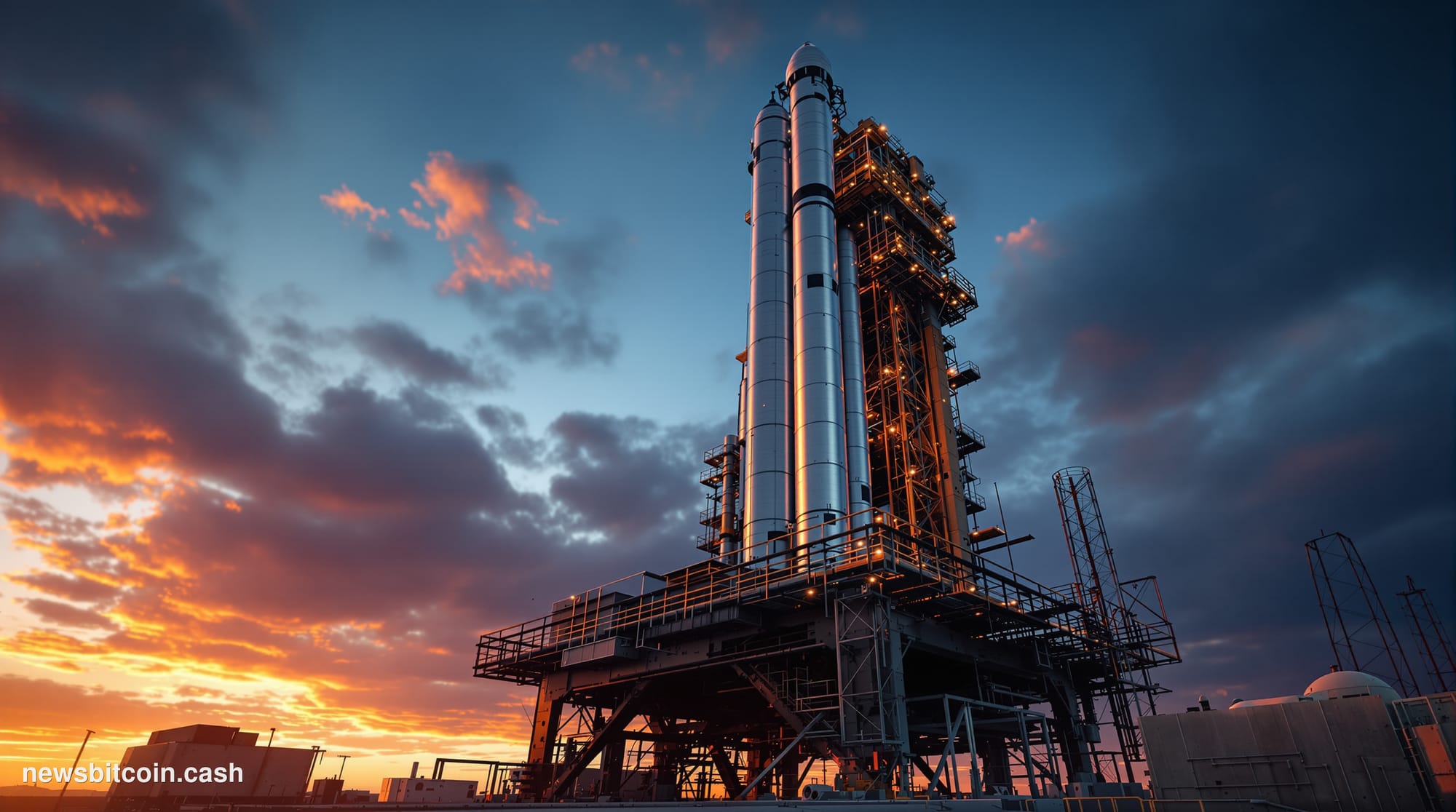
On October 15, Elon Musk made one of the most audacious corporate valuation predictions in modern financial history: that SpaceX would very probably surpass a $100 trillion valuation within the next ten years. The only scenario in which he hedged, posted directly on X, was the outbreak of a major world war. For context, that target would represent roughly 48 times the company's market value of $2.07 trillion recorded at its October 14 close — a leap so steep it redefines what the word "ambitious" means in a financial setting.
Musk's remark came in reply to a video clip featuring Ron Baron, the founder of Baron Capital, a firm known for making high-conviction, long-horizon bets on transformative companies. The exchange was telling: this wasn't a formal earnings call or an investor presentation. It was Musk, on a social platform he owns, casually affirming what reads like a number conjured from science fiction. Yet the man has a documented history of setting targets that sound impossible until, sometimes, they aren't.
What a $100 Trillion Number Actually Means
To appreciate the scale of what Musk is suggesting, consider that the entire gross domestic product of the United States in 2025 sits somewhere around $30 trillion. A $100 trillion SpaceX would be worth more than three times the entire American economy — or, put differently, it would represent a significant fraction of total global economic output. The current global equity market capitalization across all publicly traded companies sits in the range of $100 to $110 trillion. Musk is effectively predicting that one private aerospace and technology company will, within a decade, be worth as much as every publicly listed company on Earth combined today.
That framing is not hyperbole for its own sake — it is the arithmetic. And it forces a serious question: what business model, what revenue engine, could conceivably justify that figure? The answer Musk has long pointed toward involves Starlink's satellite internet dominance, Mars colonization infrastructure, point-to-point Earth transit via Starship, and potentially a vertically integrated off-world economy. If SpaceX becomes the logistics backbone of a multi-planetary civilization, traditional valuation models don't apply. That's either the argument's greatest strength or its most glaring weakness, depending on your epistemology.
The Crypto Angle: Why Digital Asset Markets Should Pay Attention
This prediction lands with particular weight in the cryptocurrency and digital assets space for reasons that go beyond headline-chasing. The infrastructure thesis underlying SpaceX's valuation case mirrors — in important ways — the infrastructure thesis that serious investors use to justify long-term positions in Bitcoin and foundational blockchain networks. In both cases, the argument is that whoever builds and controls the critical infrastructure layer of a new economic paradigm captures value at an almost incomprehensible scale over time.
Starlink already provides satellite internet to regions where traditional financial rails are absent or dysfunctional. That connectivity is, in practice, a prerequisite for cryptocurrency adoption in the developing world. A SpaceX that grows fifty-fold in value over a decade would also be a SpaceX whose satellite networks blanket the Earth and, eventually, the solar system — creating the physical connectivity layer on which decentralized finance could run at a scale not currently imaginable. The intersection of space infrastructure and digital finance is not a distant abstraction; it is already beginning to take shape in rural Africa, maritime routes, and remote research stations where Starlink terminals serve as the only gateway to digital financial services.
Ron Baron's Endorsement and the Long-Bet Framework
That Musk responded to Baron Capital's founder is worth examining independently. Ron Baron has built a reputation over decades as one of Wall Street's most patient capital allocators, running a concentrated, long-duration investment strategy that bets heavily on management quality and market size. Baron Capital has been a notable SpaceX investor, and Baron has publicly championed the company's potential for years. When a figure of Baron's credibility provides the framing for a valuation discussion and Musk replies with an affirmative, the exchange carries more institutional signal than a random social media post might suggest.
Still, even the most enthusiastic institutional backer would struggle to construct a conventional discounted cash flow model that outputs $100 trillion in ten years. The compound annual growth rate required to get from $2.07 trillion to $100 trillion over a decade exceeds 47%. Sustained at that pace, it would be the most dramatic wealth creation event in recorded corporate history — larger than the entire rise of Apple, Microsoft, and Amazon combined over comparable periods.
What This Means
Musk's $100 trillion call is best understood not as a financial forecast in the traditional sense, but as a statement of intent and a framework for how he conceptualizes SpaceX's total addressable market. For crypto and digital asset investors, the underlying structural logic — infrastructure at civilizational scale captures value that conventional models cannot price — is worth taking seriously even if the specific number invites skepticism. Whether SpaceX hits $10 trillion, $20 trillion, or something approaching Musk's target, the company's trajectory will reshape the physical and digital infrastructure of the global economy. That reshaping creates both opportunity and disruption for every asset class, including digital currencies. The only variable Musk himself conceded could derail it all: a major world war. In that single caveat lies the entire tension between visionary capital allocation and the fragility of the world it is trying to transform.
Written by the editorial team — independent journalism powered by Bitcoin News.