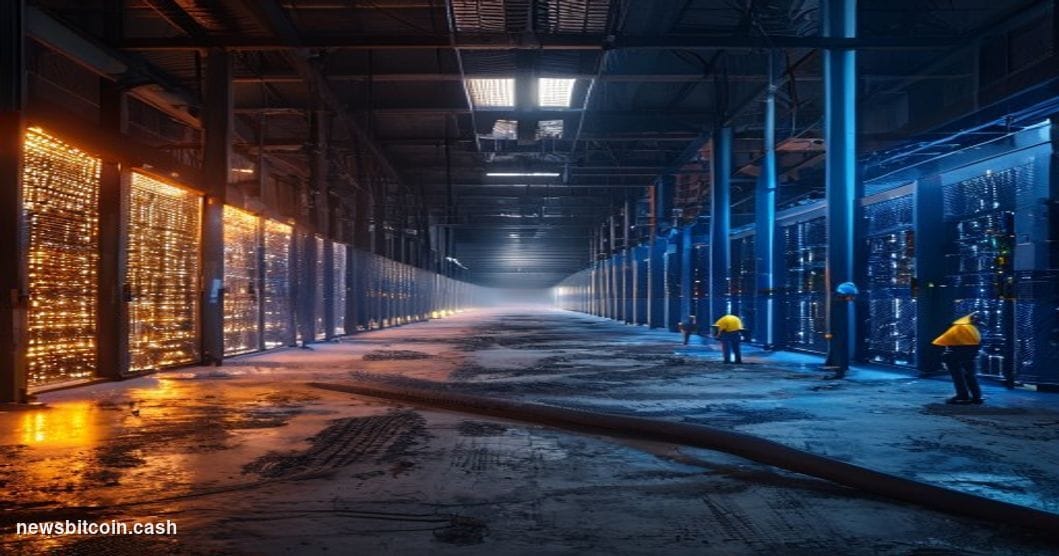
Bitcoin is sliding, Wall Street is retreating, and yet a corner of the crypto market is posting gains that have nothing to do with the BTC price. Bitcoin mining stocks are surging — not because the asset they mine has recovered, but because a growing number of these companies have quietly repositioned themselves as artificial intelligence infrastructure providers. In a market defined by two simultaneous selloffs, that divergence is impossible to ignore.
The setup is striking in its contradiction. When Bitcoin falls, mining economics tighten almost mechanically: revenue per block drops, margins compress, and the companies with the highest cost bases face the sharpest pain. Historically, that correlation between BTC price and miner equity has been close to one-for-one. What is happening now breaks that script entirely. Mining stocks are on a tear even as Bitcoin sells off and broader equity markets trade lower — a divergence that points squarely at one catalyst: artificial intelligence deals.
The AI Pivot Changes the Valuation Equation
For the past several years, publicly listed Bitcoin miners have occupied a peculiar niche in the investment landscape — leveraged bets on Bitcoin that also carried operational risk, energy risk, and regulatory risk. Investors who wanted Bitcoin exposure with a multiplier bought miners. Investors who wanted steady cash flows looked elsewhere. That binary is now dissolving as mining companies convert their most valuable underlying assets — power contracts, data center real estate, and high-density electrical infrastructure — into the raw material of the AI compute boom.
The logic is straightforward once you understand what a mining facility actually is at its core. A large-scale mining operation is, fundamentally, a building with reliable, high-capacity power delivery and serious cooling infrastructure. Those physical attributes are exactly what hyperscalers and AI firms are willing to pay premium rates to access, and they are extraordinarily difficult and time-consuming to replicate from scratch. Permitting, grid interconnection, and construction timelines measured in years mean that existing mining infrastructure carries real scarcity value — value that has nothing to do with where Bitcoin is trading on any given Thursday.
Decoupling From BTC Price Is Both a Feature and a Warning
The market is clearly rewarding miners that have successfully executed or announced AI-adjacent deals, sending their stock prices higher even as the underlying commodity they built their businesses around loses ground. This kind of decoupling from Bitcoin's spot price represents a meaningful structural shift in how these companies are being underwritten by investors. Where analysts once modeled miner equity almost exclusively around hash price — a metric that blends BTC price and network difficulty — they are now building out separate revenue streams tied to compute contracts, colocation agreements, and data center service fees.
That diversification is genuine and, for shareholders, welcome. But it carries its own set of risks that deserve scrutiny. A mining company that derives a growing share of its revenue from AI compute hosting is no longer a pure-play Bitcoin business — it is a hybrid infrastructure operator navigating two highly competitive, capital-intensive industries simultaneously. The AI data center market is attracting aggressive investment from some of the best-capitalized companies on the planet. The competitive moat that miners enjoy today, essentially a head start on power access, could narrow faster than investors expect if utility-scale power projects or modular nuclear facilities begin coming online at scale.
What the Selloff Context Reveals
The broader stock market decline running parallel to Bitcoin's slide adds another layer of analytical interest. Risk-off environments typically punish speculative and capital-intensive sectors disproportionately — and mining stocks have historically been among the first casualties when investor appetite for risk contracts. The fact that they are bucking both a Bitcoin downturn and a general equity retreat simultaneously suggests the AI deal narrative is doing genuine heavy lifting in the minds of institutional investors, not merely retail momentum traders chasing headlines.
That investor confidence may be well-founded, or it may be getting ahead of the actual revenue these AI arrangements will ultimately produce. Announced deals and signed contracts are not the same as delivered megawatts and recognized revenue. The mining sector has a long history of announcements that outpaced execution, and the AI infrastructure business is complex enough to generate its own delays. Investors cheering mining stocks higher today are, in part, placing a bet on operational competence in a domain most of these companies entered only recently.
What This Means
The divergence between Bitcoin's spot price and the performance of mining equities is not a temporary anomaly — it is a signal that the business model underpinning these companies is genuinely evolving. AI deals are providing a second revenue engine that partially insulates miners from the volatility of the asset they were built around. For long-term observers of the sector, this is the most significant structural development in public mining since the post-halving consolidation wave. Whether the current stock gains are justified by the actual economics of these AI arrangements will become clear as companies begin reporting concrete revenue figures tied to compute contracts. Until then, the market has made its call: in a world where both Bitcoin and stocks are falling, the AI pivot is the story worth buying.
Written by the editorial team — independent journalism powered by Bitcoin News.