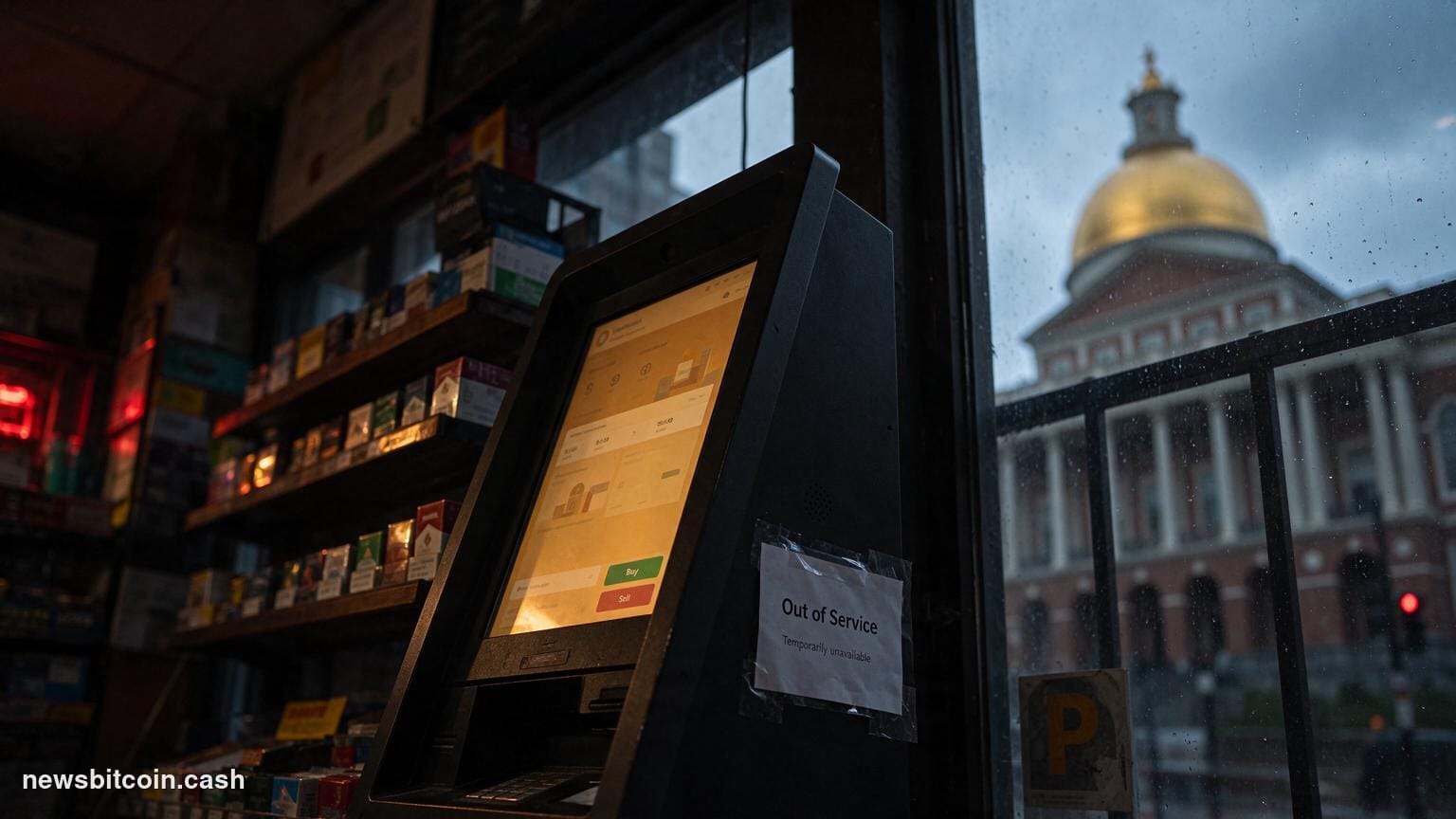
A hard regulatory deadline is approaching in New England. Massachusetts is now counting down to January 5, 2027 — the date by which a statewide ban on cryptocurrency automated teller machines (ATMs) could fully take effect. The implications stretch well beyond the Commonwealth's borders, raising urgent questions about financial access, regulatory overreach, and whether one state's decision could ignite a chain reaction of crypto ATM restrictions across the United States.
Crypto ATMs have quietly embedded themselves into the fabric of American retail life over the past decade. Walk into a gas station in Worcester, a convenience store in Springfield, or a check-cashing outlet in Roxbury, and there is a reasonable chance you will find one of these machines offering the ability to convert cash directly into Bitcoin or other digital assets. For underbanked communities — those without reliable access to traditional financial institutions — these machines often represent one of the most accessible on-ramps into the digital economy. A blanket statewide ban eliminates that on-ramp entirely, and does so by regulatory fiat rather than market forces.
The stakes for local economies are real and immediate. Operators of crypto ATM networks — many of them small and mid-sized businesses — have built revenue models around machine placement fees, transaction commissions, and exchange spreads. A statewide ban in Massachusetts does not merely inconvenience a few tech-forward consumers; it threatens the commercial viability of operators who have made capital investments based on a regulatory environment that is now being reversed beneath them. Beyond the operators themselves, the retail locations that host these machines often collect placement fees that contribute meaningfully to thin-margin businesses. Strip those out, and the downstream economic disruption adds up fast.
What makes the Massachusetts situation especially consequential is its potential to function as a legislative template. State legislatures across the country watch each other closely when it comes to novel financial regulation, and a successful enforcement of a full crypto ATM ban — particularly in a state with the political and academic credibility of Massachusetts — sends a powerful signal. If Boston can do it without triggering significant legal challenge or public backlash, regulators in Sacramento, Albany, or Austin may feel emboldened to pursue similar measures. The January 5, 2027 deadline, in this sense, is not just a Massachusetts problem. It is a stress test for the entire retail crypto access infrastructure in the United States.
Consumer protection has frequently been cited as a driving rationale behind crypto ATM regulatory efforts at the state level. These machines have, in documented cases, been exploited for fraud — particularly scams targeting elderly users who are directed by bad actors to deposit cash at crypto ATMs as a form of payment for fictitious debts or government fines. Those concerns are legitimate and deserve serious policy responses. The question, however, is whether a total ban is a proportionate remedy, or whether it sacrifices broad financial inclusion in pursuit of a narrower fraud-prevention goal that could arguably be achieved through tighter transaction limits, mandatory disclosures, or enhanced Know Your Customer (KYC) protocols already available as regulatory tools.
The crypto industry has not been passive in the face of these pressures. ATM operators and digital asset advocacy groups have increasingly engaged state legislators, arguing that the technology itself is neutral and that the regulatory energy should be directed at bad actors rather than at the machines. That argument has had mixed success. Some states have moved toward licensing frameworks and transaction caps rather than outright prohibition — a middle path that acknowledges both the consumer protection concerns and the legitimate utility of the technology. Whether Massachusetts has fully weighed that middle path before the January deadline remains a critical open question.
There is also a broader infrastructure argument that often gets lost in these debates. Crypto ATMs, whatever their limitations, represent a physical, tangible point of access to decentralized financial networks. At a moment when policymakers routinely express concern about financial inclusion and the unbanked population, removing these machines from communities that rely on cash-first transactions is a policy choice that runs directly counter to those stated goals. The irony of a progressive state like Massachusetts potentially leading the charge on restricting crypto access — particularly in lower-income urban neighborhoods where these machines are most concentrated — deserves more scrutiny than it typically receives in legislative hearings.
What This Means
The January 5, 2027 deadline in Massachusetts is not merely an administrative calendar entry. It represents a fork in the road for how American states approach the physical infrastructure of crypto access. If the ban proceeds without meaningful legal challenge, industry adaptation, or legislative reconsideration, it will establish that a state can eliminate an entire category of digital asset access with limited friction — and others will take note. For operators, consumers, and policymakers alike, the next several weeks demand close attention. The outcome in Boston's legislative corridors may well determine what a crypto ATM map of the United States looks like by the end of the decade.
Written by the editorial team — independent journalism powered by Bitcoin News.