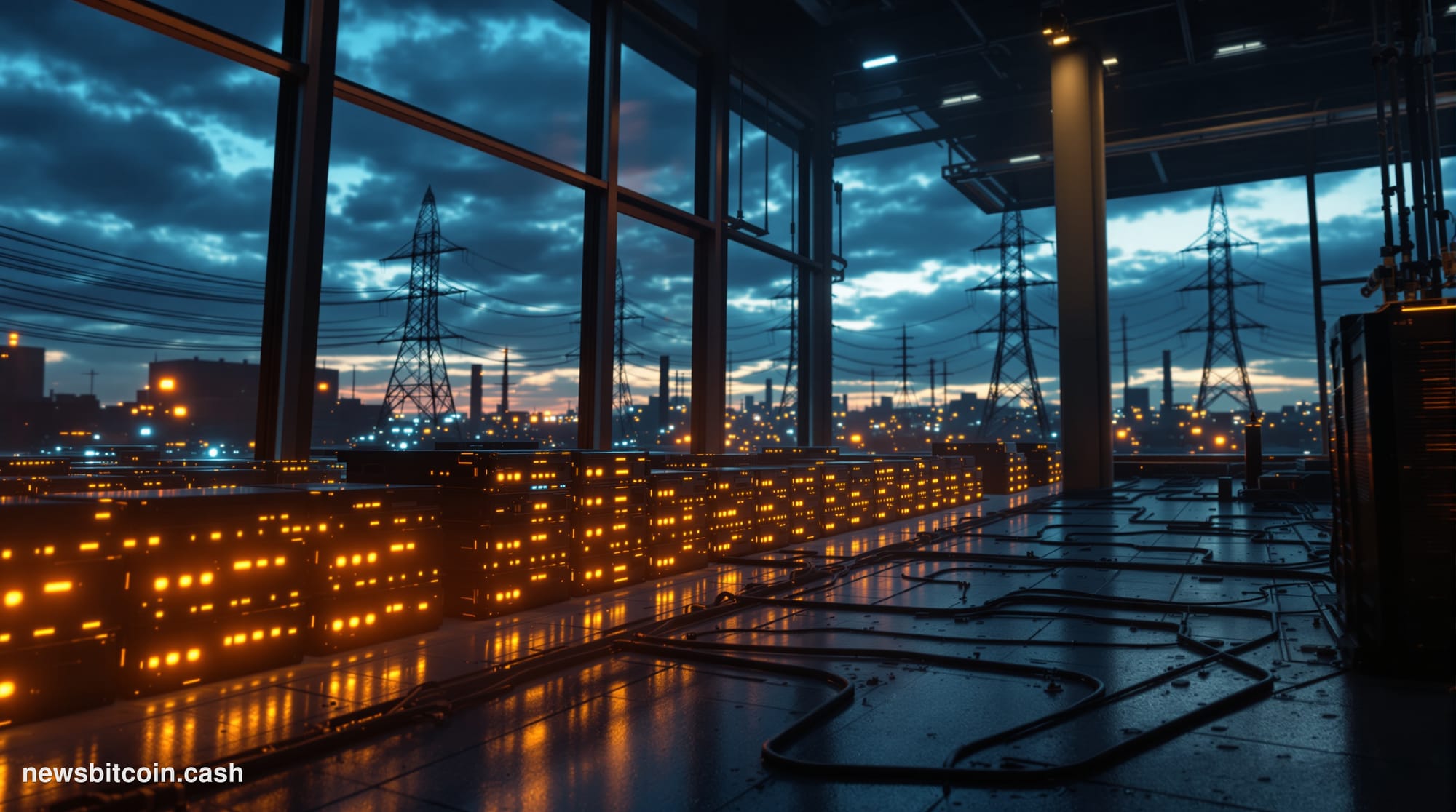
MARA Holdings, one of the largest publicly traded Bitcoin miners in the United States, has executed one of the most consequential balance-sheet moves in its history: offloading 13,597 Bitcoin after September 30 at an average price of $81,039 per coin, generating approximately $1.1 billion in proceeds. The majority of that capital — $750 million — went straight to retiring Bitcoin-backed loans, a move that simultaneously unlocked 17,477 BTC previously locked up as collateral. What remains is a company visibly repositioning itself, using the liquidity headroom to fund a push into artificial intelligence infrastructure and data-center development.
The Strategic Logic Behind a $1.1 Billion BTC Sale
For years, Bitcoin miners operated under a straightforward playbook: mine BTC, hold BTC, borrow against BTC. The strategy made intuitive sense during prolonged bull markets — it deferred taxable events while keeping exposure to upside intact. MARA was an aggressive practitioner of this model, accumulating a substantial treasury and pledging it as collateral for large credit facilities. That approach, however, comes with structural fragility. Bitcoin-backed loans create forced-liquidation risk during drawdowns and tie up productive capital in a form that generates no yield and cannot be redeployed quickly.
By selling into the $81,039 range and deploying $750 million to eliminate those obligations outright, MARA's management has effectively chosen operational flexibility over leveraged Bitcoin exposure. The debt retirement also had an immediate mechanical benefit: freeing 17,477 BTC in pledged collateral. That's a substantial reserve that can now be held unencumbered, sold strategically, or deployed toward future infrastructure without the overhang of a lender's liquidation clause.
From Mining to Machine Learning: A Pivot With Real Infrastructure Stakes
The more strategically interesting element of this transaction is where MARA intends to direct the remaining capital after debt service. The company has signaled a clear move toward artificial intelligence infrastructure and data-center development — a transition that is becoming an industry pattern among energy-intensive compute operators. Bitcoin mining and AI training workloads share a fundamental common denominator: both require massive power capacity, dense compute infrastructure, and sophisticated thermal management. The physical plant that powers a mining operation can, in theory, be repurposed or expanded to service AI demand.
This is not purely theoretical. Across the sector, mining companies with access to cheap power and existing data-center footprints have been exploring partnerships with AI firms hungry for GPU capacity and reliable electricity. MARA's $1.1 billion liquidity event positions it to invest seriously in that transition rather than merely announce it. The difference between a press release and an actual infrastructure pivot is capital — and MARA now has a cleaner balance sheet from which to deploy it.
Reading the Collateral Release as a Signal
The 17,477 BTC released from collateral deserves particular attention. At the same average price that MARA used for its sale — $81,039 — that tranche of Bitcoin represents roughly $1.42 billion in market value. The fact that this reserve is now unencumbered changes MARA's financial optionality considerably. Management can choose to hold it as a treasury asset, deploy it opportunistically, or use it as the basis for more favorable, less restrictive financing structures in the future. What it cannot do anymore is be seized by a lender at the worst possible moment.
The timing of the sale, executed after September 30 at prices in the $81,000 range, also reflects a deliberate decision to act during a period of relative Bitcoin price strength. Miners who have survived the post-halving compression in block rewards know that waiting for a mythical perfect top often means waiting too long. Locking in $81,039 per coin on 13,597 BTC while simultaneously eliminating debt obligations is a defensible execution, regardless of where Bitcoin trades in subsequent months.
What This Means for the Broader Mining Sector
MARA's transaction is a data point that the broader mining industry will be watching closely. The post-halving economics of Bitcoin mining have tightened margins across the board, and companies that accumulated BTC-collateralized debt during more bullish periods now face a structural reckoning. MARA has chosen to resolve that tension proactively — trading a leveraged Bitcoin position for a cleaner capital structure and a strategic bet on AI infrastructure demand.
Whether the AI pivot pays off depends on execution: the ability to secure power purchase agreements, deploy the right compute mix, and attract hyperscaler or enterprise clients. But the prerequisite for all of that is a balance sheet that isn't hostage to Bitcoin price volatility. By liquidating 13,597 BTC, wiping $750 million in debt, and liberating nearly $1.42 billion in collateral, MARA has bought itself the operational latitude to find out if that bet is correct. The industry is watching — and so are investors who must now decide whether MARA is a Bitcoin miner, an AI infrastructure company, or something entirely new.
Written by the editorial team — independent journalism powered by Bitcoin News.