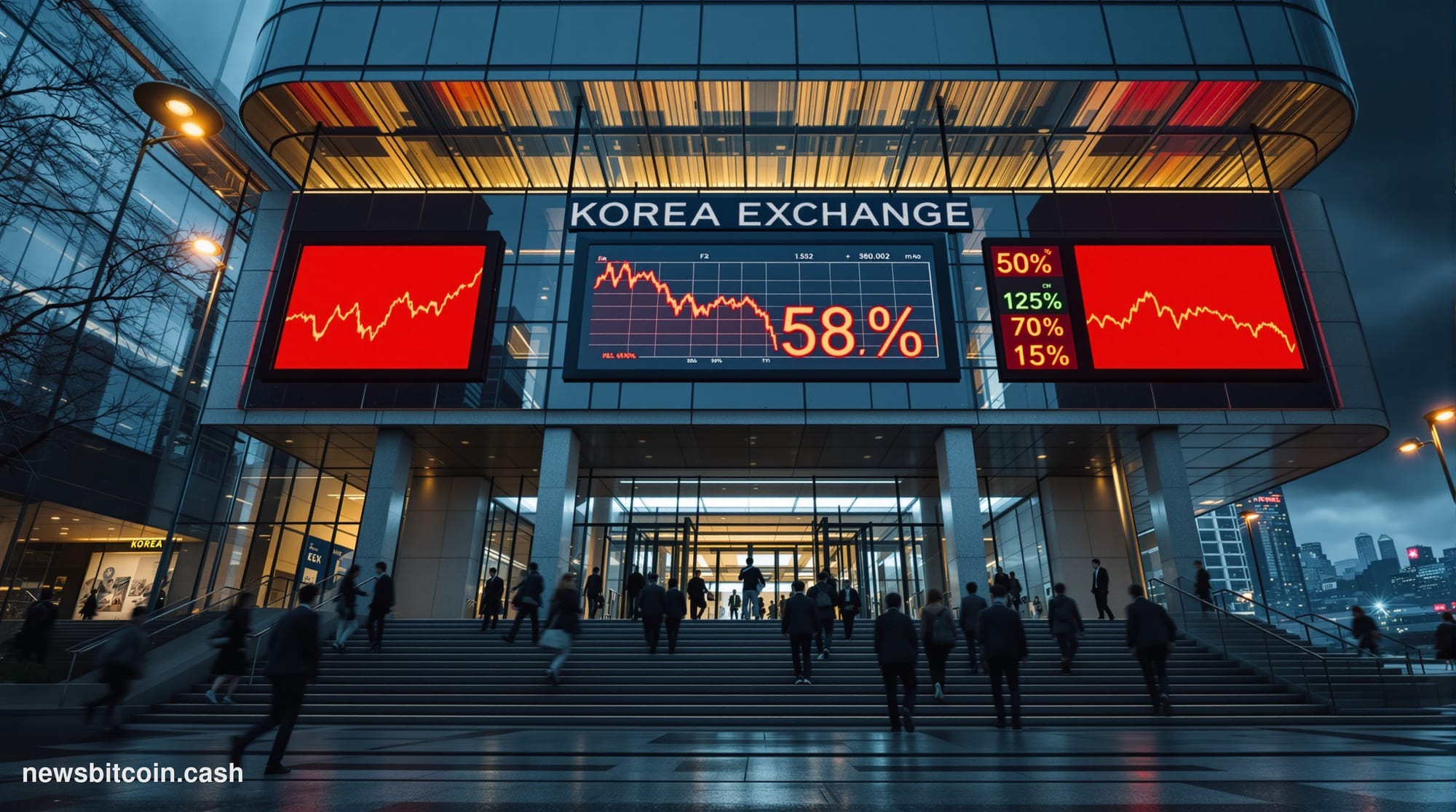
South Korea's benchmark equity index, the Korea Composite Stock Price Index (Kospi), suffered a sharp and disorderly selloff on Wednesday, plunging 6.45% in a single session as semiconductor stocks snapped a fragile recovery attempt. The decline was severe enough to activate another sell-side sidecar halt on the Korea Exchange — a circuit-breaker mechanism reserved for moments when futures markets spiral fast enough to threaten the integrity of underlying cash markets. It was not the first time this mechanism fired in recent sessions, a signal that South Korean equities are locked in a pattern of escalating volatility rather than a clean stabilization.
What a Sidecar Actually Means
The sidecar mechanism on the Korea Exchange is a specific, program-trading brake designed to cool automated sell programs when futures prices on the Kospi 200 drop at a pace that suggests cascading, machine-driven liquidation rather than orderly price discovery. Once triggered, it suspends program sell orders for a defined period, effectively forcing a pause in algorithmic selling. The fact that it was triggered again — implying a prior activation in recent trading — tells a story about the structural fragility underneath South Korean equities at this moment. These are not one-off shocks being absorbed; they are recurring pressure events testing the market's ability to find a floor.
Chips at the Center
The proximate cause of Wednesday's rout was the collapse of the anticipated semiconductor rebound. Chip stocks, which carry enormous weight inside the Kospi given that South Korea houses two of the world's most strategically critical memory manufacturers, had shown tentative signs of stabilizing in the sessions preceding the crash. That recovery thesis failed. When chip stocks reversed and slid instead of holding, the selling radiated outward across the broader index with enough force to reach the 6.45% drawdown threshold — a magnitude that, in a single session, erases weeks of index gains and resets market confidence.
South Korea's semiconductor sector occupies a geopolitical and macroeconomic crossroads unlike almost any other equity subsector globally. Demand signals from data-center operators and artificial intelligence infrastructure buildouts had injected cautious optimism into the space in recent quarters. Wednesday's action suggests that optimism, at least as priced into Korean equities, had run ahead of the underlying reality. A stalled chip rebound is not merely a domestic Korean story — it reverberates through global supply chains, touches the earnings of major technology firms, and feeds directly into the risk calculus of institutional investors positioned across Asia-Pacific markets.
The Crypto Correlation Context
For readers tracking digital asset markets, this kind of macro-equity dislocation carries direct relevance. Risk-off episodes of this severity — where a major national equity index loses more than 6% in a day and automated circuit breakers fire — historically compress global risk appetite in the short term. Coinbase-listed assets, decentralized finance protocols, and crypto-native equities all exist within a broader liquidity ecosystem that tightens when institutional desks in Seoul, Tokyo, and Hong Kong are forced into defensive positioning. When capital is being destroyed at this pace in one of Asia's most liquid equity markets, the ripple effects on speculative asset classes are rarely neutral.
The pattern also matters for Bitcoin and broader digital asset narratives around institutional adoption. The thesis that crypto assets serve as uncorrelated stores of value is stress-tested precisely in moments like Wednesday's Kospi collapse. Whether Bitcoin holds its range while Korean equities crater, or whether it trades in lockstep with the risk-off unwind, will be instructive for how institutional allocators model correlation in their portfolios heading into the remainder of 2026.
What This Means
The Kospi's 6.45% single-session decline, compounded by a repeated activation of the Korea Exchange's sell-side sidecar, reflects something more troubling than a routine correction. It reflects a market that attempted a recovery — specifically in the chip sector that underpins so much of South Korea's export-driven economy — and failed. Repeated circuit-breaker triggers within a compressed timeframe indicate that the volatility is structural, not episodic. For global investors, this is a reminder that semiconductor supply chains remain one of the most potent macro risk vectors in 2026, capable of shaking benchmark indexes with enough force to override automated trading infrastructure. For digital asset markets, the episode is a live stress test of correlation assumptions that every serious institutional allocator should be watching closely.
Written by the editorial team — independent journalism powered by Bitcoin News.