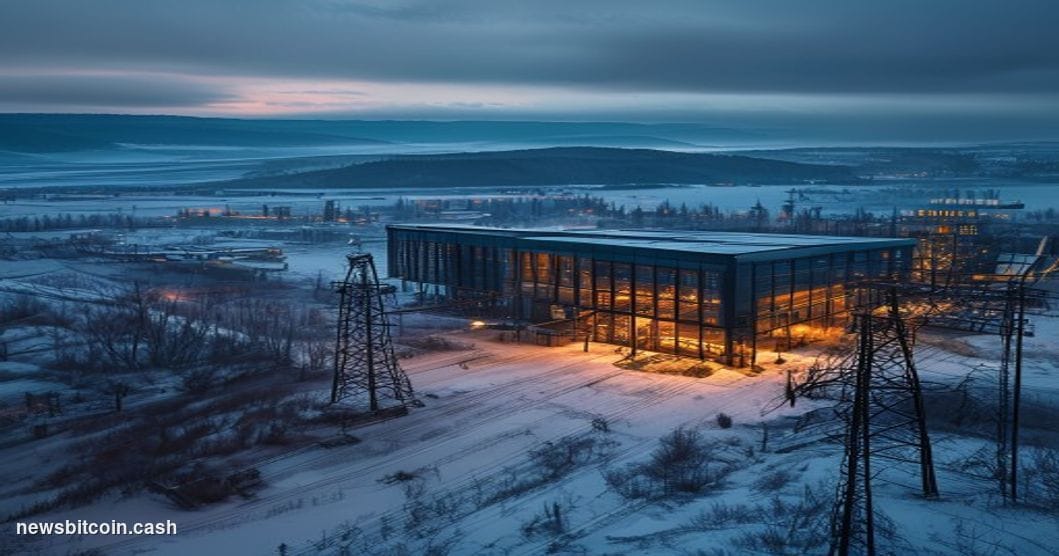
The pivot from Bitcoin mining to artificial intelligence infrastructure is no longer a trend on the horizon — it is arriving in Québec's Eastern Townships. Keel Infrastructure has secured the regulatory and municipal approvals necessary to consolidate three separate Bitcoin mining facilities in the province into a single, purpose-built campus dedicated to artificial intelligence and high-performance computing (HPC). The planned site, located in Sherbrooke, Québec, will carry a capacity of 96 megawatts, positioning it as a serious contender in the rapidly crowding North American HPC landscape.
The approvals represent a significant structural inflection point for Keel Infrastructure, a company that built its operational footprint in Canada on the back of Bitcoin mining — an industry that, for years, gravitated to Québec precisely because of the province's abundant, competitively priced hydroelectric power. That same energy advantage, which once made the region attractive for proof-of-work computation, is now being redirected toward the considerably more capital-intensive demands of AI model training and inference workloads. The logic is consistent; the execution is a wholesale transformation.
Why Sherbrooke, Why Now
Sherbrooke is not an accidental choice. Québec's grid, powered predominantly by Hydro-Québec, offers some of the lowest carbon-intensity electricity in North America — a feature that hyperscalers and enterprise AI buyers have increasingly priced into their infrastructure procurement decisions. For Keel, consolidating three geographically dispersed mining sites into one unified 96 MW campus makes operational sense on multiple dimensions: it reduces redundant staffing and management overhead, concentrates power interconnection negotiations with the utility into a single agreement, and allows the company to present a coherent, scaled product to prospective AI tenants rather than a patchwork of legacy mining assets.
The 96 MW figure deserves context. In the HPC and AI colocation market, a campus of that scale is meaningful but not dominant. Major hyperscale campuses routinely exceed 200 MW to 500 MW. What a 96 MW footprint does offer, however, is enough capacity to attract mid-tier enterprise AI deployments, national research institutions, or specialized model developers who require dedicated, power-dense infrastructure without the minimum commitment thresholds that larger facilities impose. It is a strategically defensible position in a market that still has room for focused, regionally anchored operators.
The Broader Reallocation of Mining Infrastructure
Keel Infrastructure's move is part of a broader reallocation happening across the Bitcoin mining sector. As mining economics tighten following the April 2024 halving — which cut the block subsidy from 6.25 to 3.125 BTC — operators with significant power contracts and physical infrastructure have been reassessing whether their highest-value use is continued proof-of-work computation or pivoting toward AI and HPC tenants willing to sign longer-term, higher-margin contracts. Several publicly traded miners have already announced or completed similar pivots, and private operators like Keel are now following with their own structural realignments.
What distinguishes Keel's approach is the consolidation angle. Rather than simply marketing existing mining buildings as "AI-ready" — a claim that often overstates the actual power density, cooling capacity, and fiber connectivity of legacy mining sheds — the company appears to be taking a more deliberate path: collapsing three separate sites into one greenfield-adjacent development in Sherbrooke, presumably with the infrastructure specifications that genuine HPC workloads demand. The regulatory approvals secured suggest local authorities are aligned with this vision, which in Québec's energy-constrained environment is no small endorsement.
Energy Politics and Provincial Appetite
Québec's relationship with cryptocurrency miners has been complicated. The province has at various points imposed moratoriums on new mining connections, citing grid capacity constraints and the preferential treatment historically afforded to industrial users. The fact that Keel has navigated the approvals process successfully — converting what were mining power allocations into an AI campus designation — indicates that provincial energy regulators may view AI and HPC workloads more favorably than raw Bitcoin mining from a socioeconomic returns perspective. AI campuses carry a stronger political narrative: high-skill job creation, research partnerships, and alignment with national AI strategy priorities that provincial governments are eager to claim credit for.
That political calculus matters for any infrastructure operator working within Hydro-Québec's allocation framework. Positioning as an AI campus rather than a mining operation may unlock more favorable interconnection terms, faster approval timelines, and a more durable operating license over the long run — even if the underlying physics of power consumption look broadly similar.
What This Means for the Sector
Keel Infrastructure's Sherbrooke campus consolidation is a case study in pragmatic infrastructure evolution. The company recognized that three smaller, distributed Bitcoin mining sites carried diminishing competitive returns in a post-halving environment and moved decisively to convert that footprint into a single, credentialed AI and HPC asset. At 96 MW, the campus will not redefine the North American data center market — but it does not need to. It needs to attract enough AI compute demand to justify the capital outlay and demonstrate that regionally anchored operators with grid-connected land can successfully navigate the mining-to-HPC transition. If Keel executes, it becomes a template. If the broader sector is paying attention, it should be watching Sherbrooke.
Written by the editorial team — independent journalism powered by Bitcoin News.