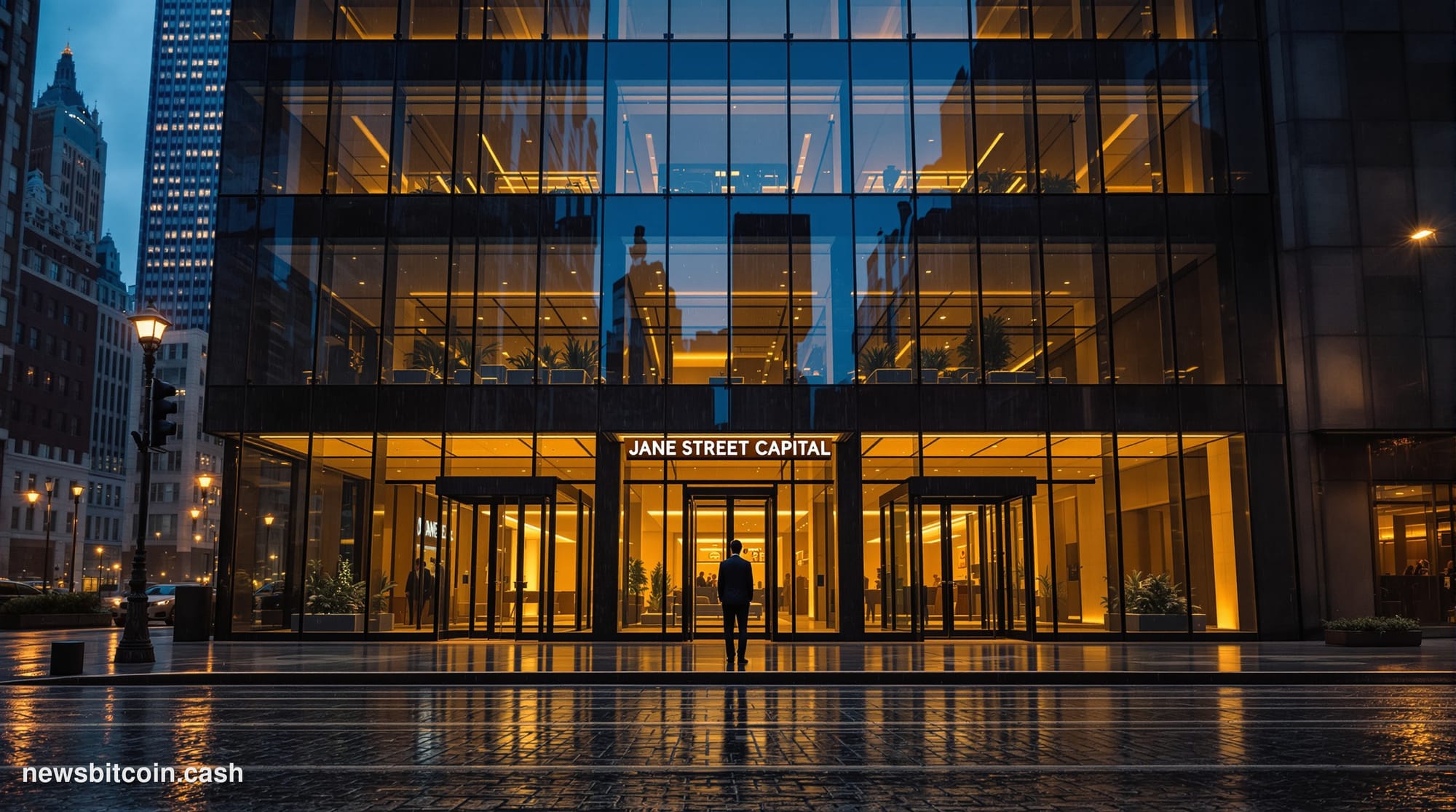
For a firm that had not logged a single month of negative trading revenue in a decade, July arrived like a circuit breaker. Jane Street, the notoriously secretive quantitative trading powerhouse, absorbed roughly $15 billion in losses during the month — simultaneously setting a grim record as its worst monthly loss ever and marking its first negative trading-revenue period since 2016. The culprit at the center of the damage: a concentrated investment in Situational Awareness, an artificial intelligence-focused hedge fund whose value collapsed alongside the broader technology selloff that rattled markets through July.
The scale of the loss demands a moment of context. Jane Street is not a retail brokerage or a speculative startup — it is one of the most sophisticated market-making and proprietary trading operations on the planet, with a reputation built on disciplined risk management and algorithmic precision across equities, fixed income, options, and crypto markets. A $15 billion single-month drawdown is not the kind of number that fits neatly into any narrative about cautious, systematic trading. It is, instead, a signal that something structurally different happened here: a directional bet on AI infrastructure went badly wrong at the worst possible time.
Situational Awareness and the AI Concentration Problem
The vehicle at the heart of Jane Street's pain is Situational Awareness, a hedge fund built around artificial intelligence strategies. Details on the fund's specific holdings and leverage profile remain sparse — that opacity is fairly standard in the hedge fund world — but the mechanics of what happened are legible enough. Jane Street held a meaningful position in the fund, and when AI-adjacent technology equities began selling off sharply in July, Situational Awareness's valuations moved in lockstep with the broader tech correction. Jane Street's exposure, rather than acting as a diversifier, amplified the damage.
This is precisely the concentration risk that critics of the AI investment supercycle have flagged for months. As capital flooded into AI-themed funds, positions across different vehicles began to correlate tightly — meaning what looked like diversification on paper was, in practice, a series of overlapping bets on the same underlying thesis: that AI infrastructure spending would remain elevated indefinitely, and that the equities exposed to that spending would continue to outperform. When the tech selloff arrived, those correlations collapsed any illusion of hedging.
A Decade of Dominance, One Month of Reckoning
The 2016 benchmark matters more than it might appear at first glance. In the decade between Jane Street's last negative month and July 2026, the firm navigated the COVID-19 volatility spike of March 2020, multiple Federal Reserve policy pivots, the 2022 crypto collapse, and repeated bouts of equity market turbulence. Through all of it, the firm remained in positive territory on a monthly trading-revenue basis. That streak was not luck — it reflected genuine structural advantages in market-making, latency arbitrage, and risk calibration that few competitors can replicate.
Breaking that streak with a record loss rather than a modest down month is precisely what makes July so analytically significant. It suggests that the firm's AI-related exposure was large enough relative to its overall book to override the natural hedging and diversification embedded in its core market-making operations. In other words, the Situational Awareness position was not a small satellite allocation — it was substantial enough to overwhelm the firm's normal risk buffers.
Still Standing, But the Questions Linger
The source reporting notes that despite the July carnage, Jane Street has still generated more than a positive year-to-date figure — a critical detail that prevents this story from being read as existential. The firm remains profitable on a 2026 basis, and its underlying market-making franchise is almost certainly intact. A single catastrophic month does not erase the structural advantages that have made Jane Street one of the most consistently profitable trading operations in modern finance.
But the loss does raise legitimate questions about governance and risk limits at firms that have historically operated with exceptional discretion. How large was the Situational Awareness allocation relative to Jane Street's total capital? Were there stop-loss mechanisms in place, and if so, why did losses reach $15 billion before positions were unwound? These are questions that regulators, counterparties, and the firm's own leadership will be asking internally — even if the answers never surface publicly, given Jane Street's private partnership structure and its historical aversion to disclosure.
What This Means for the AI Trade
Beyond Jane Street's own balance sheet, this episode carries a broader warning for institutional capital that has been rotating aggressively into AI-themed vehicles. The technology selloff that triggered July's losses is a reminder that thematic investing — regardless of how compelling the underlying narrative — creates concentration risk that is difficult to fully hedge. When the AI thesis faces even a temporary repricing, every fund with correlated exposure moves in the same direction simultaneously.
For the digital assets ecosystem specifically, this dynamic is worth watching closely. AI-crypto convergence plays have been attracting serious institutional capital, and Jane Street itself is a significant liquidity provider in crypto markets. A firm managing internal losses at this magnitude may adjust its risk appetite, widen spreads, or reduce capital deployment in adjacent markets — including crypto — as it rebalances its overall exposure. The ripple effects of a $15 billion July loss do not stay contained to a single fund or a single asset class.
Jane Street will almost certainly recover. Its franchise is deep, its talent base is formidable, and one record-setting loss does not rewrite a decade of structural outperformance. But July 2026 will be studied as a case study in what happens when one of the world's most sophisticated trading firms allows a thematic AI concentration to grow large enough to overwhelm its own risk architecture.
Written by the editorial team — independent journalism powered by Bitcoin News.