Frank Holmes, the executive chairman of HIVE Digital Technologies, is sounding an alarm that is equal parts macro warning and infrastructure thesis: governments around the world will collectively print $100 trillion, and the only rational responses are to hold Bitcoin and gold. But buried inside that headline argument is a quieter, arguably more consequential story — one about how the physical backbone of the Bitcoin mining industry is quietly becoming the most valuable real estate in artificial intelligence.
Holmes has spent decades navigating the intersection of hard money and speculative cycles, and his current positioning reflects that experience. The $100 trillion figure is not rhetorical flourish. It represents his projection of cumulative global monetary expansion — sovereign debt monetization, deficit spending, and central bank balance sheet growth — across major economies in the years ahead. For Holmes, this is not a fringe scenario. It is base case. And it makes the scarcity properties of both gold and Bitcoin not merely attractive, but structurally necessary for capital preservation.
The gold argument is familiar. Millennia of monetary history, central bank reserve accumulation, and inflation-hedge mechanics have been rehearsed extensively. What makes Holmes's framework fresher is the Bitcoin layer — and specifically, why the mining infrastructure that secures the Bitcoin network is emerging as something far more versatile than its original mandate suggests.
When Mining Sites Become AI Data Centers
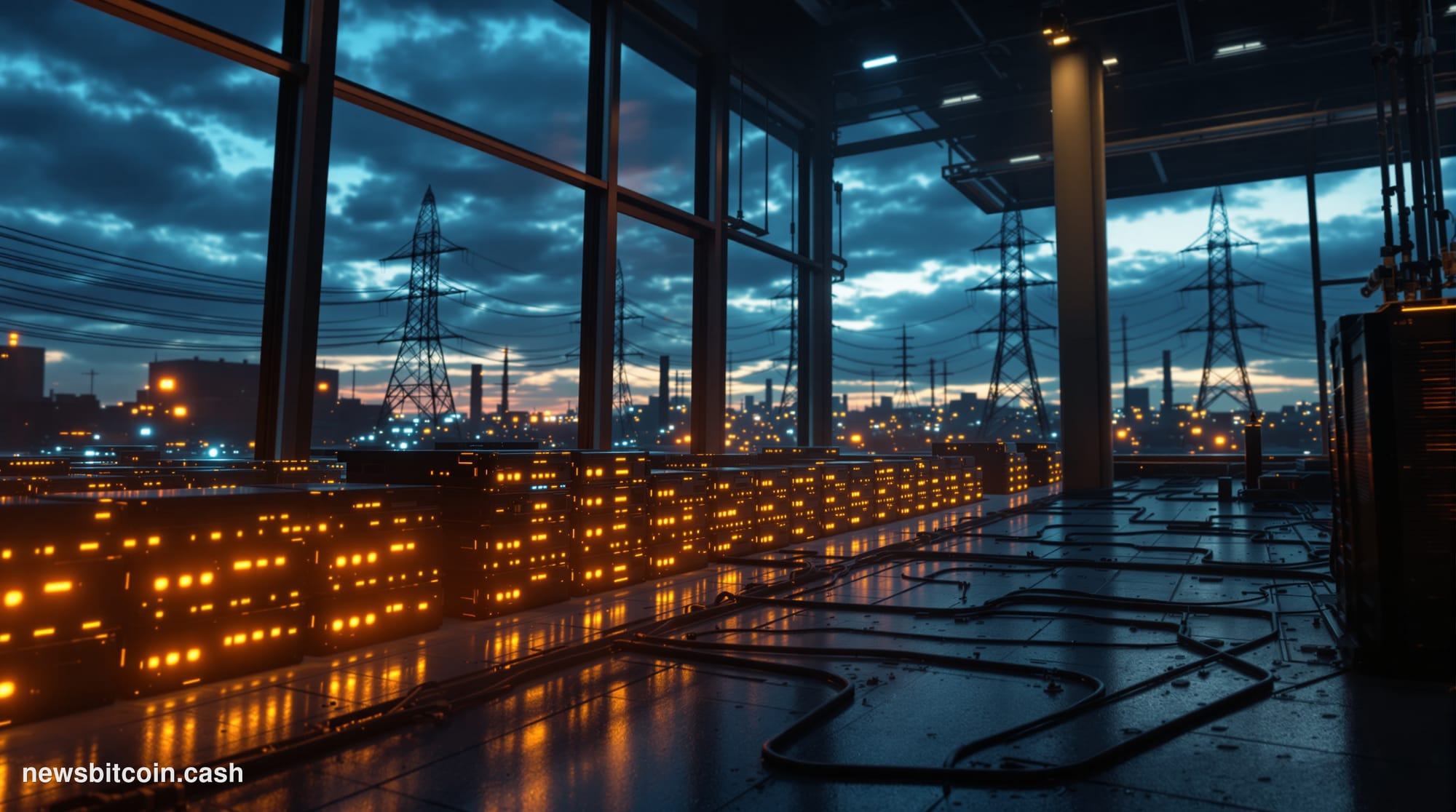
Bitcoin miners, by necessity, have always solved one of the hardest problems in enterprise infrastructure: sourcing massive quantities of reliable, low-cost electrical power and building the physical facilities to deploy it at scale. These are not commodity skills. Power purchase agreements, grid interconnection rights, and purpose-built cooling systems represent years of permitting, negotiation, and capital expenditure. They are deeply illiquid assets that take significant time to replicate from scratch — which is precisely why the artificial intelligence industry is eyeing them with such intensity.
Holmes makes the case that HIVE and its peers are sitting on infrastructure that AI hyperscalers urgently need. The computing demands of large language models, inference workloads, and AI training clusters are straining power grids globally. Building new data centers from raw land takes years. Repurposing an existing, grid-connected mining site with established power capacity can happen in a fraction of that time. This is not a theoretical arbitrage — it is an operational pivot already underway.
Equally notable is the role of repurposed hardware. When Ethereum transitioned from proof-of-work to proof-of-stake in September 2022 — the event known as the Merge — it effectively rendered an enormous global fleet of graphics processing units (GPUs) redundant for crypto mining overnight. Holmes highlights how those former Ethereum GPUs are now being redeployed into AI compute workloads. The hardware that once validated Ethereum transactions is now processing the matrix multiplications that power generative AI. It is a remarkable second life for assets that many wrote off as stranded the moment the Merge completed.
Hard Assets in a Soft-Money Era
The macro scaffolding beneath Holmes's infrastructure thesis is the monetary debasement argument. If sovereign governments are structurally committed to expanding money supplies to service debt obligations, fund entitlement programs, and stabilize financial systems during crises, then assets with fixed or algorithmically constrained supply should, over time, appreciate relative to fiat purchasing power. Bitcoin's 21 million coin cap and gold's geological scarcity are the two clearest expressions of that logic available to investors today.
What distinguishes Holmes's position from generic hard-money advocacy is the operational angle. HIVE is not simply a passive Bitcoin holder making a balance sheet bet on price appreciation. The company is actively repositioning its physical mining infrastructure to capture revenue from AI compute demand — essentially monetizing the power and facility assets independently of Bitcoin's market cycle. This creates a dual revenue thesis: long Bitcoin as a monetary asset appreciating against debased fiat, while simultaneously generating cash flow from the AI industry's insatiable appetite for GPU compute and powered rack space.
For institutional investors trying to navigate a world where central bank credibility is increasingly strained and AI capex is accelerating simultaneously, the HIVE model represents an unusual convergence. It offers exposure to two of the most consequential structural trends of the current decade — monetary regime stress and the AI compute buildout — through a single operational entity built originally to mine a single cryptocurrency.
What This Means for the Industry
Holmes's argument is ultimately a reframing of what Bitcoin miners are. They are not merely participants in a niche consensus mechanism. They are operators of critical power infrastructure that the broader digital economy — crypto and AI alike — cannot function without. As the $100 trillion monetary expansion thesis plays out across sovereign balance sheets, the physical assets that miners have quietly assembled may prove as durable a store of value as the Bitcoin those facilities produce. The repurposed Ethereum GPU fleet is a preview of how rapidly that infrastructure can be redirected. The question investors need to ask is whether they have been undervaluing the land beneath the mining rigs all along.
Written by the editorial team — independent journalism powered by Bitcoin News.