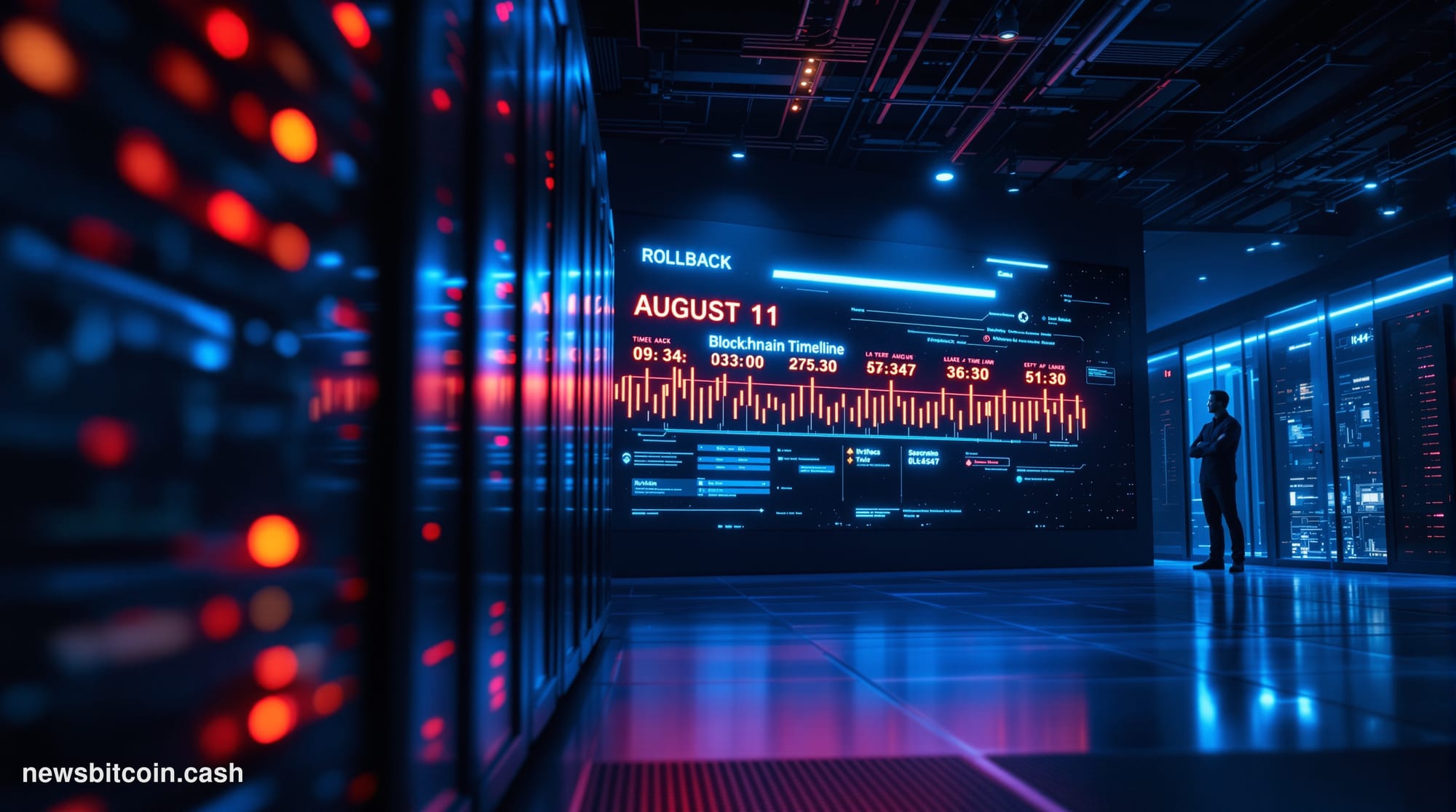
In one of the most drastic unilateral interventions ever attempted on a proof-of-stake blockchain, Harmony is set to delete nearly a week of its own chain history — rolling back to a snapshot dated August 11 — in a direct surgical response to the emergence of billions of fraudulently created ONE tokens on its network. Validators are actively coordinating the restart, and the implications extend far beyond Harmony itself, raising uncomfortable questions about what immutability really means in practice when a protocol faces an existential threat.
What Happened to the Chain
The trigger for this extraordinary measure was the discovery of forged ONE tokens — fabricated at a scale measured in the billions — circulating on the Harmony network. Whether the result of a smart contract exploit, a consensus-layer vulnerability, or a deeper infrastructure compromise, the outcome is the same: a massive volume of illegitimate supply materialized inside a network whose economic model depends entirely on token scarcity and validator trust. Left unchecked, billions of forged tokens would have the capacity to devastate the token's market value, corrupt staking economics, and render the entire validator incentive structure meaningless.
Harmony's chosen remedy is blunt and deliberate: wind the clock back to August 11, the last clean state before the fraudulent tokens entered the ledger. Every transaction, every block, every state change recorded between that date and the rollback decision simply ceases to exist on the canonical chain. For a network that markets itself on decentralization and finality, this is not a minor patch — it is an admission that finality, under sufficiently catastrophic circumstances, is negotiable.
The Mechanics of Erasing History
A blockchain rollback of this scope requires coordinated action from the validator set. Validators must agree to abandon the current chain tip, load a prior state snapshot, and recommit to building on top of that restored foundation. In a healthy, decentralized network with hundreds of independent validators spread across jurisdictions, achieving that consensus is genuinely difficult. The fact that Harmony's validator community is moving toward restart in apparent unison says something important about the severity of the forged-token crisis — and, critics will note, about the degree of centralized coordination that remains possible within nominally decentralized systems.
Once the rollback is executed, any legitimate activity that occurred on Harmony between August 11 and the moment of the reset — genuine transfers, staking events, smart contract interactions — will be erased alongside the fraudulent ones. There is no surgical option. The chain does not distinguish between honest transactions and those built on a corrupted state. Users who transacted in good faith during that window face the uncomfortable reality that their activity will be treated as if it never occurred.
A Familiar Nightmare, A Familiar Debate
For anyone who has followed blockchain history with any depth, the Harmony rollback will inevitably recall the Ethereum community's 2016 decision to fork following the DAO hack — a moment that split the network and produced Ethereum Classic as a monument to the "code is law" philosophy. That episode established a precedent that large-scale protocol interventions, however disruptive, remain on the table when existential sums are at stake. Harmony's decision draws from the same playbook, even if the specific mechanism differs.
What distinguishes this situation is the scale of the fabrication. Billions of forged ONE tokens represent not merely a theft from existing holders but a fundamental corruption of the supply ledger itself. A hack that drains a treasury is damaging; an exploit that manufactures supply from nothing attacks the monetary credibility of the entire protocol. In that context, the rollback begins to look less like a controversial intervention and more like the only mathematically coherent path to network survival.
What This Means for the Ecosystem
The Harmony episode will register as a stress test for a principle the industry has never fully resolved: when immutability collides with catastrophic fraud, which value wins? Every time a development team or validator consortium chooses intervention over principle, the answer hardens in one direction. That is not necessarily wrong — protocols that cannot defend themselves against existential exploits do not survive long enough to uphold any principles — but it demands honesty about what is actually being offered to users.
For builders and institutions considering Harmony as an infrastructure layer, the rollback resets more than just block history. It resets the trust calculus. Developers will need to evaluate how the team communicates the restored chain's state, how affected users from the erased window are compensated or acknowledged, and what technical changes are introduced to prevent a recurrence. Validators preparing the restart carry more than a technical burden — they carry the obligation to make the case that the network that re-emerges is materially safer than the one that went down.
Blockchain immutability has always been a conditional guarantee. Harmony just made that condition visible.
Written by the editorial team — independent journalism powered by Bitcoin News.