What began as localized protest meetings in American suburbs has evolved into a coordinated global reckoning with the infrastructure demands of artificial intelligence. Community resistance to AI data centers is now flaring across four continents, with residents in Australia, South Korea, Japan, and Malaysia actively pushing back against projects that developers have tried to site in close proximity to homes. The movement signals something more consequential than not-in-my-backyard politics: it reflects a deepening public debate about who bears the physical cost of the world's insatiable appetite for computing power — and by extension, the infrastructure that underpins everything from large language models to blockchain networks and crypto mining operations.
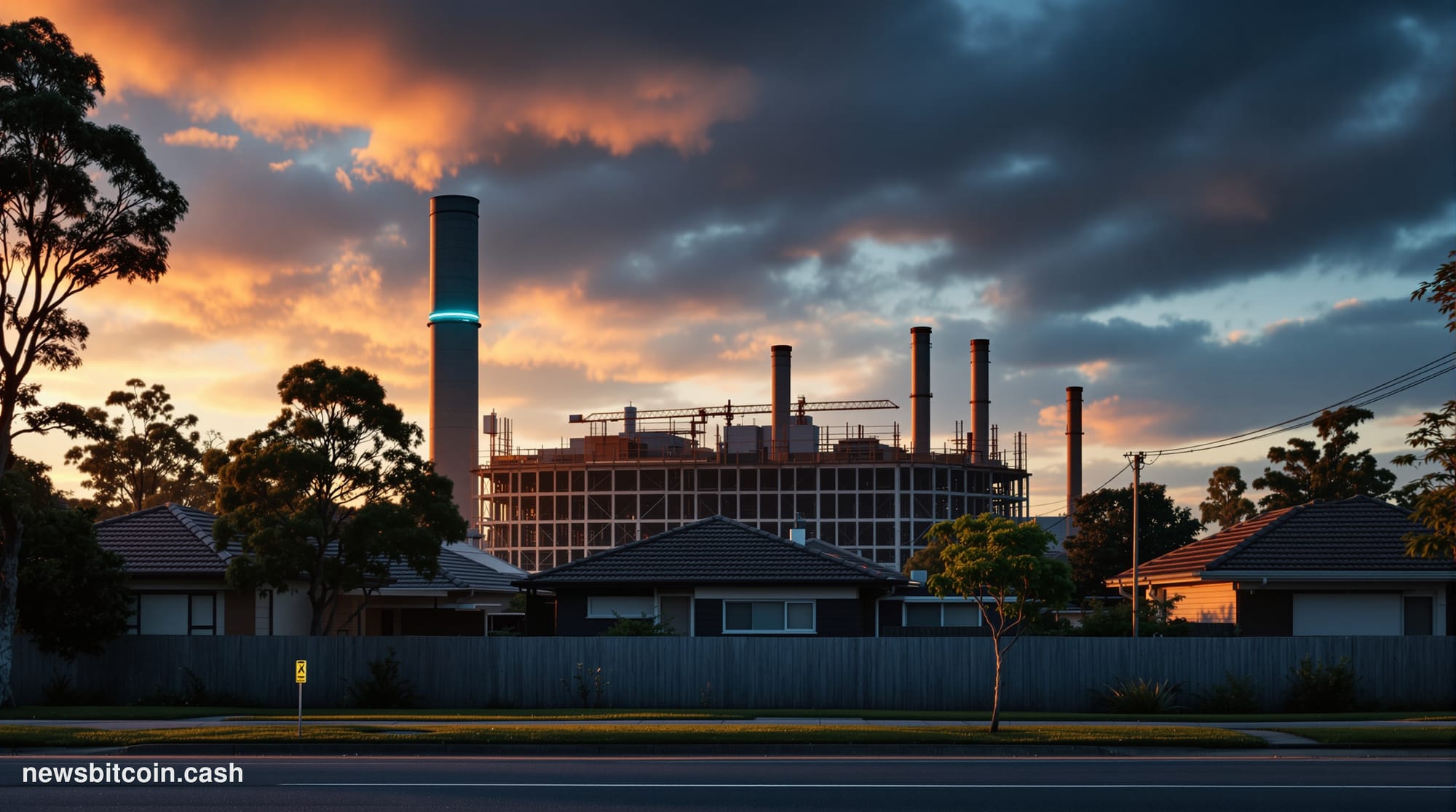
The most striking early victory for this global resistance came in Sydney, where Australia's largest property company was forced to abandon a planned data center after drawing fierce opposition from local residents. The project's fatal flaw was immediately obvious to anyone who visited the site: the facility would have been constructed approximately 20 meters from existing homes. That is not a planning oversight — it is the kind of proximity that turns neighbors into activists, and in this case, it worked. The developer's decision to walk away from the project represents a significant early test of whether communities can successfully assert veto power over infrastructure that national governments and the tech industry have treated as a matter of near-automatic approval.
The significance of the Sydney withdrawal should not be underestimated. Australia's property and development sector has historically operated with considerable political leverage, particularly when projects are framed as economic drivers or part of national digital strategy. That even the country's largest property company could not push through a data center against organized residential opposition suggests the calculus has shifted. Communities are no longer accepting the premise that AI infrastructure automatically serves the public interest, regardless of where it is built or what it costs neighbors in noise, heat, electromagnetic interference, and diminished property values.
Across the Pacific, similar confrontations are taking shape in South Korea, Japan, and Malaysia — three countries that have aggressively courted hyperscale data center investment as a cornerstone of their digital economy ambitions. The tension is acute because governments in these nations have made sovereign competitiveness arguments for accelerating data center buildout, often fast-tracking approvals and offering tax incentives to attract global cloud providers and AI infrastructure firms. Residents near proposed sites, however, are increasingly asking questions that economic development frameworks tend to ignore: What happens to local water supplies? Who absorbs the cost of grid upgrades? What are the long-term health implications of living adjacent to a facility running tens of thousands of servers around the clock?
For the crypto and digital assets industry, this global revolt carries direct implications. Blockchain infrastructure — from proof-of-work mining farms to the server clusters that power validator nodes, exchanges, and decentralized finance protocols — shares the same fundamental footprint as AI data centers. The power loads, cooling requirements, and physical scale are comparable. Jurisdictions that once welcomed crypto mining operations with open arms have already demonstrated a pattern of reversing course when communities organize. New York State's moratorium on certain proof-of-work mining operations and recurring conflicts over mining sites in rural communities across the American South and Midwest previewed exactly the kind of local resistance that AI data centers are now encountering at scale globally.
The infrastructure buildout required to sustain both AI workloads and blockchain networks at their current growth trajectories is genuinely enormous. Industry analysts have estimated that data center power demand could double or triple within the decade as AI model training and inference workloads multiply. Crypto networks, despite the shift of major protocols toward proof-of-stake consensus mechanisms, still contribute meaningfully to global compute and energy demand. The communities now mobilizing in Sydney, Seoul, Tokyo, and Kuala Lumpur are effectively forcing a conversation that tech and crypto developers have long preferred to defer: there is no neutral geography when it comes to industrial-scale computing. Every server rack lands somewhere, and the people who live near that somewhere are increasingly refusing to stay quiet.
What this means for investors, developers, and policymakers is a materially more complex siting environment for digital infrastructure going forward. The era of treating suburban and peri-urban land as frictionless territory for hyperscale facilities appears to be ending. Projects will need more robust community engagement, genuine setback distances from residential zones, and in many cases entirely new site selection criteria. For the crypto industry specifically, the lesson is the same one that AI infrastructure developers are now learning the hard way in Sydney and across Asia: the social license to operate is not granted by a government approval — it has to be earned from the people who live next door.
Written by the editorial team — independent journalism powered by Bitcoin News.