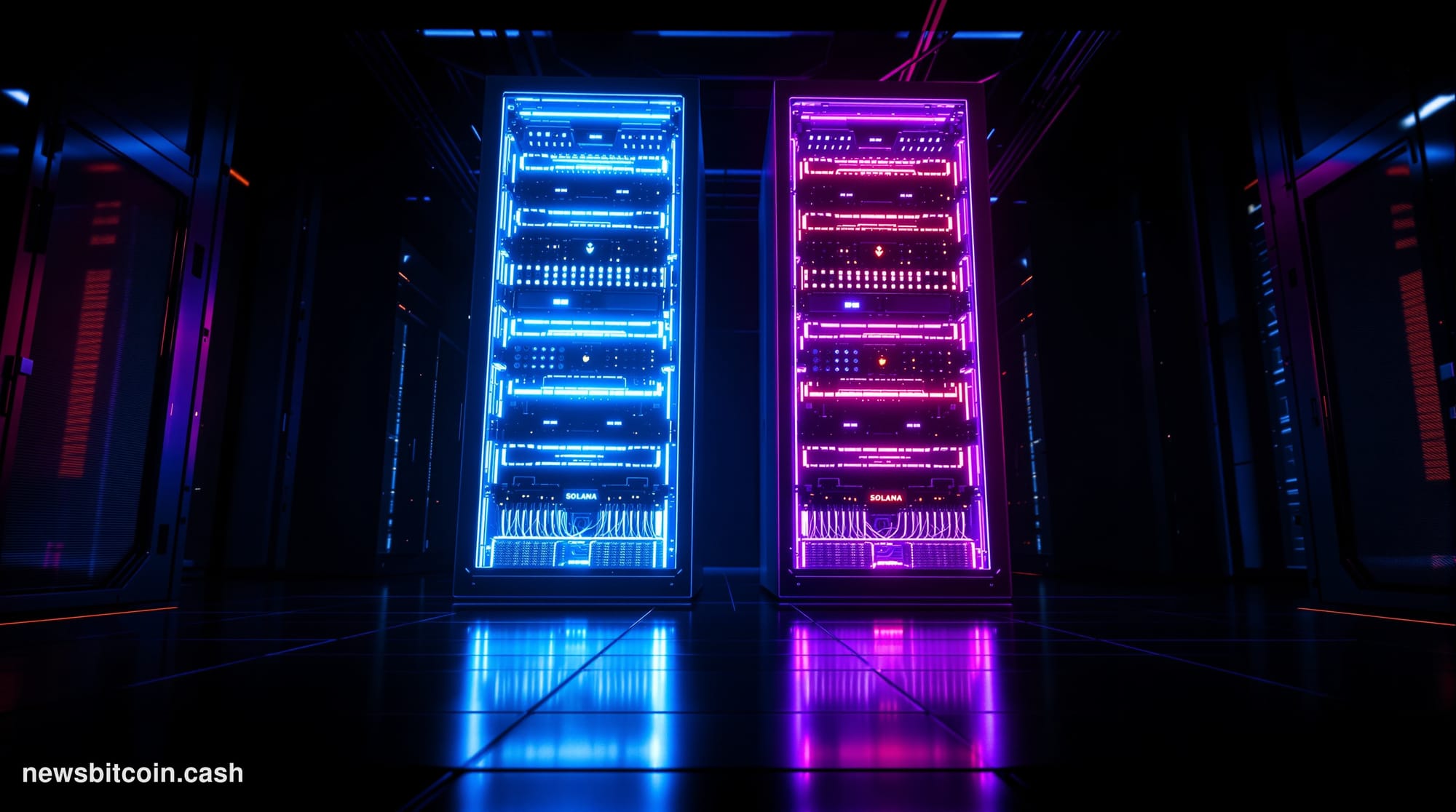
There is a version of crypto coverage that never leaves the price chart. It tracks peaks and corrections, overlays moving averages, and frames every protocol decision as a catalyst or a headwind for the next rally. That version of the story is missing the point in 2026. The year's most consequential developments are happening at the protocol layer — specifically, inside two upgrades that will reshape how Ethereum and Solana function at their core: Glamsterdam and Alpenglow.
These are not marketing rebrands or incremental patches. They represent the kind of deep architectural work that defines what a blockchain network can and cannot do for the next several years. When developers, validators, and institutional builders make long-term infrastructure bets, they are reading upgrade roadmaps, not candlestick charts. The Glamsterdam and Alpenglow cycles are the document everyone serious is reading right now.
Ethereum's Glamsterdam: Building on the Post-Merge Foundation
Ethereum's upgrade cadence has followed a deliberate, sometimes maddeningly slow, progression since the Merge shifted the network to proof-of-stake. Each subsequent hard fork has added efficiency, reduced complexity, or expanded capability for the layer-2 ecosystem that now carries the bulk of Ethereum's actual transaction volume. Glamsterdam — the name itself a portmanteau in the tradition of prior Ethereum upgrades that blend city names — continues that trajectory. It arrives as Ethereum's developer community has become increasingly focused on making the base layer leaner and more capable of supporting the dense ecosystem of rollups, bridges, and decentralized applications built on top of it.
The significance of a named Ethereum upgrade should not be understated. These hard forks require coordination across a globally distributed set of client teams, validator operators, and application developers. Getting any single upgrade to mainnet is a feat of open-source project management. Getting a transformative one through without disruption is a genuine engineering achievement. The fact that Glamsterdam is framed as one of 2026's most important blockchain events signals that what it contains goes beyond routine maintenance.
Solana's Alpenglow: Rewriting the Consensus Engine
Solana's story in 2026 reads differently. The network spent much of 2022 and 2023 defending itself against accusations of centralization and suffering high-profile outages that rattled institutional confidence. Since then, the development community has worked methodically to harden the infrastructure. Alpenglow represents the most ambitious piece of that effort — an upgrade aimed at the consensus mechanism itself, which is where Solana's most persistent technical criticisms have been anchored.
Consensus rewrites are rare in production blockchain networks precisely because the risk surface is enormous. A flaw at that layer does not produce a buggy smart contract or a failed transaction; it can fragment the network entirely. That Solana's developers are pushing forward with Alpenglow in a live, high-stakes environment — one processing millions of transactions and supporting a multi-billion-dollar decentralized finance and non-fungible token ecosystem — speaks to both the maturity of the engineering team and the urgency of the problem being solved. If Alpenglow ships cleanly, it strengthens Solana's case as a credible long-term infrastructure layer rather than a fast-but-fragile alternative to Ethereum.
Why Protocol Upgrades Are the Real Story
The broader framing here deserves direct engagement. It has become fashionable in crypto media cycles to treat every protocol development as a price event — will this upgrade be bullish or bearish? That framework collapses the actual significance of what infrastructure work represents. Blockchain networks are, at their most fundamental level, coordination mechanisms. Their value derives from the reliability, throughput, and programmability of that coordination. Upgrades that improve those properties compound over time in ways that dwarf short-term price movements.
Consider the Ethereum Merge in September 2022. Its immediate price impact was ambiguous and short-lived. Its infrastructure impact — eliminating proof-of-work energy consumption, enabling future scalability upgrades, repositioning Ethereum for institutional adoption — has been structural and lasting. Glamsterdam and Alpenglow belong to the same category of events: moments where the underlying capability of a network either advances or stalls.
For anyone building on these networks — whether they are deploying a decentralized exchange, structuring a real-world asset tokenization product, or writing institutional custody software — the upgrade roadmap is the investment thesis. Capital and developer talent flow toward networks that execute. The second half of 2026 will tell us a great deal about which networks those are.
What This Means
Glamsterdam and Alpenglow arriving in the same upgrade cycle creates a rare moment of parallel stress-testing for crypto's two dominant smart contract platforms. Both networks are attempting significant protocol-level changes while supporting live, high-value ecosystems. Success for both would mark 2026 as a genuine inflection point in blockchain infrastructure maturity — not because prices moved, but because the foundations underneath them got meaningfully stronger. Failure, or even a messy rollout, would do the opposite. Watch the testnets, read the developer calls, and pay attention to validator participation rates. The chart to follow in the second half of 2026 is not denominated in dollars.
Written by the editorial team — independent journalism powered by Bitcoin News.