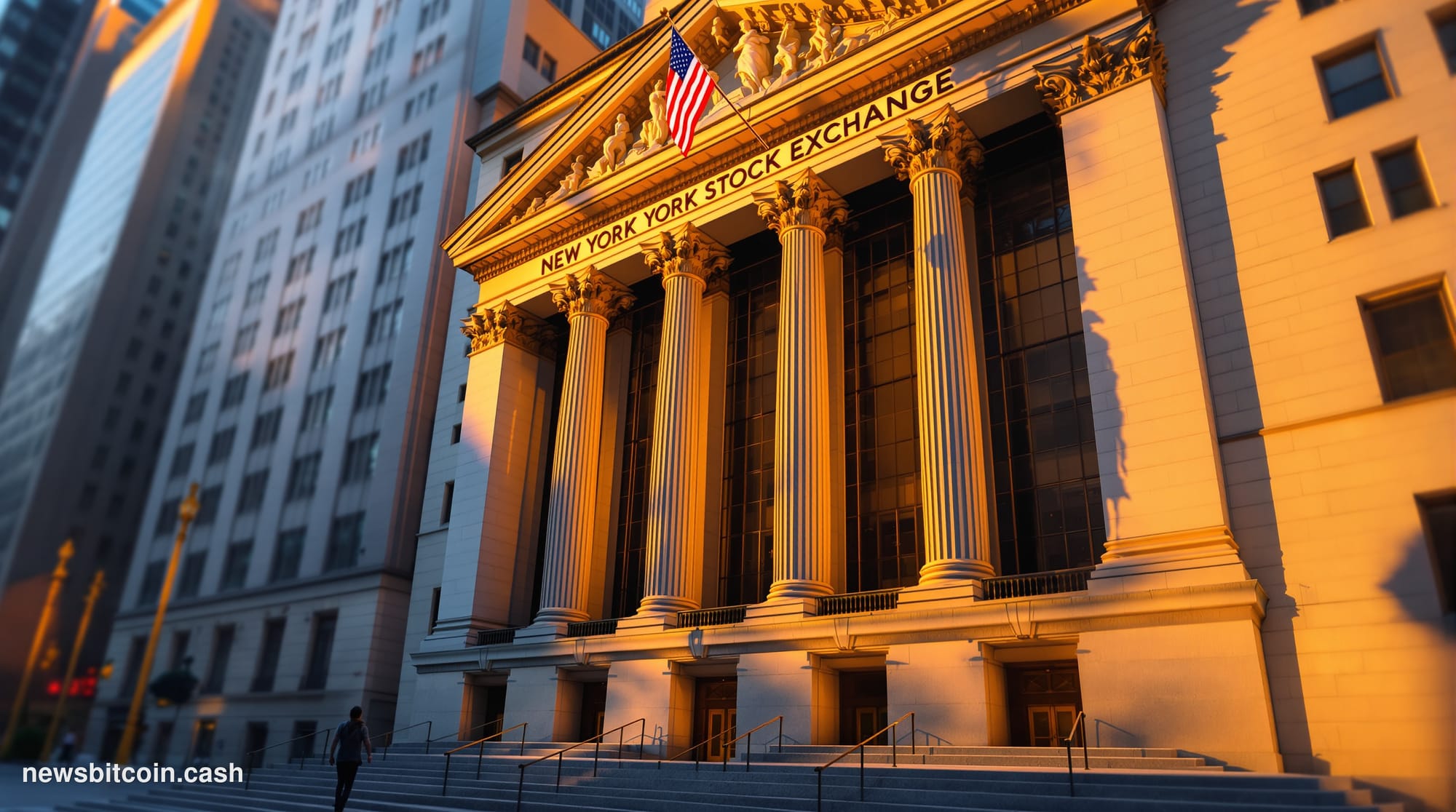
A little-known financial infrastructure firm called Formation Securities is quietly assembling what could become one of the more consequential experiments at the intersection of traditional equities and blockchain technology. The company is planning a stock trading venue built on Solana that would allow around-the-clock trading of tokenized shares — and it intends to operate under an exemption granted by the U.S. Securities and Exchange Commission (SEC). If it clears the regulatory and technical hurdles ahead, the platform could launch as early as 2027.
The initial lineup of tokenized shares planned for the venue spans three companies: Galaxy Digital, the crypto-native merchant bank; Exodus, the self-custody wallet company that became one of the first firms to tokenize its equity on a public blockchain; and Forward Industries, a hardware and industrial design firm. The selection is telling. These are not blue-chip S&P 500 names. They are, by design, companies already embedded in or adjacent to the digital asset ecosystem — an audience likely to be comfortable holding and trading tokenized equity through blockchain-native infrastructure.
The core proposition of Formation Securities' venue centers on a problem that has long frustrated retail and institutional investors alike: the artificial constraint of market hours. Traditional U.S. equity markets close at 4:00 PM Eastern and remain dark through weekends and public holidays. That rigidity made sense in an era of paper ledgers and phone-order brokers, but it sits uncomfortably alongside the expectations of a generation raised on crypto markets that never sleep. By anchoring its platform to Solana — a blockchain specifically designed for high throughput and low-latency settlement — Formation Securities is making a direct architectural argument: public blockchains are ready to serve as the rails for regulated securities markets.
The SEC exemption is the fulcrum on which this entire plan balances. Exempt trading venues operate under a relaxed regulatory framework compared to fully registered national securities exchanges, allowing more experimental market structures to exist without first navigating the full weight of exchange registration. Formation Securities appears to be threading this needle deliberately, using the exemption as a path to market that keeps regulatory compliance intact while giving the firm room to build and test a novel trading architecture. This is not a workaround — it is a recognized regulatory category, and deploying it here signals that at least some part of the regulatory conversation around tokenized securities has matured enough to allow real products to move forward.
Solana's selection as the underlying blockchain carries strategic weight beyond raw performance metrics. The network has re-established itself as a leading smart contract platform following the turbulence of late 2022, and it has accumulated a growing body of institutional attention. Its throughput capabilities — capable of processing tens of thousands of transactions per second at fractions of a cent in fees — make it technically suited for a trading venue that would need to handle continuous order flow across time zones. For tokenized equities specifically, the ability to settle trades near-instantaneously on-chain, rather than through the existing T+1 or T+2 settlement cycles, is a material operational upgrade.
The choice to debut with Galaxy Digital, Exodus, and Forward Industries also reflects a pragmatic go-to-market logic. Tokenizing shares of companies that already have blockchain-native investor bases reduces the friction of onboarding. Galaxy Digital's shareholders are, by definition, already comfortable with digital asset exposure. Exodus's equity is itself a product of blockchain tokenization — the company issued its shares as blockchain tokens directly to investors, bypassing traditional brokerage entirely. These aren't arbitrary picks; they are companies whose investors are most likely to participate in and validate the new venue's mechanics before it scales to broader equity markets.
What Formation Securities is attempting is, in essence, a proof of concept for the next generation of equity infrastructure. The tokenized securities market has been a subject of serious institutional interest for years — from JPMorgan's private blockchain experiments to BlackRock's tokenized money market fund — but publicly accessible, SEC-compliant, 24/7 tokenized stock trading on a permissionless blockchain remains largely theoretical. A working venue, even one starting with three tickers, would represent a qualitative leap from discussion to deployment.
The 2027 timeline gives Formation Securities a narrow but real window to establish itself before larger incumbents — traditional exchanges exploring blockchain settlement, or crypto-native platforms seeking equity trading licenses — close the gap. The question is not whether tokenized equities will eventually trade around the clock on blockchain infrastructure. The question is who builds the credible, regulated venue first. Formation Securities is raising its hand.
Written by the editorial team — independent journalism powered by Bitcoin News.