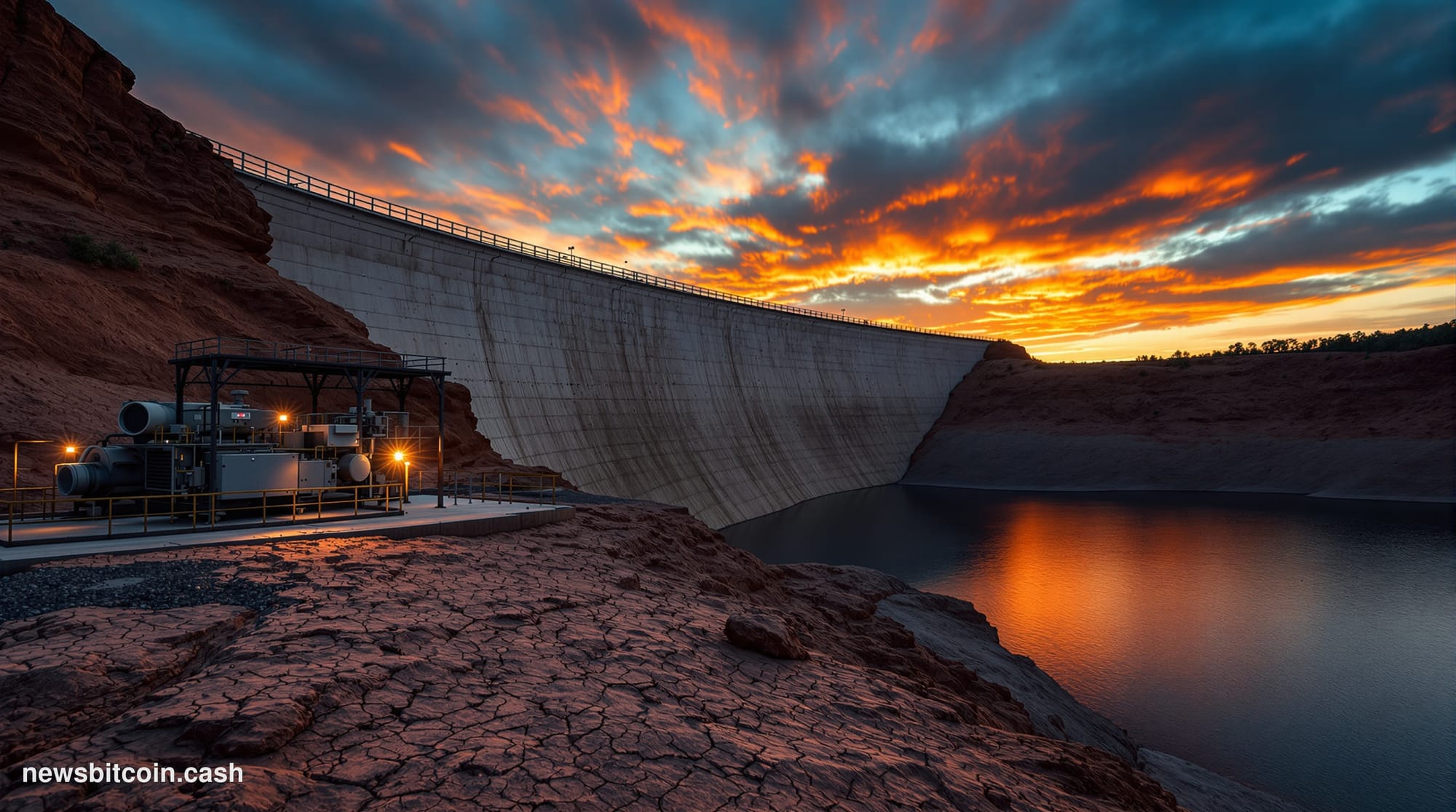
Ethiopia's state-owned power utility has imposed a sweeping 77% reduction in electricity supply to Bitcoin mining operations across the country, citing a severe hydropower shortage driven by declining inflows into the nation's key reservoirs. The move throws into sharp relief the precarious relationship between energy-intensive crypto infrastructure and the natural resource constraints that underpin grid stability in one of Africa's fastest-growing mining markets.
The scale of the cut is extraordinary. A 77% reduction is not a temporary dimming of lights — it is a near-total shutdown of an industry that had, until this crisis, become a significant pillar of the utility's commercial revenue. According to reports, Bitcoin miners accounted for 35% of the state-owned power producer's revenue in the prior year. That figure alone tells a story of just how rapidly Ethiopia had positioned itself as a credible destination for industrial-scale crypto mining, leveraging its historically cheap and abundant hydroelectric power as a competitive advantage over rivals in Central Asia and North America.
The hydropower shortage, caused by declining reservoir inflows — likely linked to erratic rainfall patterns across the Ethiopian highlands — has forced the utility into an unavoidable triage decision. Households and manufacturers were placed at the top of the priority hierarchy. Bitcoin miners, despite their outsized financial contribution to the utility's balance sheet, were placed last. From a political and social governance standpoint, this is hardly surprising. No government can afford to be seen cutting power to homes and factories while data centers running cryptographic computations remain fully lit. But the economic cost of that decision deserves careful examination.
The 35% revenue figure is not a rounding error. It represents a structural dependency that the utility itself cultivated, presumably because Bitcoin miners offered something rare in frontier energy markets: reliable, high-volume, price-insensitive demand. Mining operations, by their nature, consume electricity continuously and predictably, making them ideal anchor tenants for power grids with surplus generation capacity. Ethiopia's utility benefited enormously from that dynamic — until the surplus evaporated.
This episode exposes a fundamental tension in the emerging model of pairing Bitcoin mining with renewable energy infrastructure in developing economies. The pitch is compelling in theory: miners monetize otherwise stranded or curtailable power, utilities gain a flexible revenue stream, and miners benefit from low-cost clean electricity. Ethiopia was frequently cited as a textbook example of this arrangement working in practice. The country's vast hydroelectric potential, anchored by mega-projects on the Blue Nile, seemed to offer near-limitless runway for mining expansion. What the model did not fully account for was climate variability — the possibility that reservoir inflows could decline sharply enough to destabilize the entire equation.
The vulnerability here is not unique to Ethiopia. Any mining ecosystem built on hydro-dependent grids — from Paraguay to Laos to the Pacific Northwest of the United States — carries a version of this same risk. Reservoirs are not batteries in the traditional sense; they are subject to precipitation cycles, upstream water usage, and increasingly, the compounding effects of climate disruption. When those inputs weaken, the curtailment hierarchy kicks in, and miners — legally categorized as discretionary industrial consumers in most jurisdictions — are first in line for cuts.
For the mining companies operating in Ethiopia, the 77% reduction represents a cash flow emergency. Mining profitability is a function of uptime, hash rate contribution, and energy cost. Remove 77% of your power allocation and you have effectively removed 77% of your productive capacity while fixed costs — hardware depreciation, personnel, lease obligations — remain largely unchanged. Some operators will have hedged through diversified site portfolios. Others, particularly smaller or newer entrants who concentrated their infrastructure in Ethiopia to capture the favorable power economics, face potentially existential pressure.
The broader signal for institutional capital evaluating frontier mining markets is sobering. Ethiopia attracted mining investment precisely because it offered low-cost renewable power backed by substantial installed hydro capacity. That thesis has not been invalidated — but it has been stress-tested in a way that reveals the need for more sophisticated risk modeling around hydrological variability, grid priority frameworks, and sovereign discretion over power allocation. A utility that derives 35% of its revenue from miners can and will cut those miners off when political and social imperatives demand it. That is not a criticism; it is a reality that investment underwriting must price in from the outset.
What this means for the global mining industry is a renewed conversation about energy diversification and grid resilience. Single-source renewable dependency — whether hydro, solar, or wind — carries curtailment risk that operators and investors have historically underweighted relative to the cost savings on offer. Ethiopia's 77% cut should serve as a reference case for the sector: favorable energy economics and clean power credentials are necessary but insufficient conditions for sustainable mining infrastructure. The durability of the power supply, and the utility's contractual and political latitude to prioritize other consumers, matters just as much as the price per kilowatt-hour.
Written by the editorial team — independent journalism powered by Bitcoin News.