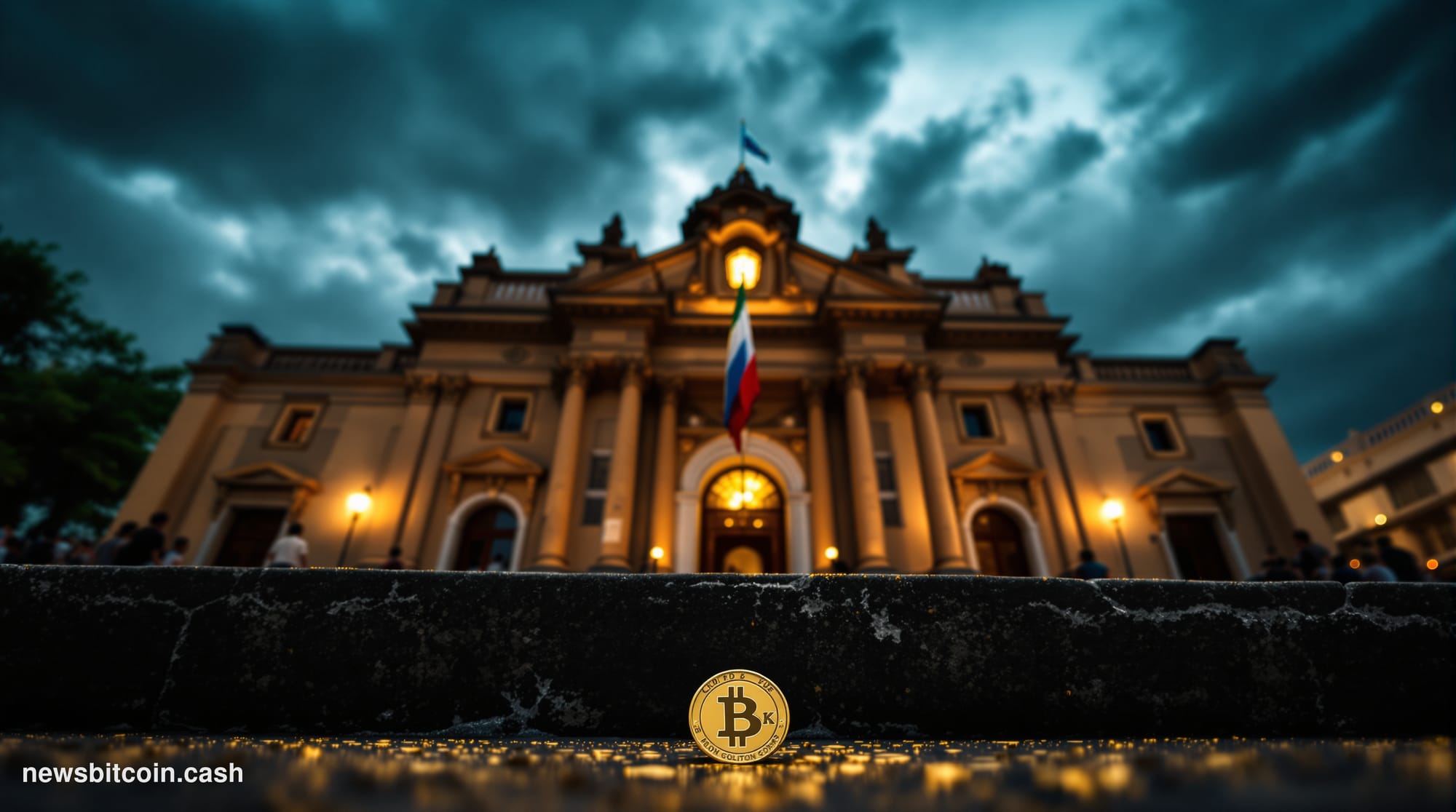
El Salvador's experiment with state-led Bitcoin accumulation has hit a formal pause. Under the terms of a freshly confirmed arrangement with the International Monetary Fund (IMF), San Salvador has agreed to stop purchasing additional Bitcoin with public resources — a significant policy reversal for a government that staked much of its international identity on being the world's first sovereign Bitcoin adopter. In exchange, the IMF has unlocked $138 million in financing and, notably, waived a missed program criterion, signaling that the Fund is willing to offer flexibility in exchange for concrete commitments to scale back state crypto exposure.
The deal represents a reckoning that many analysts saw coming. Since President Nayib Bukele made Bitcoin legal tender in 2021, the country's relationship with the IMF had grown increasingly strained. International lenders were skeptical of the fiscal risks embedded in holding a volatile digital asset on the national balance sheet, and repeated negotiations over a broader financial support program foundered partly on the Bitcoin question. The release of $138 million — tied explicitly to this new commitment — suggests the two sides have now found a workable, if uncomfortable, middle ground.
What makes the arrangement particularly telling is the IMF's decision to waive a missed criterion. In program language, a waiver of this kind is not routine goodwill; it is a deliberate instrument used when a member country fails to meet an agreed benchmark but the Fund judges that the broader reform trajectory still justifies continued disbursement. The IMF's willingness to grant that waiver here indicates the institution views El Salvador's concession on Bitcoin accumulation as substantive enough to compensate for whatever benchmark slipped. It also reveals the IMF's strategic priority: reducing state involvement in crypto matters more to the Fund than penalizing a technical miss.
The push for less state involvement in crypto goes beyond a simple freeze on purchases. The IMF's language around "less state involvement" implies a broader structural expectation — likely touching on the role of government-backed crypto infrastructure, the mandatory acceptance provisions that were later softened by El Salvador's own legislative amendments, and the degree to which public institutions remain exposed to digital asset volatility. Reading between the lines, the Fund appears to be nudging El Salvador toward a model where Bitcoin remains permissible for private actors but exits the machinery of sovereign finance entirely.
For the Bitcoin community globally, the optics are complicated. El Salvador's adoption story has functioned as a proof-of-concept argument for nation-state Bitcoin treasury strategies — an argument that advocates have cited repeatedly when lobbying other emerging-market governments to consider similar moves. A formal agreement to halt accumulation, extracted under financial pressure, gives critics a concrete data point: that when the sovereign borrowing window is open and the IMF holds the keys, Bitcoin exposure becomes a bargaining chip, not a strategic asset. That framing will be contested vigorously, but it now has a documented precedent attached to it.
At the same time, context matters. El Salvador is a small economy operating under genuine fiscal constraints, and the $138 million disbursement addresses real financing needs that the country cannot easily source elsewhere. The government's calculus was never purely ideological; it was also about attracting investment, remittances infrastructure, and international attention. If the Bitcoin chapter has now been partly subordinated to IMF conditionality, it may reflect a pragmatic recognition that sovereign solvency and ideological consistency are not always compatible priorities when a country needs external financing.
What remains to be watched is whether the halt on accumulation is accompanied by any move to liquidate existing holdings, or whether the current Bitcoin stack — built incrementally through the government's automated daily purchase strategy — remains on the national balance sheet untouched. The IMF's reported emphasis is on stopping further state purchases and shrinking crypto's role in public finance going forward, not necessarily on forcing a fire sale of what has already been acquired. That distinction matters considerably for both the country's net Bitcoin position and for market sentiment around sovereign selling pressure.
What This Means
El Salvador's agreement with the IMF draws a clear line between Bitcoin as a tolerated private financial instrument and Bitcoin as an active instrument of state economic strategy. The $138 million disbursement and the waived criterion confirm that the IMF was willing to move — but only after securing a meaningful rollback of the policies it found most objectionable. For other governments watching this dynamic, the signal is unambiguous: access to multilateral financing and an aggressive state Bitcoin accumulation strategy are increasingly difficult to hold simultaneously. El Salvador's pivot does not kill the sovereign Bitcoin thesis, but it adds a significant asterisk that policymakers everywhere will need to acknowledge.
Written by the editorial team — independent journalism powered by Bitcoin News.