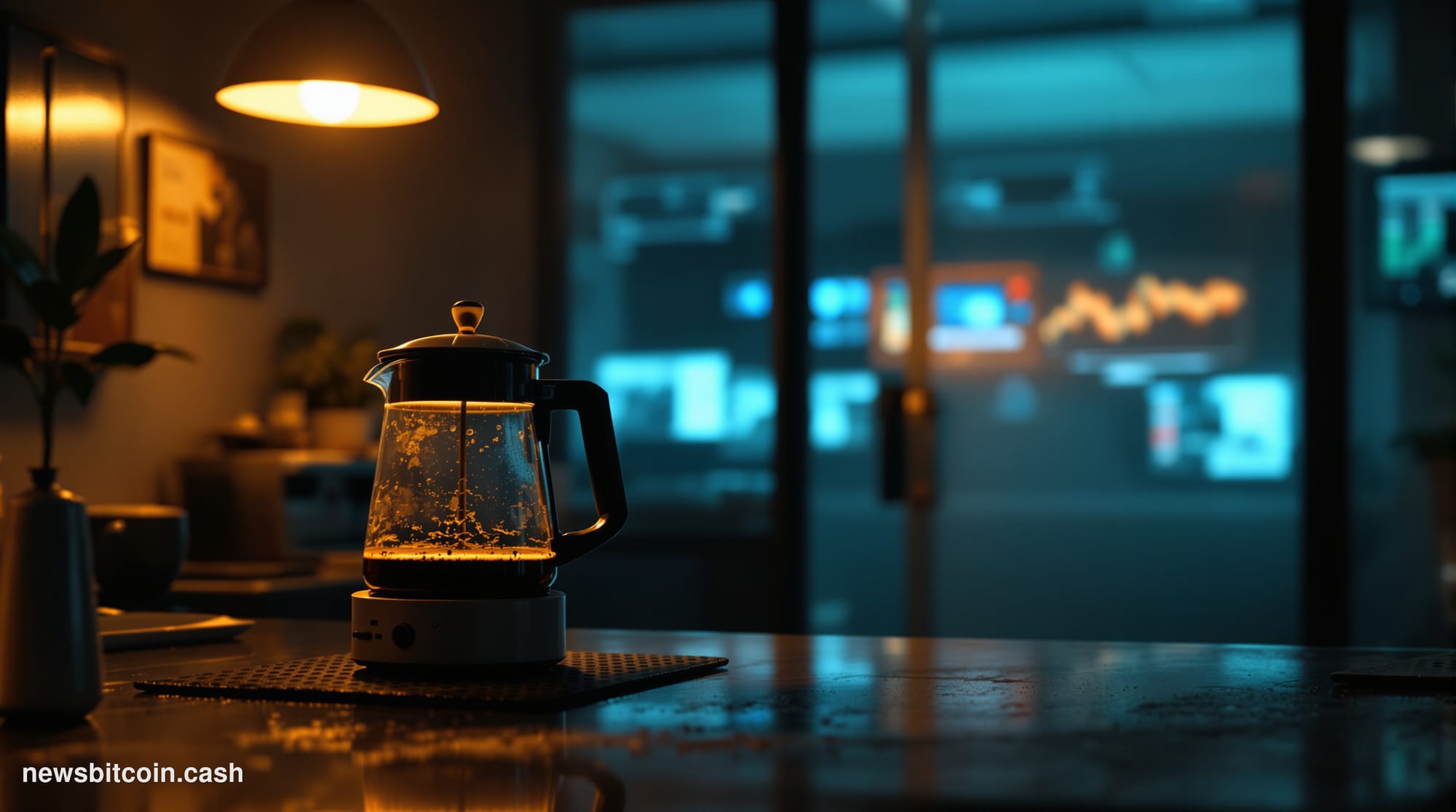
On a Cambridge University computer science floor sometime in the early 1990s, a group of researchers did something that, in retrospect, perfectly predicted the internet's strange relationship with human attention: they pointed a camera at a coffee pot. The resulting grainy, low-frame-rate video feed — eventually broadcast to the wider world as one of the first publicly accessible webcams — drew rapt fascination from audiences who had absolutely no practical reason to care whether the Trojan Room pot was full or empty. They watched anyway. Millions of them. And as Blockworks poses the question at the start of 2026, crypto is still searching for its equivalent moment — that inexplicable, irrational, deeply human tipping point when a technology stops being a tool and starts being a spectacle.
The coffee pot analogy is deceptively sharp. What made the Trojan Room webcam compelling wasn't utility. Nobody outside that Cambridge building needed to know the coffee status. It was novelty married to accessibility — a window into something real, live, and utterly mundane, made suddenly magical by the medium carrying it. The early internet didn't win hearts through white papers or technical specifications. It won them through coffee. And cats. And, eventually, everything else humans find worth looking at.
Crypto has spent the better part of fifteen years presenting itself primarily through the language of finance and ideology. Bitcoin whitepapers. Ethereum Virtual Machine specifications. Debates about monetary policy and self-sovereign identity. These are not coffee pots. They are important, often brilliant, and almost entirely incapable of making a civilian stop scrolling and stare.
The irony is that Bitcoin itself had a brief, coffee-pot-adjacent moment around 2017, when the price surge turned it into appointment television for a generation of retail investors who had never previously cared about basis points or block rewards. People watched Bitcoin's price the way people watched that coffee pot — obsessively, irrationally, with no clear plan for what they'd do with the information. But price speculation, it turned out, is a brittle form of cultural gravity. When the number stopped going up reliably, the casual audience drifted away, and what remained was a committed but insular community speaking largely to itself.
Ethereum's non-fungible token (NFT) boom in 2021 came closer to a genuine coffee-pot moment than almost anything else the industry has produced. For a brief window, people who had no interest in decentralized finance (DeFi) or layer-2 scaling solutions were genuinely captivated by the idea of owning a digital image. The fascination was irrational, which is precisely what made it culturally significant. But the NFT moment also burned itself out at extraordinary speed, leaving behind a residue of skepticism that the industry is still working to metabolize heading into 2026.
What the coffee pot story teaches, and what crypto has not yet fully absorbed, is that mass cultural moments are rarely engineered. The Cambridge researchers didn't set out to create one of the internet's founding myths. They wanted to know if the coffee was ready. The lesson for the crypto industry as it enters a new year is uncomfortable: the killer application may not look like an application at all. It may look like something embarrassingly simple, immediately legible to a non-technical audience, and solving a problem so ordinary that serious builders might initially dismiss it.
There are candidates percolating. Stablecoin-powered remittances are quietly reshaping how migrant workers move money across borders — a story more emotionally resonant than any token price chart. Blockchain-verified credentials are beginning to appear in contexts ordinary people actually encounter: concert tickets, academic certificates, supply chain provenance labels on grocery store shelves. Coinbase's push toward mainstream consumer onboarding and the broader industry's belated focus on user experience suggest that at least some builders have recognized the problem. But recognition and solution remain meaningfully different things.
The deeper question Blockworks raises — and leaves deliberately open — is whether crypto's coffee-pot moment is structurally possible at all, or whether the technology is simply too abstract, too politically loaded, and too entangled with financial speculation to ever produce the kind of naive, delighted, everybody-look-at-this reaction that a grainy Cambridge webcam once provoked. The internet eventually got there not because technologists explained it better, but because someone pointed a camera at something real and left it running.
What This Means
As the industry reflects on where it stands at the opening of 2026, the honest answer is that crypto's cultural breakthrough remains unfinished. The infrastructure is more robust than it has ever been. The regulatory environment, while still evolving, is more legible. But infrastructure and legibility have never been what makes a technology feel inevitable to ordinary people. Something simpler, stranger, and probably not yet invented will have to do that work. The coffee was ready. The question is whether anyone's watching.
Written by the editorial team — independent journalism powered by Bitcoin News.