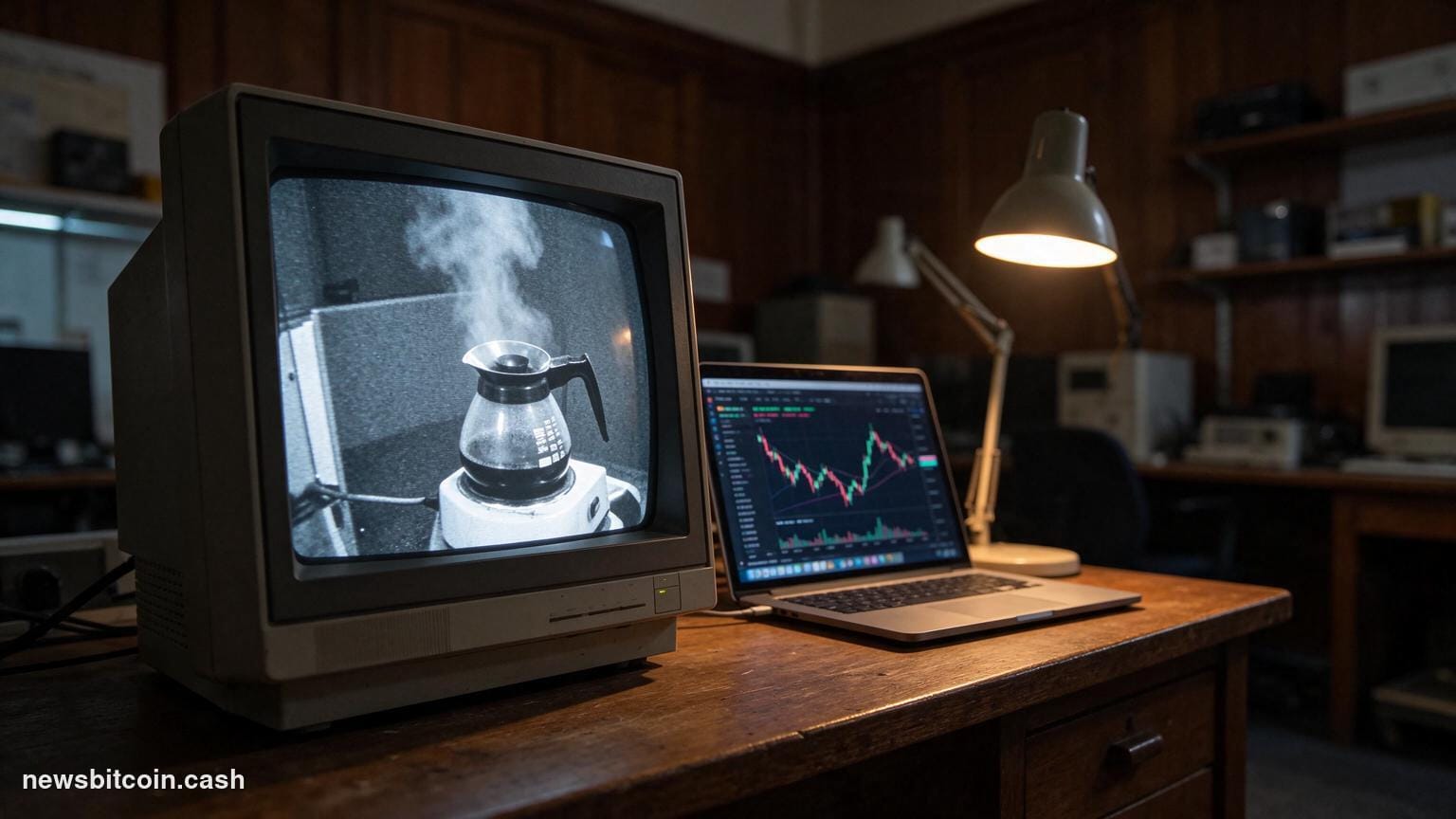
Somewhere in Cambridge in the early 1990s, a group of computer scientists solved a problem so trivial it was almost art: they were tired of walking down the hall to find the coffee pot empty. Their solution — a live video feed of the pot, viewable from any networked terminal in the building — became the Trojan Room coffee pot cam, the internet's first widely known webcam stream. Within years, people across the world were tuning in, completely transfixed, to watch coffee sit in a glass jug and do absolutely nothing. No narrative arc. No financial incentive. No utility whatsoever. Just a pot, and the strange, magnetic pull of a live window into somewhere else. That moment, absurd as it sounds, may be the most instructive case study that crypto has never properly studied.
As the calendar flips to 2026, the question that haunted the industry through its previous cycle remains stubbornly unanswered: when does cryptocurrency get its coffee pot moment? Not its institutional validation moment — that arguably arrived with the United States spot Bitcoin exchange-traded fund approvals. Not its regulatory clarity moment — jurisdictions from the European Union's Markets in Crypto-Assets regulation to evolving frameworks in Asia are stitching together at least the scaffolding of legal legitimacy. The missing piece is something far less tangible and far more important: the moment ordinary people, without any financial motivation or technical curiosity, simply find themselves drawn in.
Infrastructure Without an Audience
The uncomfortable truth about crypto entering 2026 is that the rails are largely built. Layer-2 scaling networks process transactions at costs that make micropayments genuinely viable. Stablecoin volumes have matured into the hundreds of billions of dollars. Self-custody wallets have improved to the point where onboarding friction, while not frictionless, is no longer the cliff face it once was. Developers have better tooling, auditors have better frameworks, and institutions have cleaner custody solutions than at any prior point in the industry's history. By almost every infrastructure metric, the network is ready. What it lacks is the equivalent of an audience leaning toward a monitor, watching a coffee pot, unable to explain exactly why.
This distinction matters enormously. The Trojan Room coffee pot did not succeed because it solved a problem for its viewers. The researchers who built the feed solved their own problem — monitoring coffee levels. The global audience that discovered it had no problem being solved at all. They were simply captured by the novelty of presence: the idea that a camera in Cambridge could make you feel like you were standing in a corridor you'd never visit. The technology disappeared behind the experience. That disappearance is precisely what blockchain-based products have almost never achieved. Users remain acutely aware they are using crypto, usually because the experience demands it of them — seed phrases, gas fees, bridge confirmations, wallet addresses. The machinery is always visible.
The Killer App Misdirection
The industry has long framed this problem as a search for the "killer app" — the singular application that unlocks mainstream adoption the way email unlocked the internet for a generation that had no interest in file transfer protocols. That framing, while useful rhetorically, may actually obscure what's needed. The coffee pot was not a killer app. It was a killer experience. Nobody downloaded software to watch it and nobody paid for access. It existed, and people noticed, and then people told other people, and those people noticed too. The organic quality of that propagation is precisely what crypto's growth cycles have consistently failed to replicate. Each wave of adoption — initial coin offerings in 2017, decentralized finance in 2020, non-fungible tokens in 2021 — has been driven predominantly by financial incentive, which means the moment the incentive fades, the audience leaves.
That is not how the Trojan Room coffee pot worked. People did not stop watching because the coffee ran out.
What Organic Actually Looks Like
The closest crypto has come to a genuine coffee pot moment may be in the quieter corners of the ecosystem — the artist who discovered they could sell work directly to a global audience without a gallery, the remittance corridor where stablecoins cut transfer costs for a family moving money across borders, the game where digital ownership actually meant something to the player who earned it. These are not headline moments. They don't generate the kind of price-chart euphoria that fills conference stages. But they share the essential quality of the Cambridge coffee pot: someone encountered the technology, found it genuinely useful or fascinating on its own terms, and kept coming back without being paid to do so.
Scaling those quiet moments into something the broader public feels, rather than something the industry tells the public it should feel, is the actual challenge of 2026 and beyond. The infrastructure argument has been won internally. The price discovery argument cycles endlessly. What hasn't happened yet — and what the coffee pot understood before the internet even knew it needed one — is the moment when the technology simply becomes a window that people want to look through, for no particular reason except that something interesting is on the other side.
The pot brewed in Cambridge for years before anyone outside the building noticed. The question for crypto is whether it has the patience to wait for the same kind of accidental, unstaged discovery — or whether the industry's compulsion to announce its own importance will keep getting in the way.
Written by the editorial team — independent journalism powered by Bitcoin News.