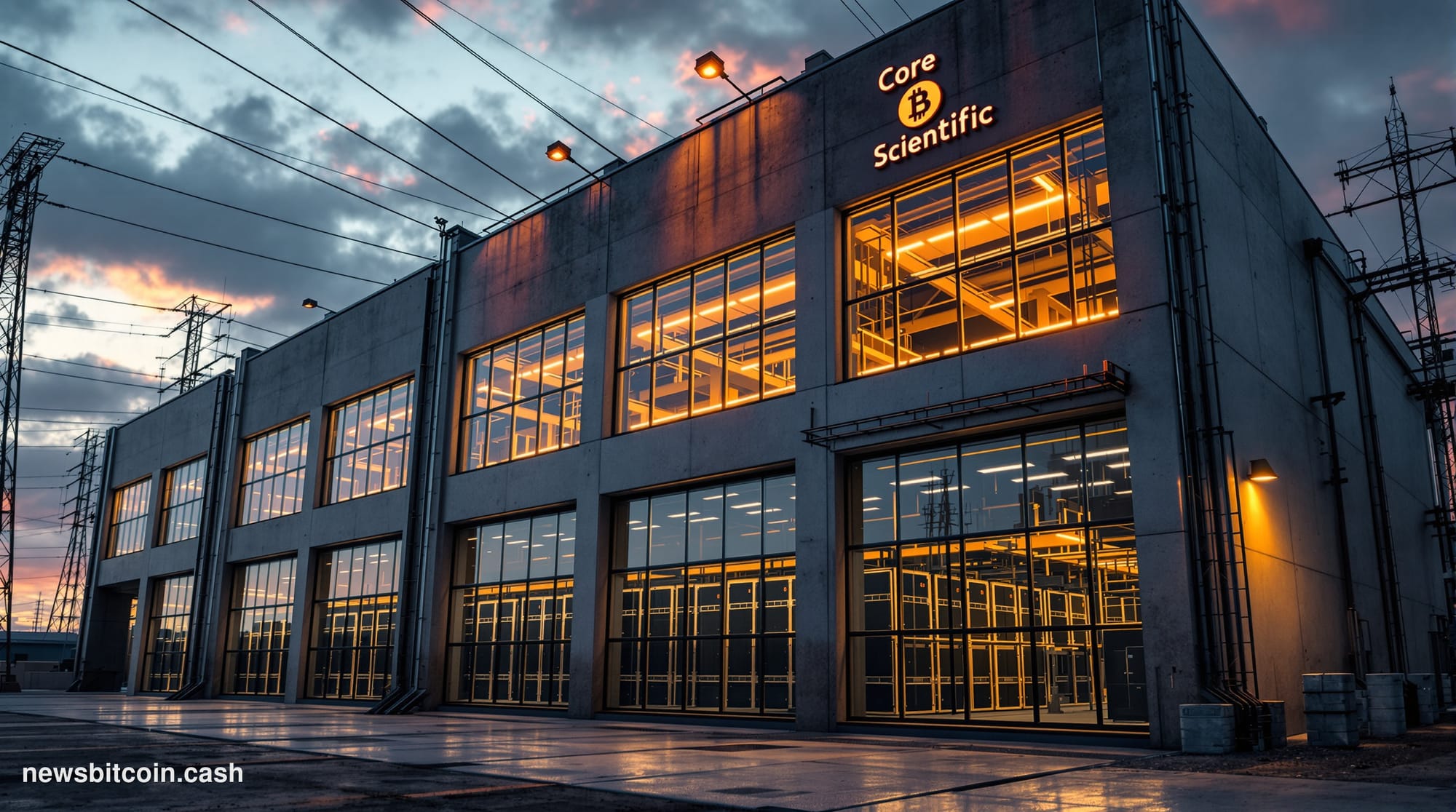
The harsh mathematics of Bitcoin mining economics reached a breaking point for Core Scientific in the first quarter, as the publicly-traded miner posted a staggering $347 million loss while its artificial intelligence hosting business emerged as the primary revenue driver. The company mined just 279 Bitcoin during the quarter, representing a precipitous 45% decline from the same period a year earlier, underscoring how even major mining operations are struggling with the fundamental unit economics of their core business.
This stark financial reality illuminates a broader transformation sweeping through Bitcoin mining infrastructure. Core Scientific's pivot toward AI hosting services—which has now become its largest revenue source—reflects a pragmatic recognition that the specialized data centers originally built for cryptocurrency mining can generate more reliable returns when repurposed for the exploding artificial intelligence compute market. The company's colocation business, essentially renting out space and power to AI workloads, has overtaken Bitcoin mining as its primary income stream.
The $347 million quarterly loss serves as a sobering reminder of the capital-intensive nature of Bitcoin mining and the razor-thin margins that define the industry. Unlike traditional businesses that can adjust pricing to maintain profitability, Bitcoin miners operate within the fixed constraints of network difficulty adjustments and halving cycles that systematically reduce rewards over time. Core Scientific's 45% year-over-year decline in Bitcoin production likely reflects both increased network competition and the company's strategic decision to allocate resources toward more immediately profitable AI hosting contracts.
This transition represents more than just corporate strategy—it signals a fundamental shift in how Bitcoin mining infrastructure is being valued and utilized. The specialized facilities that house mining operations possess significant advantages for AI workloads: robust power delivery systems, advanced cooling infrastructure, and high-density computing environments. These assets, originally designed to maximize hash rate production, are proving equally valuable for training large language models and running AI inference workloads that can generate more predictable revenue streams.
Core Scientific's experience reflects broader industry dynamics as institutional investors and mining companies reassess the risk-reward calculus of pure-play Bitcoin mining operations. While Bitcoin mining remains strategically important for network security and provides exposure to cryptocurrency price appreciation, the business model faces structural headwinds including increasing energy costs, regulatory uncertainty, and intensifying competition from more efficient operations. AI hosting, by contrast, offers contracted revenue streams with established enterprise customers willing to pay premium rates for computing resources.
The company's dramatic financial results also highlight the timing challenges facing Bitcoin miners in an environment of elevated capital costs and uncertain cryptocurrency valuations. The $347 million loss encompasses not just operational expenses but likely includes significant depreciation charges on mining equipment that may no longer generate positive returns under current market conditions. This accounting reality forces mining companies to make difficult decisions about asset allocation and operational focus.
Looking forward, Core Scientific's transformation from a Bitcoin mining company to a diversified digital infrastructure provider may preview the future of the broader mining industry. As AI compute demand continues accelerating and Bitcoin mining margins remain under pressure, other major mining operations will likely face similar crossroads. The companies that successfully navigate this transition—maintaining meaningful Bitcoin mining exposure while building profitable AI hosting businesses—may emerge as the most valuable infrastructure plays in the digital assets ecosystem.
Written by the editorial team — independent journalism powered by Bitcoin News.