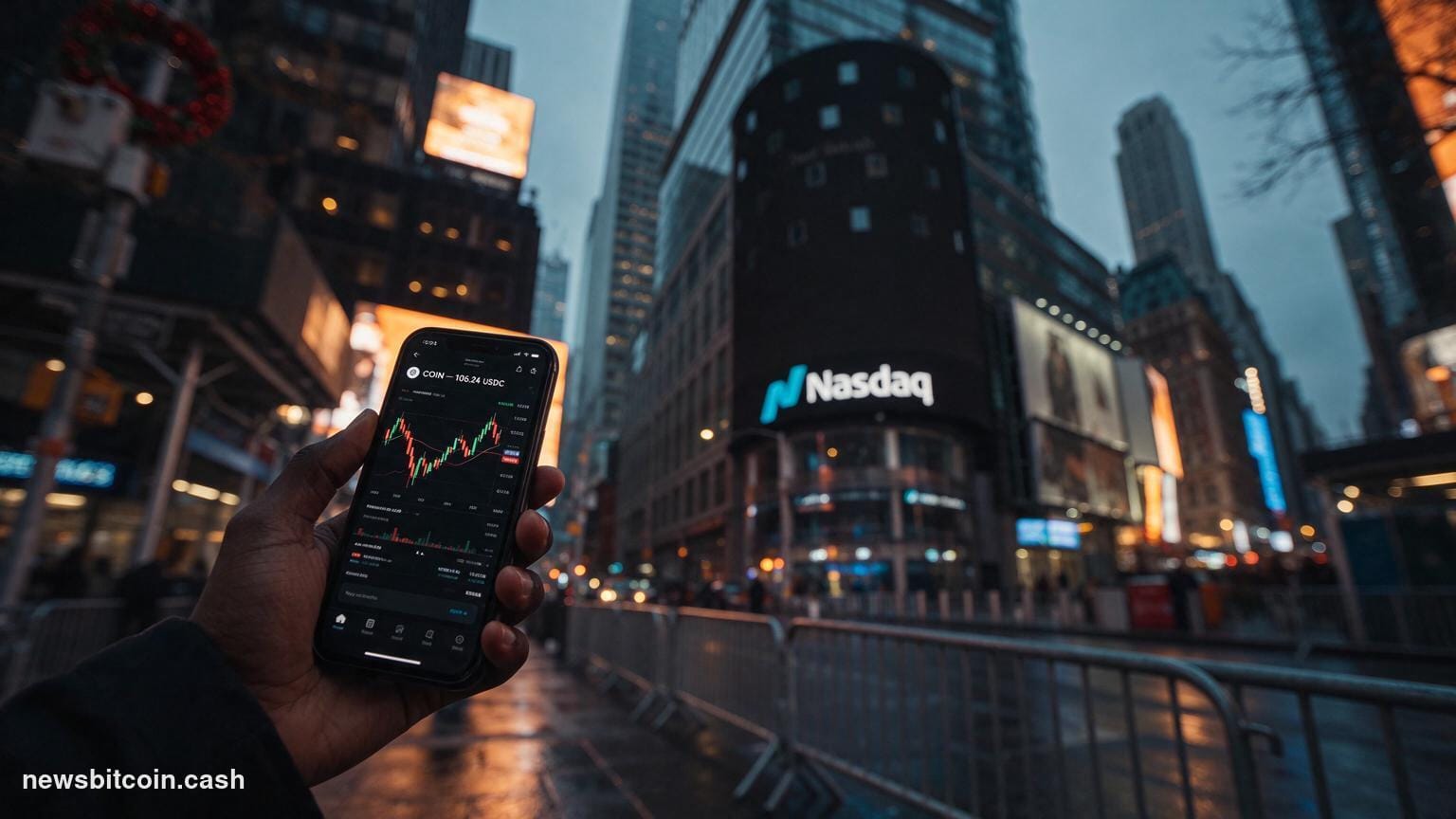
While American families were carving turkey and the Nasdaq sat dark for Thanksgiving, at least one buyer was executing a trade: a single share of Coinbase changing hands at 106.24 USDC. It is a small data point with a large implication — that the boundary between traditional equity markets and crypto infrastructure is not just blurring, it is becoming selectively irrelevant.
The price itself is almost secondary to the fact that the trade happened at all. Thanksgiving is a federal holiday in the United States. Every major stock exchange goes dark. Brokers close their order books. Settlement systems pause. The ritual of American finance takes the day off. And yet, denominated in a dollar-pegged stablecoin, a tokenized representation of one of the most prominent publicly listed crypto companies on earth continued to trade. That is the story the 106.24 USDC figure actually tells.
Context Is Everything
Whether 106.24 USDC looked like a bargain or a disappointment on that Thanksgiving depended entirely on when the buyer had last checked the conventional stock price. For someone who had been watching Coinbase trade significantly higher in the weeks prior, the holiday price might have read as a discount opportunity — or a warning sign about where sentiment was drifting in the absence of institutional market makers and their stabilizing liquidity. For someone entering fresh, with no emotional anchor to a previous close, it was simply a price: a number, a moment, a transaction settled in stablecoin without asking Wall Street's permission.
This ambiguity is not a flaw in the system — it is the system functioning exactly as designed. Tokenized equities do not inherit the consensus-pricing mechanisms of regulated exchanges. When Nasdaq is open, arbitrageurs rapidly close any gap between the tokenized price and the underlying. When Nasdaq closes, that anchor disappears. What remains is a pure expression of whatever buyers and sellers in the crypto-native ecosystem believe the asset is worth at that moment, with no floor provided by institutional desks and no ceiling imposed by circuit breakers. The 106.24 USDC print is therefore both a real price and a lonely one — discovered in a vacuum that traditional finance deliberately created by shutting down for the holiday.
The Infrastructure Argument
The deeper significance here is infrastructural. Tokenized equities — shares of publicly traded companies represented as blockchain-based tokens and settled in stablecoins like USDC — have been a topic of industry conversation for years. What Thanksgiving 2026 demonstrated is that the rails are live and in use, even if volume remains modest and price discovery remains imperfect. Someone wanted Coinbase exposure badly enough, or opportunistically enough, to execute outside of normal market hours using crypto-native settlement. That is a behavioral signal worth tracking.
It also raises legitimate questions about what "price" means in a world of always-on tokenized assets. Traditional equity investors are accustomed to a closing price — a definitive, exchange-validated number that serves as the official record for portfolios, derivatives, and collateral calculations. Tokenized markets, by contrast, produce a continuous stream of prices that may or may not align with that official record. The 106.24 USDC Thanksgiving print will not appear in Coinbase's official stock history. It exists only on-chain, meaningful to the parties involved, invisible to conventional financial reporting.
A Preview of Market Structure Tensions Ahead
Regulators and exchanges have not yet fully reckoned with this duality. As tokenization scales — from equities to bonds to real estate to commodities — the question of which price is authoritative will become increasingly contested. If a tokenized share of a blue-chip company trades at a materially different price on a holiday than it opens at the following Monday morning, who bears the basis risk? How does that affect collateral posted against tokenized positions? These are not hypothetical questions. They are the natural downstream consequences of infrastructure that the industry has been building, often faster than the regulatory frameworks designed to govern it.
For Coinbase specifically, there is an undeniable irony in being the asset that trades on-chain while its own exchange remains a central venue for crypto markets. The company has long positioned itself at the intersection of traditional finance and digital assets. A tokenized version of its own shares trading in USDC on Thanksgiving is perhaps the most literal possible expression of that positioning — a reflection of the market it helped build, trading itself, while the lights on Wall Street were off.
The 106.24 USDC figure will not reshape markets on its own. But it is a timestamp — a small, precise proof that tokenized equity infrastructure is operational, that stablecoin settlement works around the calendar, and that price discovery no longer waits for anyone's holiday schedule. What the crypto industry builds next on top of that reality will be far more consequential than any single Thanksgiving trade.
Written by the editorial team — independent journalism powered by Bitcoin News.