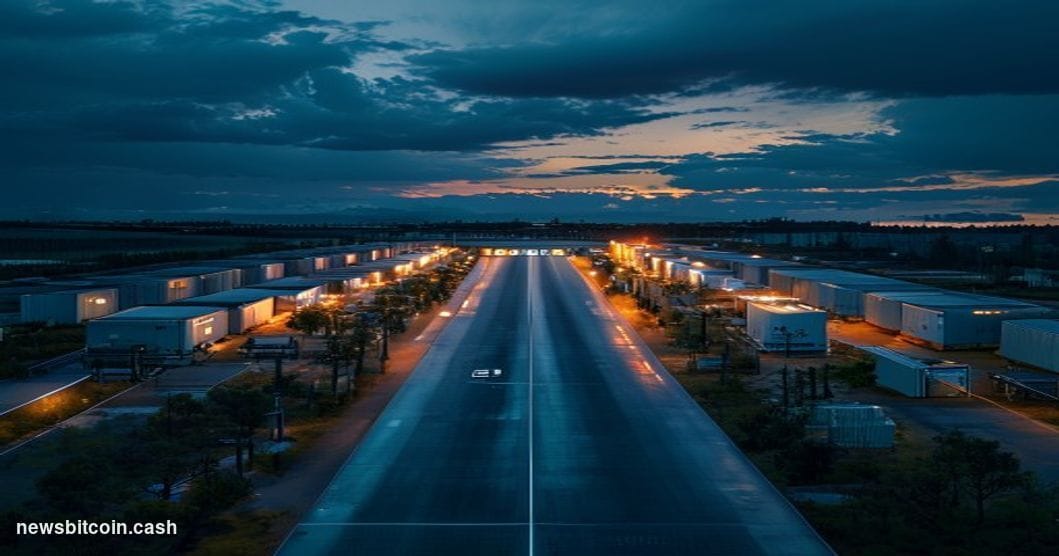
On July 14, 2026, CleanSpark announced it had signed a 20-year infrastructure lease worth $6.6 billion with an unnamed high-investment-grade global technology company, anchored at its campus in Sandersville, Georgia. The deal is not an incremental adjustment to a mining company's balance sheet — it is a structural redefinition of what CleanSpark is. In one transaction, the Nasdaq-listed bitcoin miner has staked its future on high-performance computing (HPC) for hyperscale clients, and the size of the commitment suggests there is no walking that back.
The numbers alone demand attention. At $6.6 billion over two decades, this lease rivals infrastructure commitments made by established cloud computing giants. For a company that built its identity around bitcoin mining — optimizing hash rate, managing energy costs per petahash, timing halvings — this represents a categorical leap. The tenant, though unnamed, is described as a high-investment-grade global technology company, which signals that whoever is on the other side of this contract has the creditworthiness and long-term appetite of a hyperscaler: the kind of entity that builds out server capacity measured in hundreds of megawatts and signs decade-long commitments without blinking.
Sandersville, Georgia sits in Washington County, a region that has quietly become a focal point for energy-intensive industrial development. CleanSpark's existing campus there provided the foundation — the land, the power infrastructure, the physical footprint — that made this deal possible. That existing mining infrastructure is now being redeployed, or at minimum extended, toward a different and arguably more lucrative compute workload. The pivot from proof-of-work bitcoin mining to HPC and artificial intelligence (AI) adjacent compute is not unique to CleanSpark; it has become the dominant strategic narrative among publicly listed miners over the past 18 months. But CleanSpark's $6.6 billion lease is, by any reasonable measure, the largest and most concrete execution of that strategy the sector has produced.
The logic behind the pivot is straightforward, even if the execution is complex. Bitcoin mining revenue is structurally capped by the halving schedule and bounded by the bitcoin price, both of which are outside any miner's control. HPC and hyperscale compute leases, by contrast, offer long-duration contracted revenue — exactly what institutional investors and lenders want to see on a balance sheet. A 20-year lease to an investment-grade counterparty is the kind of asset that changes how analysts model a company, how credit markets price its debt, and how equity investors value its future cash flows. In one announcement, CleanSpark has handed Wall Street a very different story to tell about the company.
What remains opaque is the identity of the tenant. High-investment-grade global technology companies capable of signing a $6.6 billion, 20-year data center lease number in the single digits worldwide. The usual suspects — the major cloud providers, large semiconductor firms with inference ambitions, or sovereign-backed technology funds — all fit the profile. CleanSpark has chosen not to disclose the name, likely at the counterparty's request, which is common in large infrastructure deals where the tenant does not want competitors to map their capacity expansion strategy. The anonymity may frustrate analysts in the short term, but it does not diminish the financial substance of the commitment.
The broader implication for the bitcoin mining industry is harder to ignore. The miners who survived the 2022 bear market and the 2024 halving compression did so by becoming operationally disciplined infrastructure companies. They built large power positions, established relationships with grid operators, and developed the kind of site management expertise that hyperscalers find difficult to replicate quickly. That expertise — not the mining rigs themselves — is what companies like CleanSpark are now monetizing. The rigs can be redeployed, sold, or run alongside the new compute workloads. The land and power relationships cannot be easily replicated by a software company that woke up to the compute capacity crisis three years too late.
CleanSpark's announcement signals that the most ambitious miners are no longer competing primarily with each other for block rewards. They are competing with real estate investment trusts, utility companies, and specialized data center developers for long-term hyperscale contracts. That is a fundamentally different competitive landscape, with different capital requirements, different risk profiles, and different valuations. A 20-year, $6.6 billion lease agreement is not the language of a speculative mining operation — it is the language of critical infrastructure.
Whether CleanSpark can execute on this transition at the scale the lease demands — building out and operating data center infrastructure that satisfies a high-investment-grade technology client over two decades — is the real question. The signing is the beginning of a very long obligation, not the end of one. But as a statement of strategic intent, it is unambiguous: the Sandersville campus is no longer just a bitcoin mining site. It is a piece of the global compute stack.
Written by the editorial team — independent journalism powered by Bitcoin News.