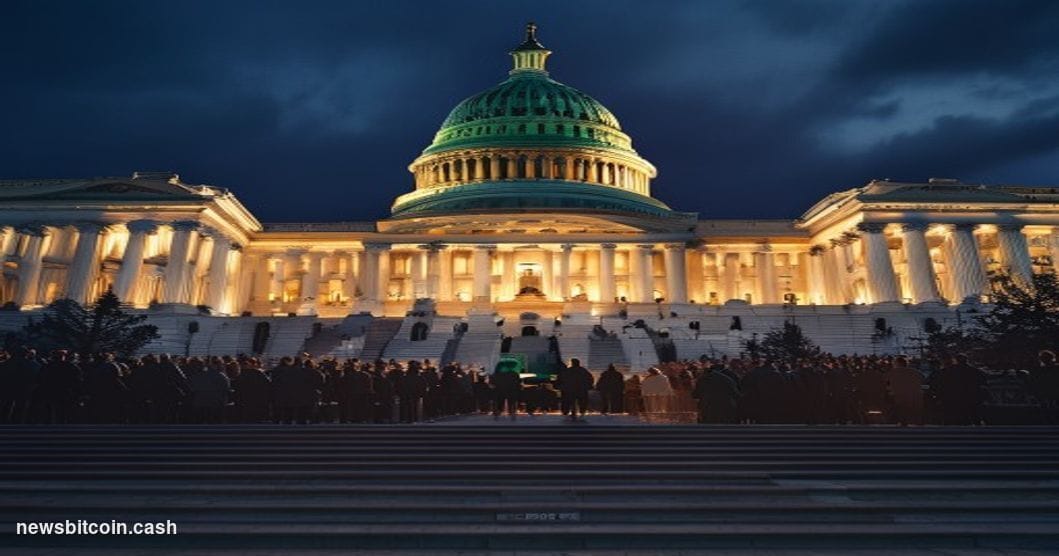
The CLARITY Act is now United States law — but the manner of its passage tells a more complicated story than the signature on the page. Enacted in 2026 with a yes-vote share of just 39.5%, the legislation designed to bring regulatory structure to the digital assets industry crossed the finish line amid fierce Democratic opposition, with critics pointing directly at one towering conflict of interest: former and current political figures' financial entanglement with the very industry they were legislating. At the center of that argument sits a reported figure of approximately $1 billion in crypto-related earnings attributed to Donald Trump.
That number — $1 billion in crypto earnings connected to Trump — became the rallying point for Democratic lawmakers who argued that signing a sweeping cryptocurrency regulatory framework into law while a sitting or politically dominant figure held such a substantial stake in the asset class represented an unprecedented conflict. Their opposition wasn't framed primarily as a policy dispute about the merits of digital asset classification or market structure rules. It was framed as a legitimacy crisis — the argument that no legislation touching an industry worth trillions of dollars can be considered credible when those steering it stand to benefit so directly.
The 39.5% yes-vote figure deserves scrutiny on its own terms. Legislation that clears a chamber or achieves presidential signature with fewer than 40% of votes in favor is a statistical rarity in the American legislative process, and it underscores just how fractured the political coalition around crypto regulation has become. What was once discussed as a bipartisan project — bringing legal clarity to blockchain-based assets and decentralized finance — has hardened into a partisan flashpoint, with Democratic opposition now representing a structural bloc rather than a collection of individual skeptics.
The irony is considerable. For years, the absence of a comprehensive digital assets regulatory framework in the United States was itself a political and economic liability. Industry participants, from major Coinbase to decentralized protocol developers, lobbied relentlessly for exactly the kind of legislative clarity that the CLARITY Act purports to deliver. Regulatory uncertainty cost American firms competitive ground against jurisdictions that moved faster — the European Union's Markets in Crypto-Assets (MiCA) framework, for instance, drew institutional capital and compliance infrastructure to Europe precisely because the United States could not get its legislative house in order. The CLARITY Act, in theory, was supposed to fix that. In practice, its passage has generated as many political headaches as it has resolved regulatory ambiguities.
Democrats are not wrong to raise the conflict-of-interest question. The principle that those who write the rules should not simultaneously be positioned to profit massively from those rules is foundational to credible governance. If Trump's crypto-related earnings genuinely approach $1 billion, the scale of that financial interest in the outcome of digital asset legislation is difficult to wave away as incidental. Whether those earnings stem from token holdings, branded crypto ventures, non-fungible token (NFT) collections, or other instruments, the magnitude alone warrants serious scrutiny from ethics watchdogs and the press alike.
At the same time, the political weaponization of that argument carries its own risks for Democrats. Opposing a market structure bill on conflict-of-interest grounds is a legitimate procedural and ethical objection. But if the substance of the CLARITY Act's provisions — how it classifies digital assets, how it delineates jurisdiction between the Securities and Exchange Commission (SEC) and the Commodity Futures Trading Commission (CFTC), how it treats decentralized protocols — is actually sound policy, then blanket opposition leaves Democrats exposed to the charge that they are blocking functional regulation for political reasons. That charge will find a receptive audience in an industry that has been demanding legal certainty for the better part of a decade.
The road ahead will be defined less by the act's passage and more by its implementation. Regulatory agencies will now have to translate the CLARITY Act's legislative language into enforceable rules, a process that tends to expose every ambiguity and contested definition that Congress papered over in the drafting room. Lobbying pressure will intensify at the agency level. Legal challenges may follow. And the conflict-of-interest arguments Democrats raised during the legislative fight will continue to shadow the rulemaking process, providing grounds for future court challenges or congressional oversight hearings if those agencies are perceived to be writing rules that favor connected interests.
What this means for the industry is a moment of cautious, provisional clarity — emphasis on provisional. The CLARITY Act is law, which is more than the industry had before. But a bill passed with 39.5% support, over sustained opposition grounded in billion-dollar conflict-of-interest allegations, is not a stable foundation. The legitimacy deficit created by this passage will follow digital asset regulation into every subsequent rulemaking, every agency guidance document, and every enforcement action for years to come.
Written by the editorial team — independent journalism powered by Bitcoin News.