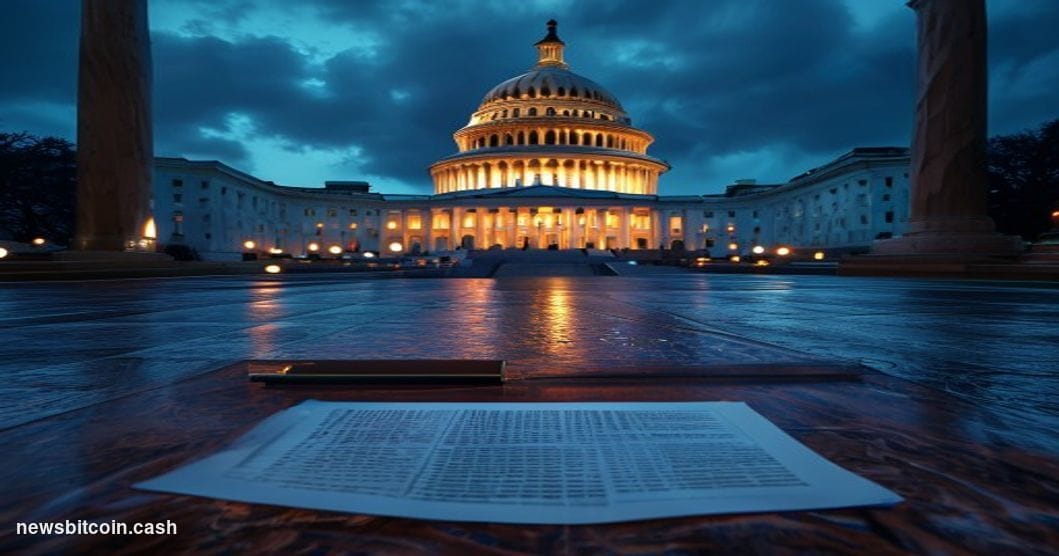
The legislative machinery in Washington is rarely accused of moving too fast, but for the crypto industry, the next few weeks may be the most consequential stretch of policy-making in the sector's history. Senior Senate negotiators have declared the Clarity Act — the sweeping crypto market-structure bill that has consumed years of drafting, lobbying, and bipartisan wrangling — is "almost there." Treasury Secretary Scott Bessent has put an even finer point on it, describing the bill's progress as sitting at the "1-yard line." With the August congressional recess bearing down, lawmakers are working under genuine time pressure to push the legislation across the finish line.
The convergence of signals from both Capitol Hill negotiators and the Treasury Department represents a striking alignment that the crypto industry has rarely enjoyed. When a sitting Treasury Secretary uses football metaphors to describe imminent passage of a digital-assets bill, it signals something more than diplomatic optimism — it reflects real coordination between the executive branch and Senate leadership. For an industry that spent the better part of a decade navigating a hostile or indifferent regulatory environment, the momentum is notable.
What the Clarity Act Would Actually Do
At its core, the Clarity Act is designed to resolve what has been the single most corrosive ambiguity in U.S. Securities and Exchange Commission enforcement: whether digital assets are securities or commodities, and under whose jurisdiction they fall. The lack of a clear answer to that question has allowed regulators to pursue enforcement actions rather than rule-making, created legal uncertainty that pushed projects and capital offshore, and left exchanges, developers, and token issuers operating under a permanent cloud. A functioning market-structure framework would change that calculus fundamentally by drawing clear jurisdictional lines between the SEC and the Commodity Futures Trading Commission (CFTC), establishing disclosure requirements, and defining what it takes for a digital asset to be treated as a commodity rather than a security.
The stakes extend well beyond compliance paperwork. Regulatory clarity at the federal level would unlock institutional capital that has remained on the sidelines — not because of risk appetite, but because of legal exposure. Custody providers, asset managers, and trading desks have long identified jurisdictional ambiguity as a primary barrier to deeper market participation. A legislative resolution would remove that barrier in ways that SEC guidance letters and no-action relief never could.
The Clock Problem
The August recess deadline is not arbitrary political theater. Congressional schedules are unforgiving: legislation that does not achieve floor time before recess risks losing momentum, losing sponsors to election-year recalibration, and losing the specific coalition of votes that makes passage viable. Senate negotiators know this, which is precisely why the language of urgency — "almost there," "1-yard line" — is being deployed publicly. These are not idle comments to journalists. They are coordinated signals intended to hold the coalition together and maintain pressure on the remaining holdouts to finalize language rather than let perfect become the enemy of good.
The framing from Treasury Secretary Bessent is particularly significant. The Treasury's involvement in crypto market-structure legislation goes beyond symbolic interest — the department has equities in stablecoin policy, anti-money laundering frameworks, and the broader question of dollar-denominated digital asset dominance globally. When Bessent characterizes the bill as inches from completion, it suggests the administration is actively engaged in the final negotiations, not merely watching from the sideline.
What Remains Unresolved
Neither the Senate negotiators nor Bessent specified what outstanding issues are holding up final agreement. In legislation of this complexity, the last yard is often the hardest. Key sticking points in prior versions of crypto market-structure bills have included the treatment of decentralized protocols, the definition of "sufficient decentralization" as a threshold for commodity classification, and the degree of preemption over state-level money transmission laws. Whether the current draft has resolved these issues cleanly — or papered over them in ways that invite future litigation — remains to be seen when the final text is released.
There is also the question of coordination with the GENIUS Act, the stablecoin legislation that has moved along a parallel track in the Senate. Crypto market-structure and stablecoin regulation are deeply intertwined; how stablecoins are classified and regulated affects trading pair economics, exchange compliance obligations, and DeFi (decentralized finance) protocol design. Passing one without the other risks creating new inconsistencies even as it resolves old ones.
The Bigger Picture
For the Bitcoin ecosystem specifically, and the broader digital-asset industry generally, the Clarity Act's passage would represent a structural shift in the relationship between crypto markets and U.S. regulatory institutions. It would not end regulatory scrutiny — nothing does — but it would replace discretionary enforcement with rule-based oversight, which is a foundation that serious markets require. The fact that both the legislative and executive branches are publicly signaling imminent completion should be treated as credible. The industry has been burned by false dawns before, but the alignment of incentives, the political calendar, and the declared proximity of both negotiators and Treasury all point in the same direction. The Clarity Act appears to be genuinely close. Whether "almost there" translates to a signed bill before recess or another near-miss will determine whether this legislative window opens or closes for another cycle.
Written by the editorial team — independent journalism powered by Bitcoin News.